Family Therapy Genogram Template
Map multigenerational patterns, triangles, and emotional cutoffs for therapeutic use.
Template Preview
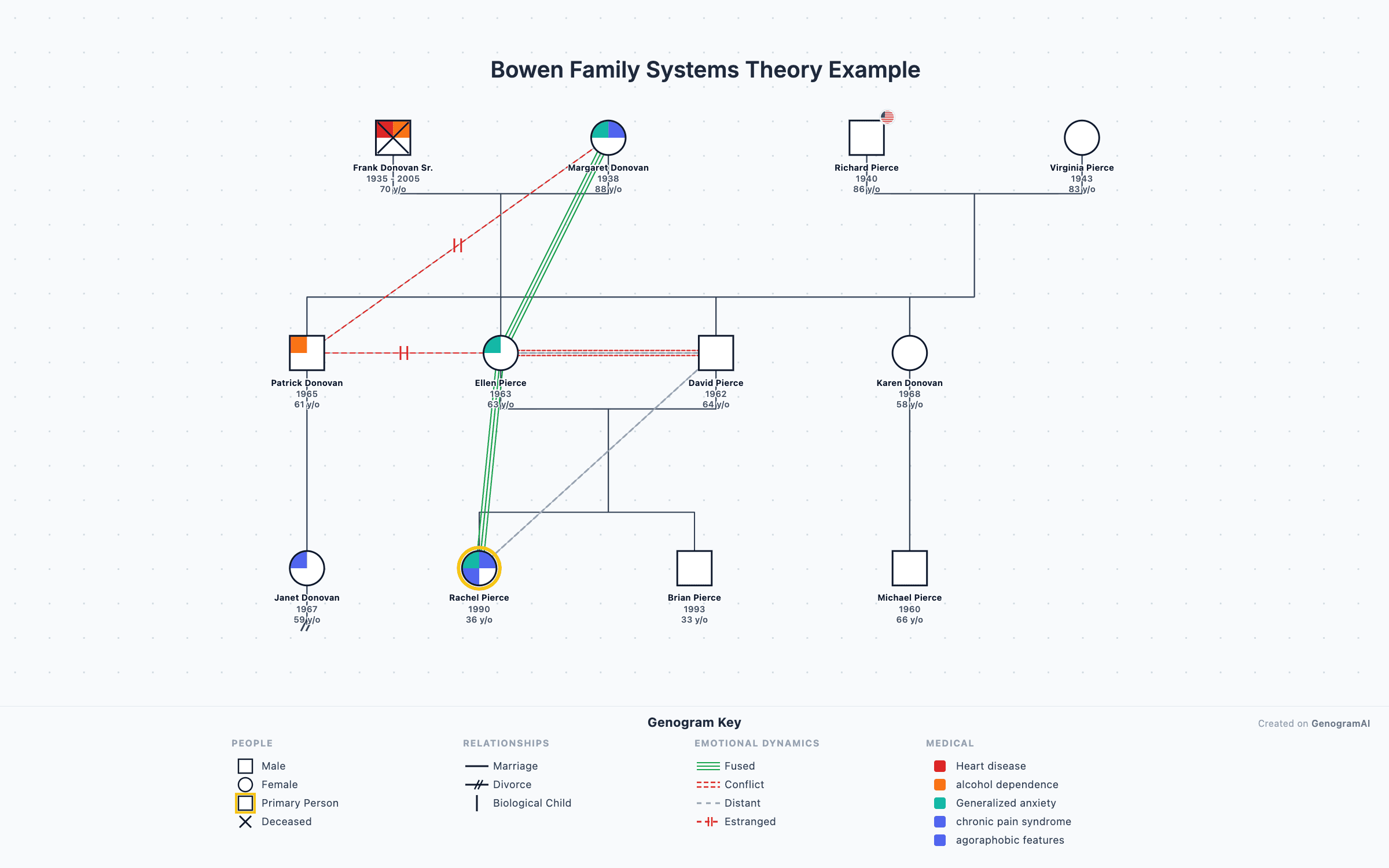
Example genogram created with GenogramAI — Family Therapy Genogram
Who Uses This Template
Licensed family therapists (LMFTs), marriage and family therapists in training, and MFT graduate students.
Common Use Cases
- Mapping multigenerational transmission of anxiety and emotional patterns
- Identifying triangles, coalitions, and cutoffs in Bowen family systems work
- Structural family therapy — subsystems, boundaries, and hierarchies
- Narrative therapy — externalizing family story patterns
- First-session family assessment and case conceptualization
How to Use This Template
Map three generations
Begin with the presenting family (parents + children), then add each set of grandparents. Use squares for males, circles for females.
Add relationship lines
Draw marriage, cohabitation, separation, and divorce lines between partners. Layer emotional relationship overlays: close, distant, hostile, cutoff, fused.
Annotate patterns
Note ages, dates, occupations, health conditions, and recurring themes. Circle triangles and label coalitions. Use this as the foundation for your treatment plan.
What's Included
Skip the blank template
Describe your family in plain English — GenogramAI builds it for you instantly.
Frequently Asked Questions
What genogram template is used in family therapy?
Family therapists use a 3-generation genogram template based on McGoldrick and Gerson's standardized notation. The template includes structural relationship lines (marriage, divorce, parent-child) and emotional relationship overlays (close, hostile, cutoff, triangulated). Bowen family systems therapy relies heavily on genograms to map anxiety transmission and triangles across generations.
How do I create a genogram for a family therapy session?
Start by drawing the nuclear family (presenting generation) in the center, then add parents and siblings of each partner above. Use squares for males and circles for females. Connect partners with a horizontal line (double horizontal for marriage). Draw vertical lines down to children, ordered left to right by birth. Add emotional relationship overlays once the structure is complete. GenogramAI automates this process from a plain-English description.
What symbols are used in a family therapy genogram?
Standard family therapy genograms use squares (males), circles (females), horizontal lines (partnerships), vertical lines (parent-child), and diagonal slashes (deceased). Relationship quality is shown with line styles: close (solid double line), distant (dashed line), hostile (zigzag), cutoff (two perpendicular marks). McGoldrick's 4th edition is the current standard reference.
Is a genogram template appropriate for all therapy modalities?
Genograms are used across modalities: Bowen family systems therapy (triangles, differentiation), structural family therapy (subsystems, boundaries), narrative therapy (story patterns), emotionally focused therapy (attachment), and integrative approaches. The template structure is the same; the clinical focus and what you annotate differs by modality.
Further Reading
- McGoldrick, M., Gerson, R., & Petry, S. — Genograms: Assessment and Treatment (4th ed.). W.W. Norton & Company, 2020
- Minuchin, S. — Families and Family Therapy. Harvard University Press, 1974
- Kerr, M.E. & Bowen, M. — Family Evaluation: An Approach Based on Bowen Theory. W.W. Norton & Company, 1988