Couples Therapy Genogram Template
Map each partner's family of origin to understand attachment patterns and relationship blueprints.
Template Preview
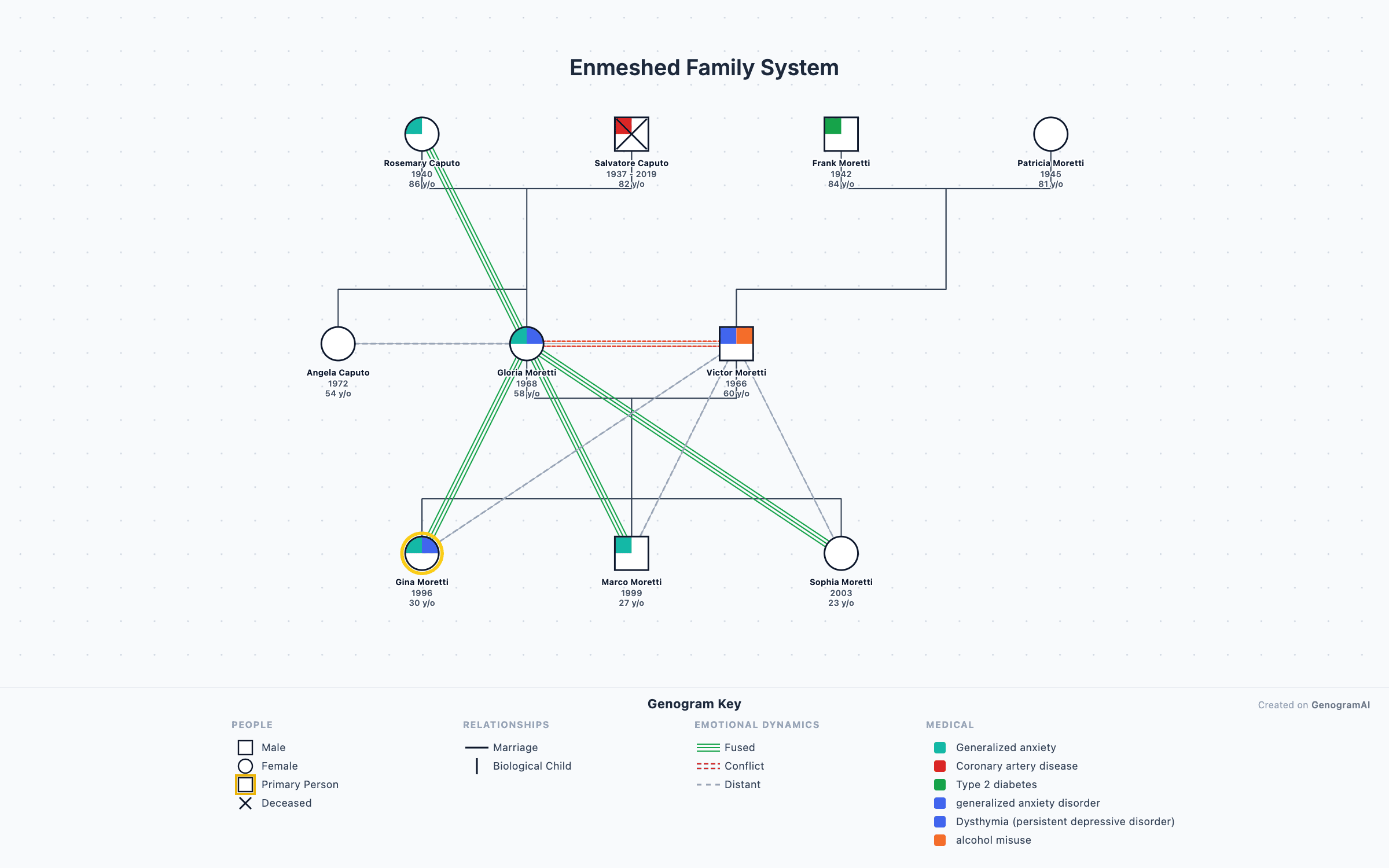
Example genogram created with GenogramAI — Couples Therapy Genogram
Who Uses This Template
Marriage and family therapists (LMFTs), couples therapists, Gottman-trained therapists, EFT therapists, and MFT students.
Common Use Cases
- Family of origin exploration in couples therapy first sessions
- Identifying each partner's relationship blueprint from their family of origin
- Gottman relationship assessment — family influence mapping
- EFT — tracing attachment injuries back to family of origin
- Premarital counseling — understanding each partner's family system
How to Use This Template
Map each partner's family of origin separately
Create two side-by-side genogram sections — one for each partner's family of origin (their parents, siblings, and grandparents). Keep the presenting couple in the center.
Add emotional relationship overlays
For each family of origin, map emotional patterns: enmeshment, cutoffs, hostility, triangles. Note which patterns each partner is now recreating or reacting against in the current relationship.
Bridge to the presenting relationship
Draw connections between each partner's family patterns and current relationship conflicts. For example: a partner who grew up with conflict avoidance may pursue distance in the current relationship.
What's Included
Skip the blank template
Describe your family in plain English — GenogramAI builds it for you instantly.
Frequently Asked Questions
Why do couples therapists use genograms?
Couples therapists use genograms to help each partner understand how their family of origin shaped their relationship expectations, communication patterns, and attachment style. Research shows that most relationship conflicts reflect each partner's internalized "relationship blueprint" — the model of partnership they absorbed from watching their parents. Making this blueprint visible through a genogram often shifts the conversation from blame to curiosity, which is a core goal of most couples therapy approaches.
What does a couples therapy genogram look like?
A couples therapy genogram typically shows two family of origin systems (one for each partner) flanking the couple in the center. Each partner's family is mapped at least two generations back (parents and grandparents), with emotional relationship overlays showing closeness, distance, conflict, and cutoff. Some therapists also add a third section showing the couple's relationship history together (prior relationships, children, relationship turning points).
When in couples therapy should a genogram be done?
Most couples therapists introduce genograms in the early assessment phase — typically sessions 1-4. The intake genogram is usually done in individual sessions with each partner (so each can speak freely about their family), then the findings are integrated into a joint session. Some therapists return to the genogram throughout treatment as new patterns emerge. The Gottman Method includes genogram-style family of origin exploration in its structured assessment protocol.
Can genograms help with conflict in couples therapy?
Yes — genograms are particularly effective at externalizing conflict. When a couple understands that their recurring argument about money reflects one partner's family history of scarcity (grandmother during the Great Depression, father who lost his job) and the other's family history of financial irresponsibility, the conflict becomes less personal and more systemic. This is a core technique in Bowen-influenced couples therapy and emotionally focused therapy (EFT).
Further Reading
- Gottman, J.M. & Silver, N. — The Seven Principles for Making Marriage Work. Harmony Books, 2015
- McGoldrick, M., Gerson, R., & Petry, S. — Genograms: Assessment and Treatment (4th ed.). W.W. Norton & Company, 2020
- Johnson, S. — Hold Me Tight: Seven Conversations for a Lifetime of Love. Little, Brown Spark, 2008