Ecomaps
Ecomap-based discharge planning: a practical guide
Quick answer
The discharge-planning problem in one paragraph
A patient is medically ready to leave. The team has done the work to stabilize the acute issue. But what happens at home? Who’s there to drive them to follow-up appointments? Will the prescriber the inpatient team set up actually be reachable? Are there community resources to fill the gaps? Standard discharge paperwork captures none of this clearly. A 30-minute ecomap before discharge often does.
Discharge planning has a well-documented gap between what gets arranged in the hospital and what actually holds together in the first 30 days out. Referrals that look strong on paper dissolve when the outpatient therapist has a 6-week waitlist. A family member who agreed to be a caregiver turns out to be in a different city half the month. A housing situation described as “stable” at intake is actually a couch-surfing arrangement that falls through in week two. Standard discharge checklists are bad at surfacing this because they ask about categories of support rather than the actual people and systems providing it.
The ecomap forces specificity. You do not draw “family support” on an ecomap; you draw the specific family member, name and role, with a line that represents the actual quality of that relationship. When you draw the discharge picture that way, the gaps and stressors become visible in a way that a checklist cannot replicate. The team can see, in the same glance, where the scaffolding is solid and where it is fragile.
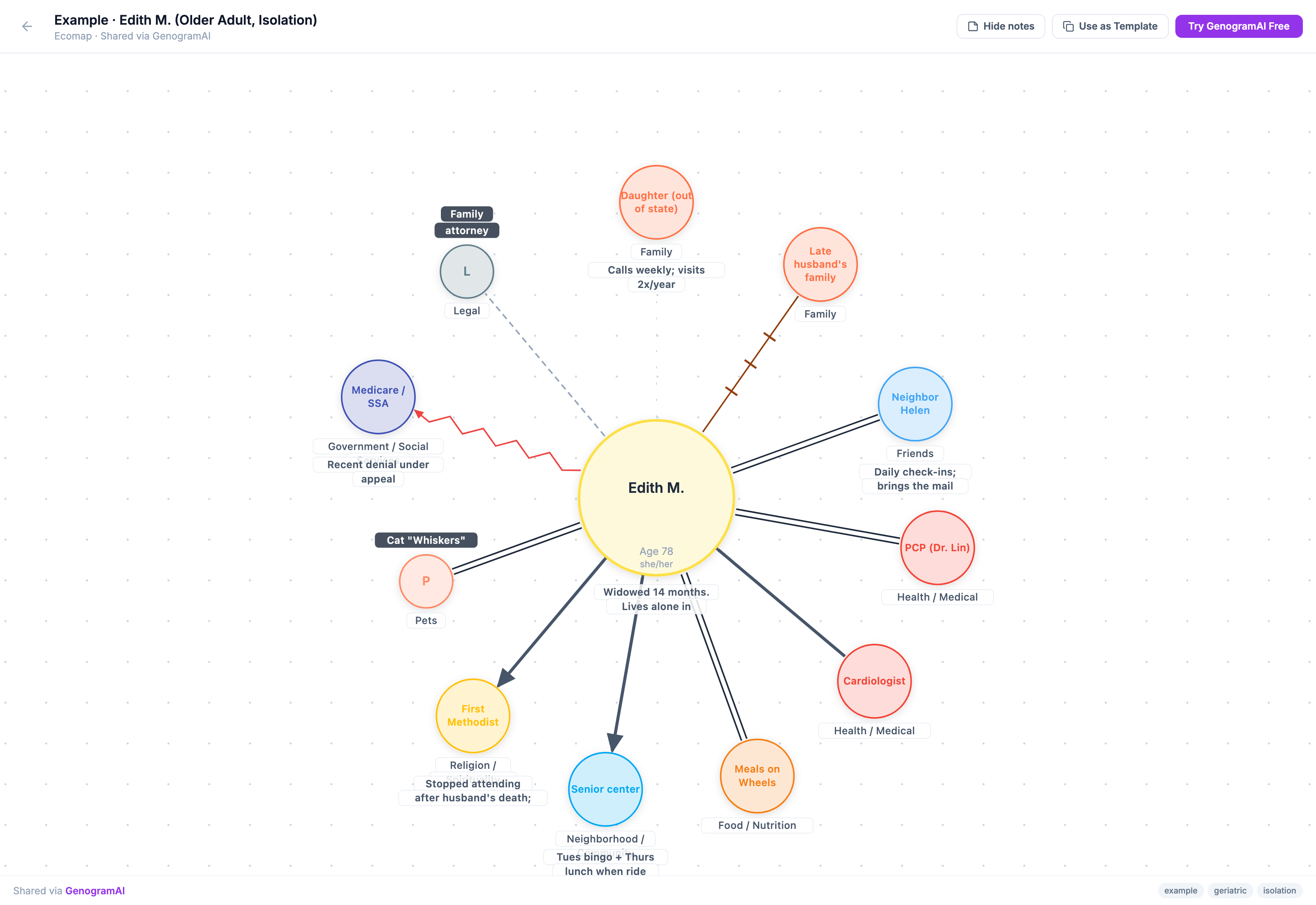
What does an ecomap surface that intake notes don’t?
- Density of the support network. A patient with 8 strong-line systems is in a different post-discharge risk category than one with 2. The ecomap shows this at a glance.
- Categorical gaps. No mental-health system on a patient with a SUD history? That’s a referral the discharge team needs to make before the patient leaves.
- Stressors waiting at home. The mother-in-law (stressful), the job (stressful and strong at once), the housing situation (broken): these are predictable post-discharge stress events the team can prepare for.
- Direction of energy. A patient with all toward-center arrows (receives a lot of support, gives little back) might be at risk of burning out their caregivers. Mutual arrows are more resilient.
A discharge ecomap workflow
- 1
Start with the chart, not the patient
Before sitting down with the patient, pull names from the chart: family contacts, outpatient providers already set up, social workers, prior referrals, the prescriber of record. Open the AI ecomap generator and paste these as a quick list. You start with a half-built canvas instead of a blank one. - 2
Sit with the patient (or family) for 20 minutes
Walk through the canvas together. Ask: "Who’s going to be involved in your day-to-day for the first two weeks?" Add what’s missing. Adjust line styles based on the patient’s reading of each relationship, especially stressful and conflicted ties, which the chart often missed. - 3
Identify the gaps explicitly
Look at the canvas and ask three questions: which service categories are absent, which relationships are stressful and strong at once, and which arrows point only toward the center. - 4
Build the referral list from the gaps
Each gap is a referral. Don’t leave the discharge meeting without an action for each: warm hand-off to outpatient prescriber, NAMI peer-specialist connection, community-resource paperwork, transportation arrangement. The ecomap is the artifact that justified each referral. - 5
Save the discharge ecomap to the chart
The discharge ecomap is the record of the system the patient is leaving the hospital into. Save it. If the patient comes back in 30 days, the readmission review starts with comparing the discharge ecomap to the readmission ecomap. That comparison is where the team learns what the discharge plan got right and wrong.
Patient data and AI
How do you turn ecomap gaps into referrals?
- What service categories are absent? (No mental health connection for a post-overdose patient? No primary-care MD for a chronic-illness patient? Red flag.)
- What relationships are drawn Stressful + Strong? These will create predictable post-discharge friction.
- What arrows point only toward the center? The patient is being supported without contributing. That is not bad, but the caregivers need support too.
| What the ecomap shows | What it means | Referral or action before discharge |
|---|---|---|
| No Mental health system on a behavioral-health or post-overdose patient | No outpatient follow-up in place | Warm hand-off to an outpatient prescriber or therapist; NAMI peer-specialist connection |
| No primary care on a chronic-illness patient | Nobody owns medication and follow-up | Confirm a primary care appointment before the patient leaves |
| Stressful + Strong line to family, work or housing | A predictable stress event in the first weeks | Plan for it with the patient; involve the family member where appropriate |
| Broken line to housing | Housing is not actually stable | Community-resource and housing paperwork |
| Weak or missing transport | Follow-up appointments will be missed | Transportation arrangement |
| Every arrow points toward the patient; one caregiver carries it all | Caregiver burnout risk | Respite, home services or caregiver support referrals |
Three categories where this pays off most
- Behavioral-health inpatient. The weeks after a psychiatric discharge are a high-risk transition, and absent outpatient connections are one of the most common gaps. An ecomap-based discharge surfaces them while there is still time to make the referral.
- Substance-use treatment. The recovery scaffolding is the discharge plan. An ecomap-based discharge specifically pressure-tests sponsor, group, prescriber, and sober peer ties.
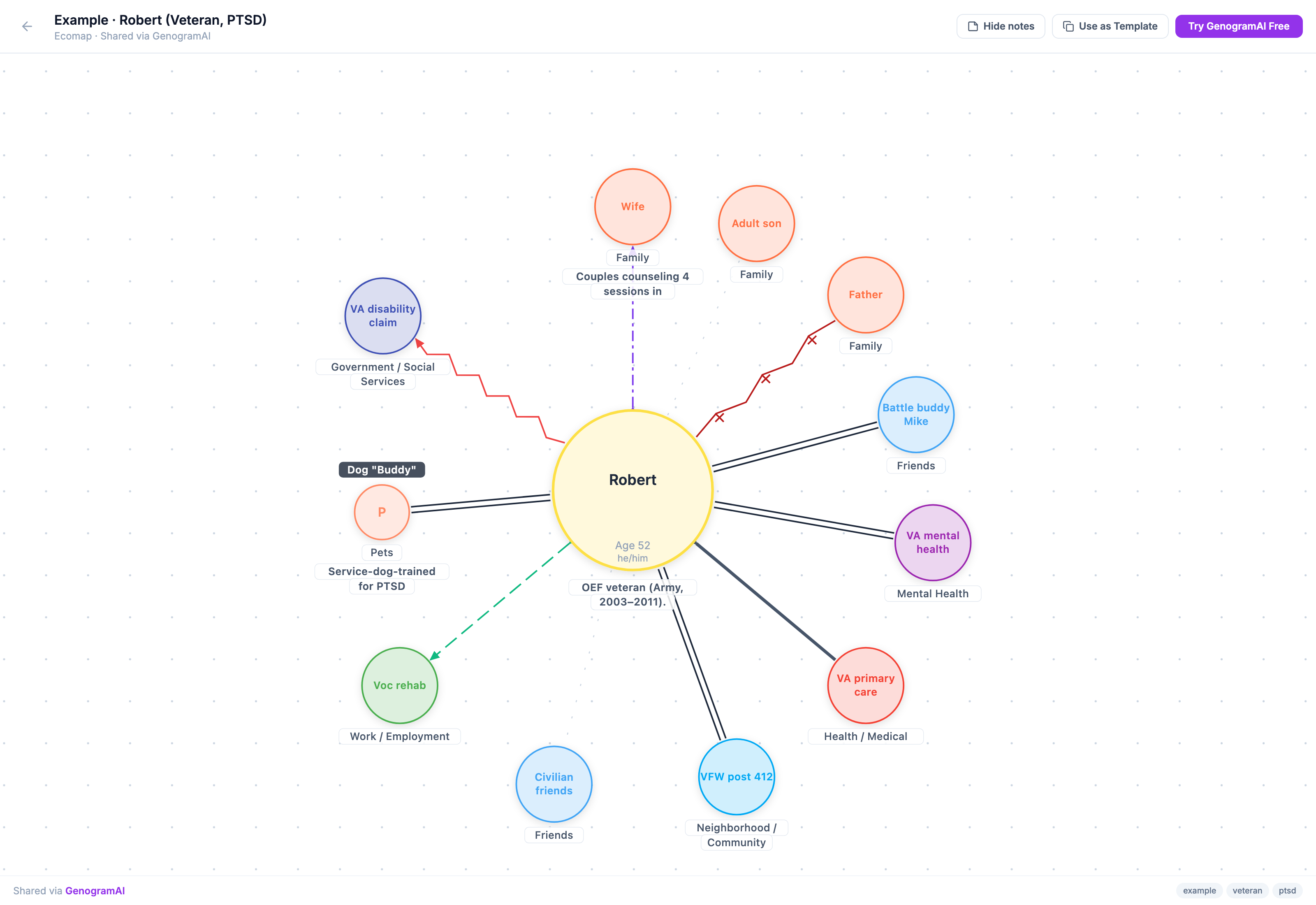
- Chronic-illness / geriatric. The caregiver network is the discharge plan. The ecomap shows whether one adult child is carrying everything (high burnout risk) or load is distributed.
Why the discharge ecomap also helps the patient
Most discharge conversations are one-directional. The team explains the plan; the patient nods. The patient is often tired, anxious, and overloaded with information. An ecomap built together shifts the dynamic. When the patient can see their own network laid out (who is on the canvas, what the lines mean, where there are gaps) they often engage differently. They will volunteer corrections. They will identify supports the team did not know about. They will flag the stressful relationship the discharge summary marked as “supportive family” because no one asked carefully enough.
This is also a health-literacy tool. A patient who has sat with an ecomap for 20 minutes understands their own discharge plan better than one who received a printed checklist. They can point to their sponsor by name, explain why the prescriber was switched, say what happens if the housing plan falls through. That understanding is its own protective factor against early readmission.
The 30-day follow-up
If you can do one thing after this guide, do this: at the 30-day mark, re-do the ecomap. Compare. The diff is your data: what worked, what fell apart, what referrals stuck. Aggregate that across cases and you have a defensible signal about where your discharge process is leaking.
The comparison does not have to be formal to be useful. Even a side-by-side glance in a case review session (discharge ecomap on the left, 30-day ecomap on the right) surfaces patterns that case notes alone cannot. Did the recovery group connection hold? Did the housing situation change? Did a stressful family relationship escalate or resolve? Two ecomaps answer these questions visually, in seconds. One ecomap answers none of them.
| Compare | At discharge | At 30 days |
|---|---|---|
| Recovery or treatment connections | Referred, first appointment booked | Attending, lapsed, or never started? |
| Housing | Described as stable | Same address? Line style changed? |
| Stressful family ties | Flagged as Stressful or Stressful + Strong | Escalated, resolved, or cut off? |
| Caregiver load | Who agreed to help | Who is actually helping, and how much? |
Frequently asked questions
What is an ecomap used for in discharge planning?
In discharge planning, an ecomap maps the support network the patient is going home to: the specific family members, providers, services and community resources, with line styles that show the quality of each connection. It makes gaps (a missing outpatient prescriber, no transport) and stressors waiting at home visible so the team can turn each one into a referral before discharge.
When should you draw the discharge ecomap?
Before the discharge meeting, once the patient is medically stable. Pre-fill it from the chart, then spend about 20 minutes walking through it with the patient or family so they can correct and add to it.
What gaps should a discharge ecomap check for?
Absent service categories (for example no mental health connection for a post-overdose patient, or no primary care for a chronic-illness patient), relationships that are both stressful and strong, and a network where every arrow points toward the patient, which can signal caregiver burnout risk.
Why redraw the ecomap at 30 days?
The difference between the discharge ecomap and the 30-day ecomap shows which referrals held, which supports fell away and which stressors escalated. Across cases, that comparison shows where a discharge process is leaking.
Try it