Examples & Case Studies
15 genogram examples for social workers, therapists and nurses
Quick answer
What makes a good clinical genogram example?
Not every genogram is clinically useful. A diagram that shows only names and birth years is genealogy, not clinical assessment. For a genogram to earn its place in a case file, supervision session, or nursing care plan, it needs to satisfy a handful of structural requirements.
Three generations minimum. A single-generation diagram shows you who is in the household. A three-generation diagram shows you the system the household grew out of. Intergenerational patterns — of substance use, of domestic violence, of cutoff, of hereditary illness — are invisible in anything shallower. Most clinical settings require three generations as the floor, with four or five generations becoming relevant in pedigree and family systems work.
The index person is clearly marked. In clinical convention, the identified patient or presenting client is drawn with a double border — a double square for a male, a double circle for a female. Every relationship line, annotation, and emotional pattern should be readable relative to that person. A genogram without a clearly identified index person forces the reader to guess the frame of reference.
Relationship lines matter as much as structure. The vertical and horizontal lines that connect people show biological and legal relationships. Equally important are the emotional relationship lines layered on top: a zigzag line for conflict, three parallel lines for enmeshment, a dashed line for emotional distance, a cut line for cutoff. In therapy contexts, these lines often communicate more about the presenting problem than the structural diagram beneath them.
Annotations are clinical, not biographical. Age, year of death, and cause of death are the baseline. Add current diagnoses, substance use history, significant life events (incarceration, hospitalization, migration), and any notation relevant to the presenting concern. In medical and nursing contexts, a hereditary condition should be flagged on every individual known to carry it, not just the index patient.
For a full reference on the notation system used across these examples, see our genogram symbols guide.
The 15 cases at a glance
| # | Case | Discipline | Key pattern |
|---|---|---|---|
| 1 | Child protective services removal (Rivera) | Social work | Isolation; alcohol and violence across two generations |
| 2 | Domestic violence pattern (Thompson) | Social work | Intimate partner violence in three generations of women |
| 3 | Foster care kinship assessment (Washington) | Social work | Comparing two kinship placements; paternal substance use |
| 4 | School-based intervention (Maya, 15) | Social work | Remarriage, a new stepsibling, a distant father |
| 5 | Elder care and caregiver burden (Chen) | Social work | Care concentrated in one daughter; cutoff and conflict |
| 6 | Intergenerational substance abuse (Johnson) | Therapy | Addiction in three generations; recovery as resilience |
| 7 | Anxiety and school refusal (Patel) | Therapy | Anxiety transmission; mother-daughter enmeshment |
| 8 | Blended family conflict (Harrison-Webb) | Therapy | Loyalty architecture across four household units |
| 9 | Couples therapy (Maria and James) | Therapy | Pursue-withdraw templates from both families of origin |
| 10 | Bowen family systems differentiation | Therapy | Triangle, fusion and a cutoff chain |
| 11 | Cardiovascular risk | Nursing | Premature MI in the paternal line |
| 12 | Type 2 diabetes | Nursing | Maternal-line T2DM and its complications |
| 13 | Cancer pedigree (BRCA) | Nursing | Breast and ovarian cancer, onset trending younger |
| 14 | Postpartum and mood disorders | Nursing | Mood disorder and postpartum depression in the maternal line |
| 15 | Nursing home admission (Edna and Walter) | Nursing | Sibling conflict and a triangulated caregiver |
Genogram examples for therapists
Therapeutic genograms place heavier emphasis on emotional relationship lines, intergenerational patterns of behavior and affect, and the family-of-origin dynamics that show up in the presenting problem. The five examples below cover substance use, anxiety transmission, blended family conflict, couples work, and Bowen family systems differentiation.
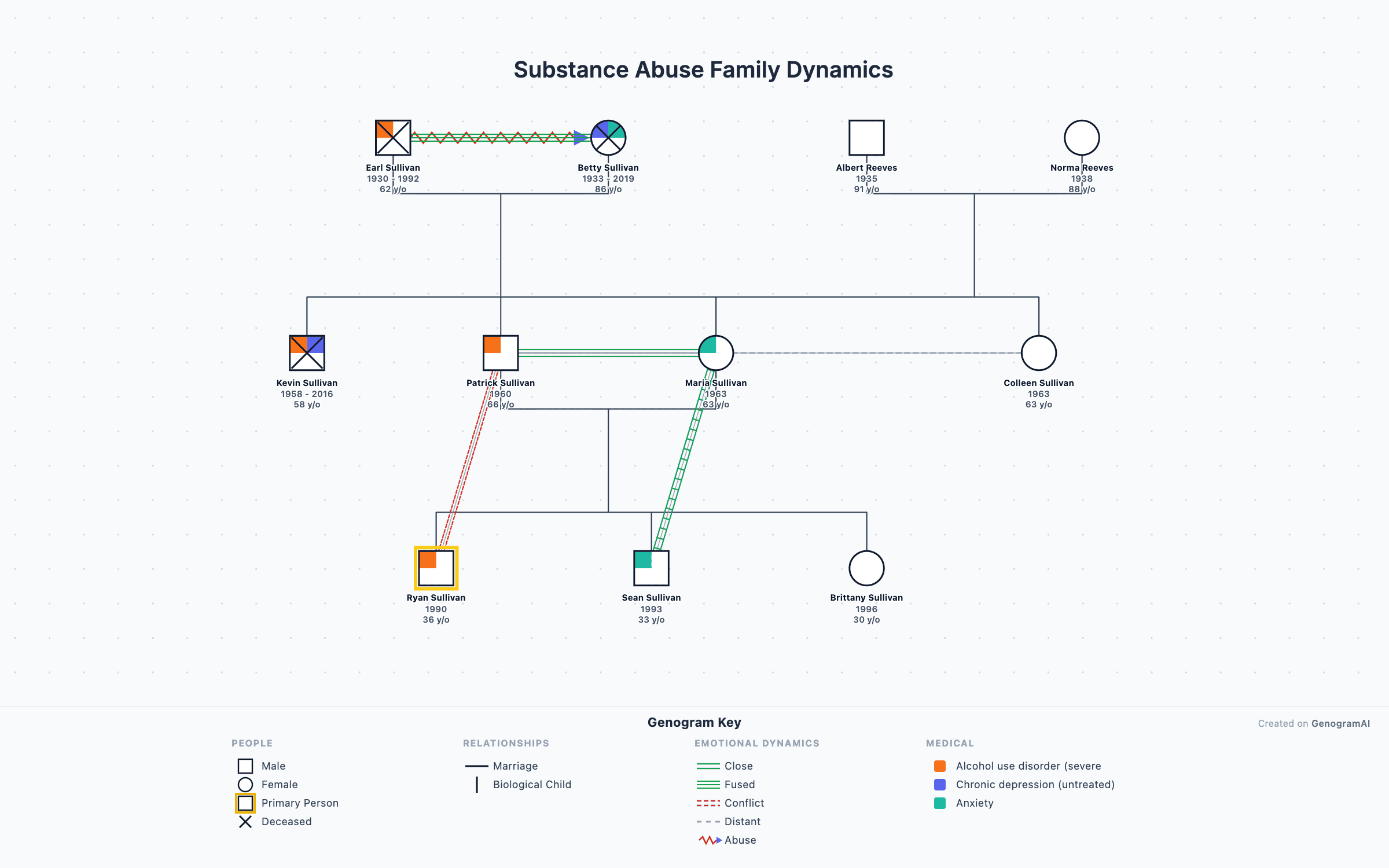
6. Intergenerational substance abuse — the Johnson family
The Johnson family genogram spans three generations with a documented substance use pattern in the paternal line. The paternal grandfather, Roy Johnson, is deceased; his cause of death is annotated as alcohol-related liver disease at age 64. The index client’s father, Earl Johnson (58), has been in recovery from alcohol use disorder for twelve years. His sobriety is annotated as a positive resilience factor on the diagram.
The index client, Mark Johnson (32), entered outpatient treatment three months ago for opioid use disorder. His younger brother, Derek (29), has an alcohol use disorder that is untreated; Derek has declined every referral from the family. Both Mark and Derek are drawn in the second generational row beneath their father. The addiction annotation appears on the paternal grandfather, the father (past), and both sons in the current generation — a three-generation vertical chain that is immediately visible on the diagram.
In a treatment context, this genogram serves multiple functions. It helps Mark externalize his addiction as something that has moved through his family system, reducing shame and increasing motivation for sustained recovery. It also identifies Derek as an untreated family member whose use may create ongoing relapse risk for Mark. The therapist can use the genogram to explore Earl’s recovery as a model, and to examine what changed in that generation and whether Mark can access similar resources. The diagram supports a systemic framing of an individual presenting problem. See further discussion at genograms in family therapy.
7. Anxiety and school refusal — the Patel family
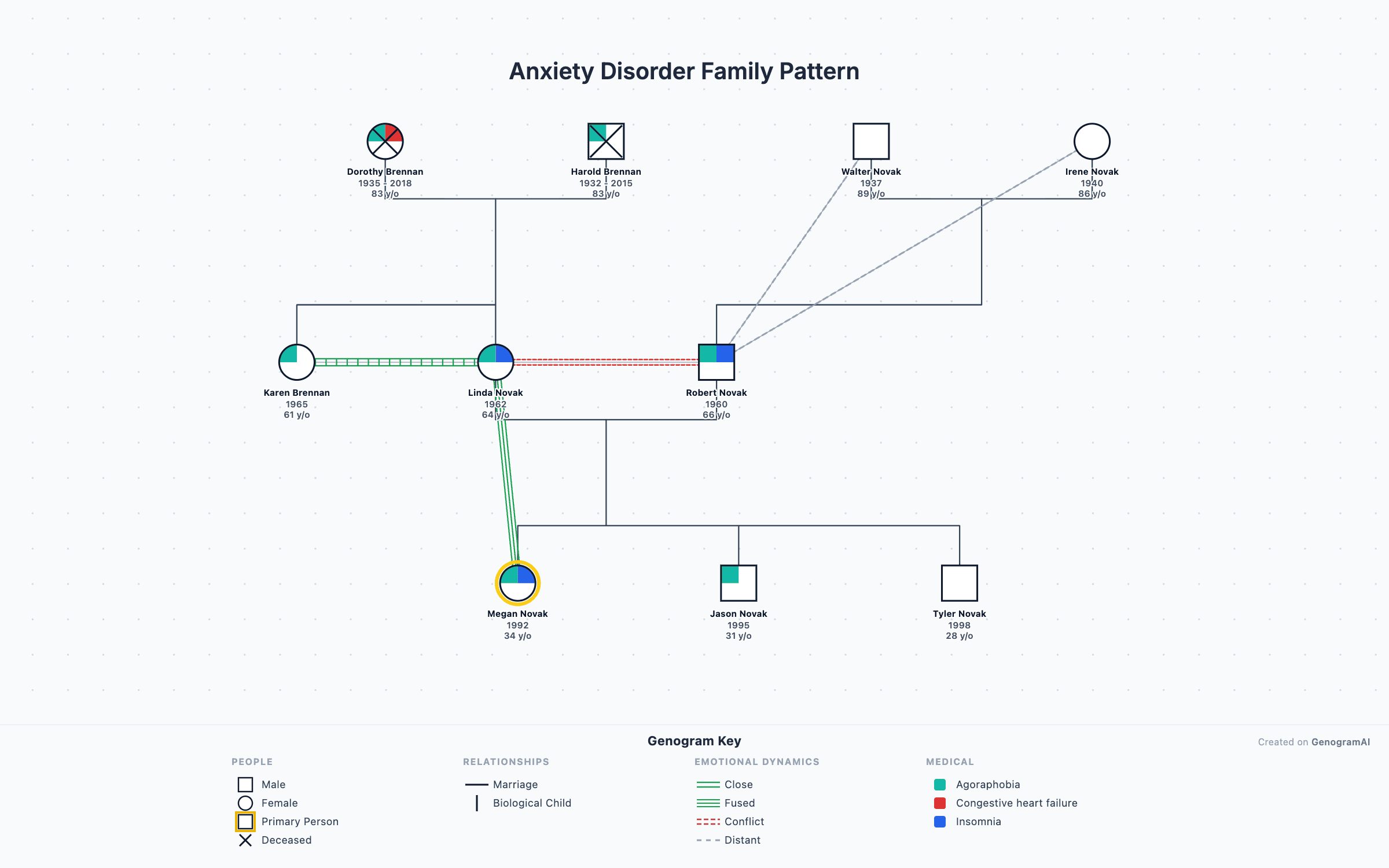
The Patel family immigrated from Gujarat fourteen years ago. The father, Raj (45), works long hours in a professional role and is described by his wife as emotionally distant — a dashed emotional relationship line connects him to the rest of the family cluster. The mother, Priya (42), is the functional center of the household. She manages all child-related decisions and communication.
The index client, Ananya (14), has been refusing school for four months. She presents with somatic complaints — nausea, headaches — on school mornings and distress that resolves completely on weekends. On the genogram, Ananya and Priya are connected with a triple-line enmeshment notation.
The genogram also maps the maternal grandmother, who lives in India but maintains daily phone contact with Priya. The grandmother is annotated with a documented history of anxiety disorder and agoraphobia. The anxiety transmission line is now visible across three generations: the grandmother’s documented anxiety, Priya’s high expressed emotion and enmeshment with Ananya, and Ananya’s school avoidance. The therapist can use this diagram to explore with Priya what messages about the world as a threatening place were transmitted across generations, and to begin differentiating Ananya’s distress from her mother’s anxiety system.
8. Blended family conflict — the Harrison-Webb family
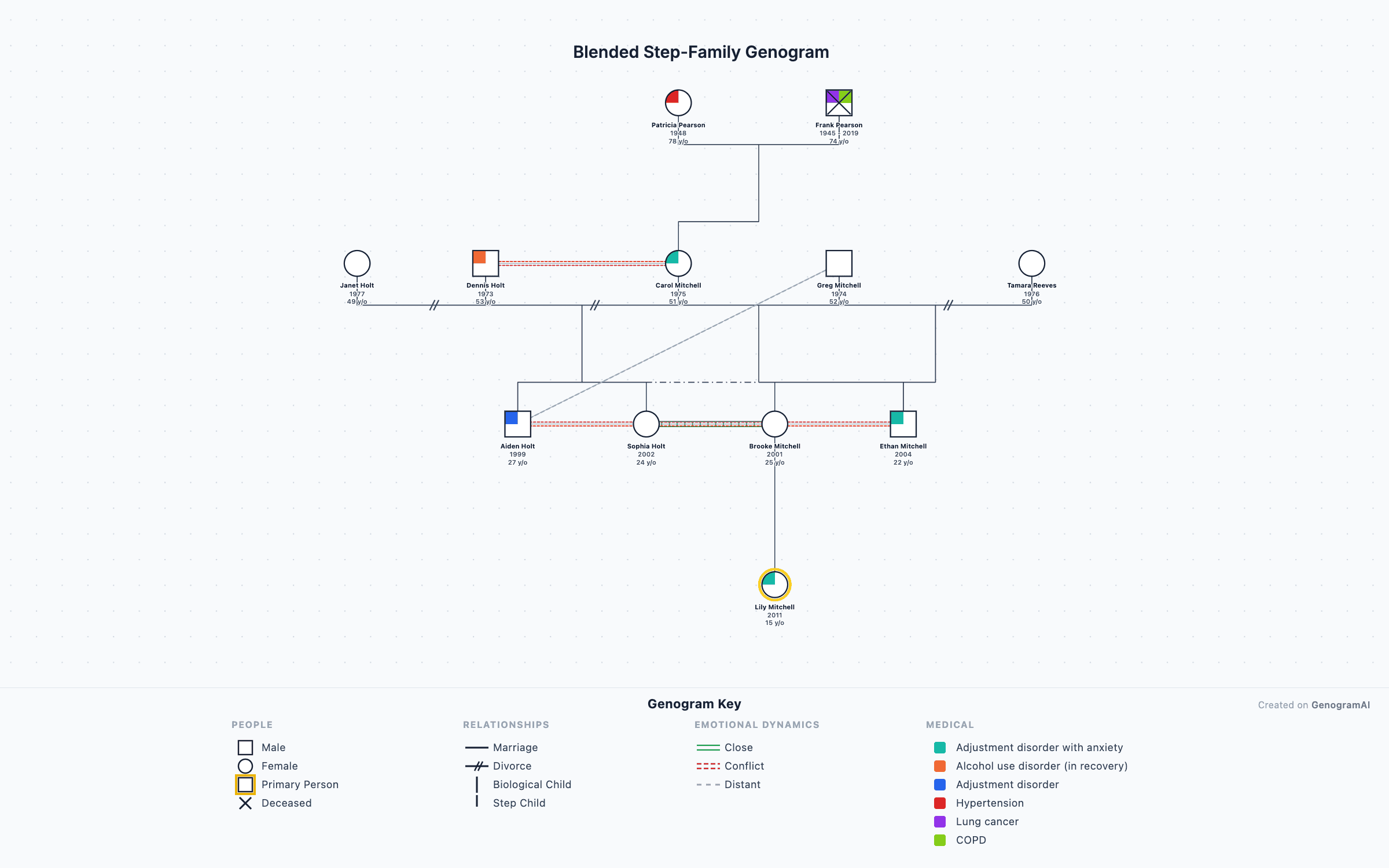
David Harrison (44) and Sarah Webb (41) each came to their current marriage with children from prior relationships. David’s previous marriage ended in divorce six years ago; he has two children, Ethan (16) and Sophie (13), who live primarily with him. Sarah’s previous marriage ended four years ago; she has one child, Liam (11), who lives with her full-time. David and Sarah have been together for three years and have a toddler, Emma (2), together.
The genogram maps four separate household units: David’s previous household, Sarah’s previous household, the current blended household, and Emma as the first member of a new nuclear unit. Emotional relationship lines show varying degrees of closeness and conflict: Ethan has a conflict notation with Sarah; Liam has a distant notation with David; Sophie and Liam have a moderate closeness line that the parents described as “better than expected.”
The genogram makes the loyalty architecture visible. Ethan, at 16, is old enough to remember his parents’ intact marriage and is the family member most resistant to integration. Sophie is more adaptable. Liam has essentially no emotional tie to David and routes all parenting through Sarah. Emma sits at the center of the diagram as the one person every other person shares a biological connection to — a natural integration point that the therapist can use intentionally. The diagram supports a treatment plan that addresses each stepparent-stepchild dyad individually rather than treating the blended family as a single unit with uniform problems.
9. Couples therapy — Maria and James
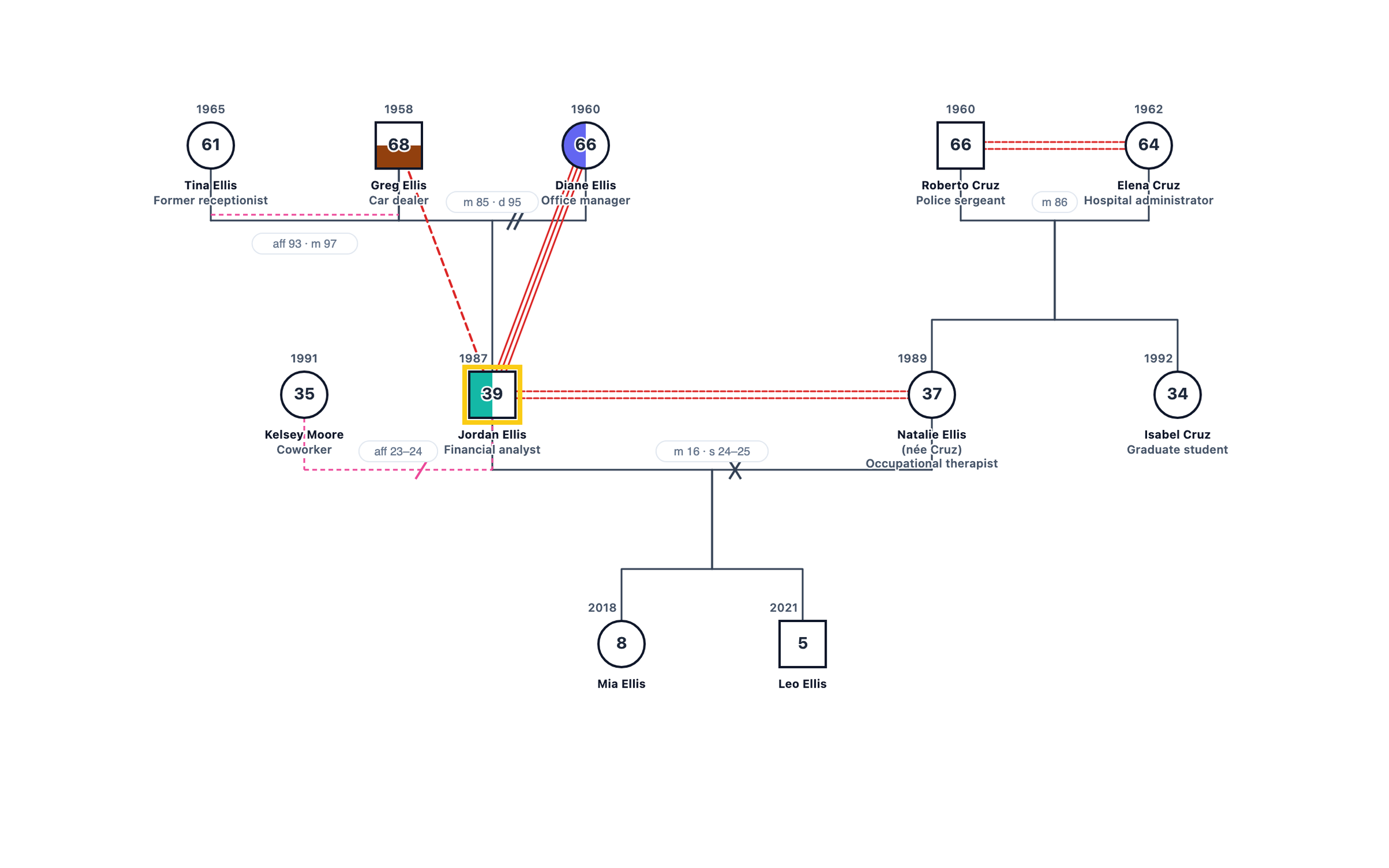
Maria (38) and James (41) have been married for eight years and are presenting with chronic conflict around emotional intimacy: Maria pursues, James withdraws. The presenting couple is the index pair at the center of the genogram. Alongside them are their families of origin mapped across two generational rows.
Maria’s parents divorced when she was 9. Her father, now 66, is annotated as emotionally unavailable throughout her childhood and has remarried twice; both subsequent marriages are shown on the diagram. Maria’s mother, now 63, remained single after the divorce and is described as having leaned heavily on Maria for emotional support. A fused/enmeshment notation connects Maria and her mother on the diagram.
James’s parents have been married for 43 years — a line notation that signals stability on the surface. His father, however, is annotated as a workaholic who was rarely home and emotionally absent. His mother is annotated as having managed the family system alone. James grew up in a household where emotional needs were met by withdrawal and busyness rather than engagement.
The genogram surfaces what the couples therapist already suspects: Maria learned that love requires pursuit because the significant men in her life consistently withdrew. James learned that emotional engagement is neither safe nor required. Both are enacting relational templates formed in their families of origin. The diagram provides a shared visual reference that depersonalizes the conflict and invites both partners to examine what they brought into the room. See genogram psychology for the theoretical framework underlying this approach.
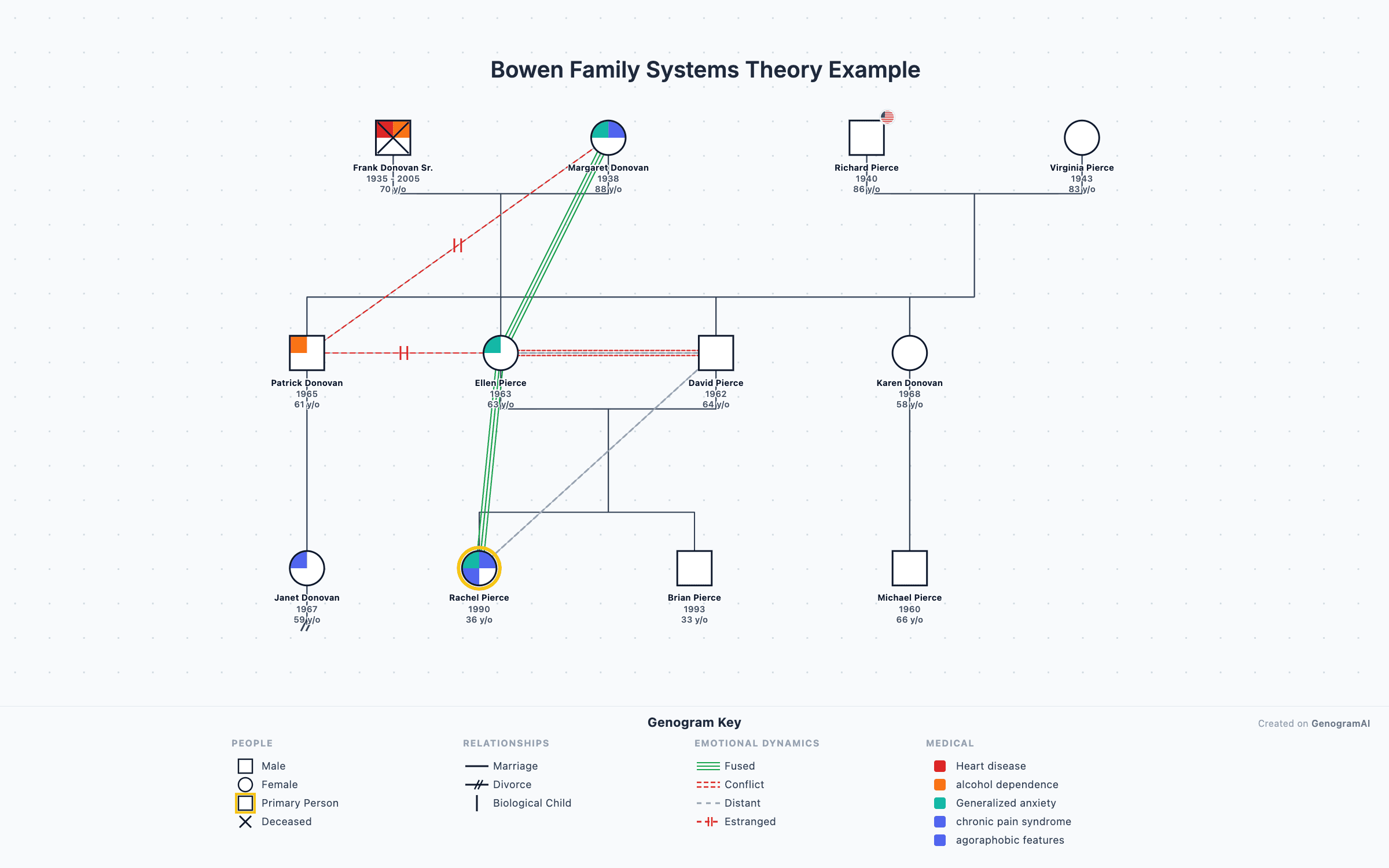
10. Bowen family systems — differentiation work
The index client is a 35-year-old woman presenting with chronic anxiety, difficulty maintaining friendships, and a pattern of either over-functioning or disappearing in her closest relationships. She describes her family as “close,” but her account suggests something more structurally specific.
Her mother (63) is described as intensely involved: daily calls, strong opinions about the client’s housing, relationships, and career, and a pattern of becoming visibly distressed when the client sets limits. A fused/enmeshed notation connects them on the diagram. Her father (66) is physically present but emotionally absent — a dashed line marks his connection to the mother. He has been emotionally cut off from his own parents since a money dispute twenty years ago; the cutoff notation and date are annotated on his generational section.
The genogram reveals a triangle: the mother, unable to get her emotional needs met by the emotionally absent father, routes her anxiety and attachment needs through the client. The client has occupied the role of emotional caretaker to the mother since early childhood — the identified patient in the family system who absorbs the anxiety the parental couple cannot metabolize between them. The father’s own cutoff from his family of origin suggests he learned this pattern there, and the genogram invites exploration of the grandparental generation to trace where the cutoff chain began.
Differentiation work uses this genogram as a map: the client is not anxious because of a character deficit but because she is functioning within a system that has required her anxiety. The diagram supports her in seeing her symptoms as relational rather than intrinsic, which is the starting point for change.
Genogram examples for nursing students
Nursing genograms — often called family health history assessments or medical pedigrees in clinical documentation — focus on hereditary disease patterns, risk stratification, and the family context of chronic illness management. The five examples below represent standard nursing assessment scenarios: cardiovascular risk, diabetes, hereditary cancer, mental health, and complex elder care decision-making.
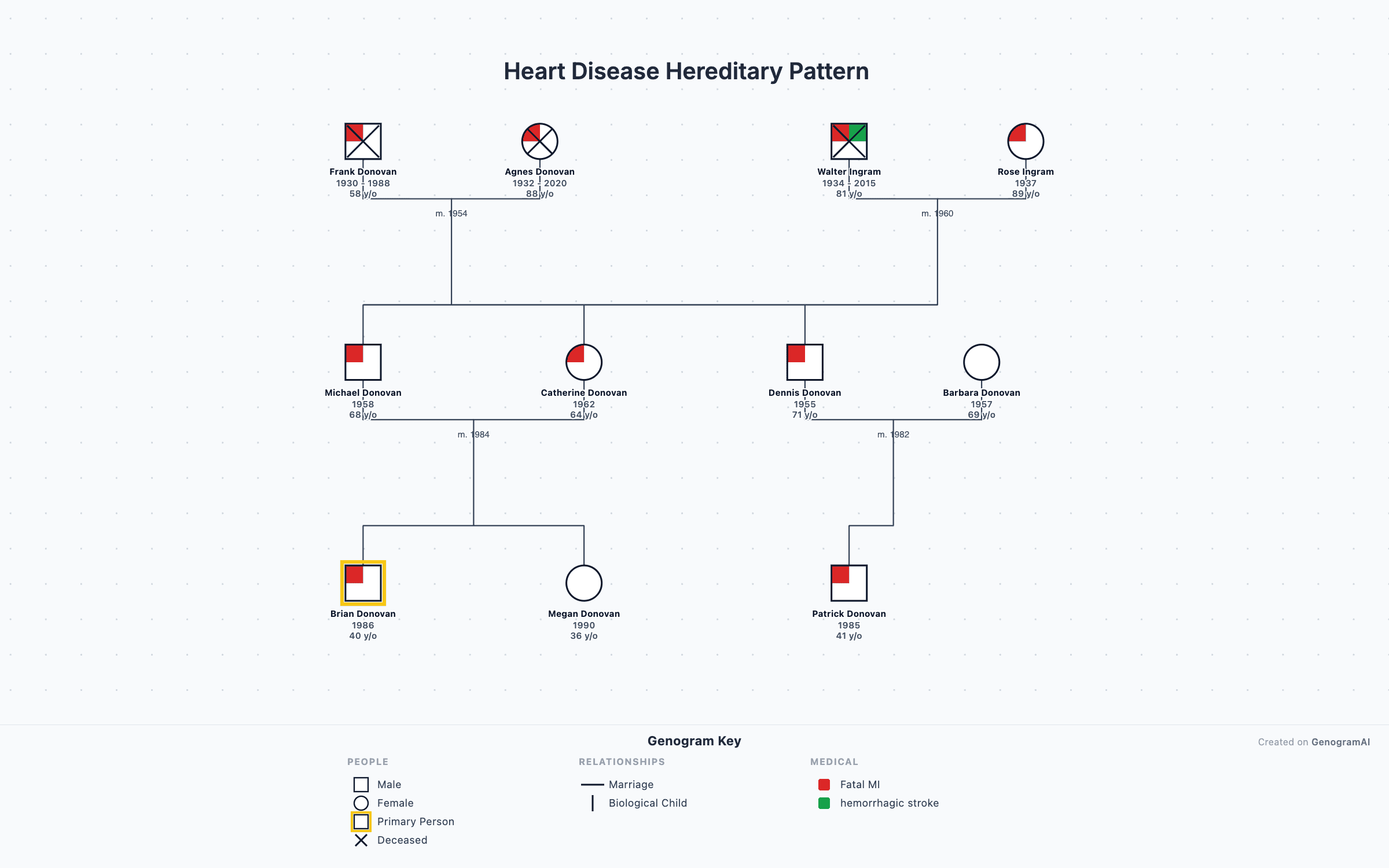
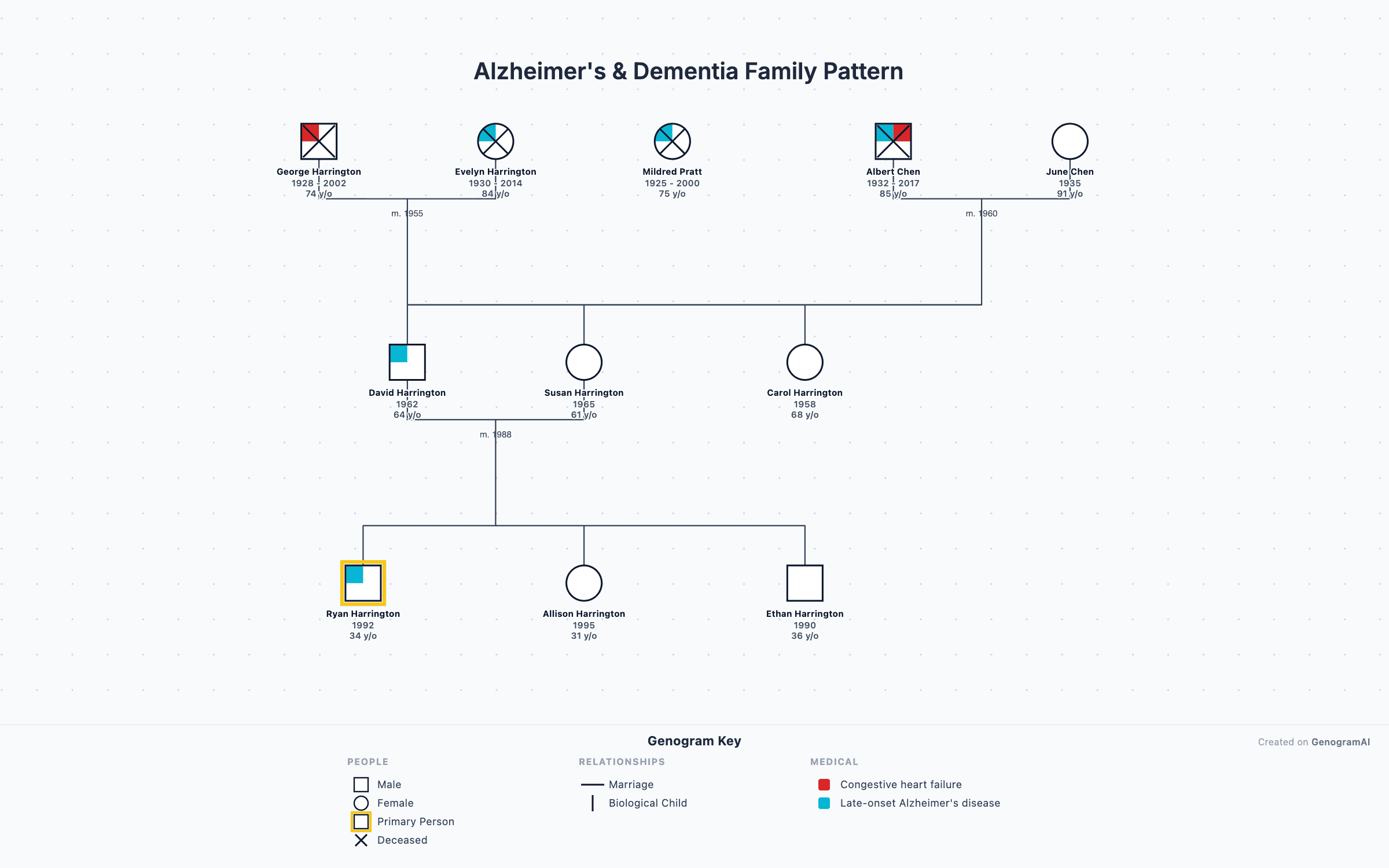
11. Cardiovascular risk — three-generation family health history
The index patient is a 58-year-old male admitted following his first myocardial infarction. Standard post-MI nursing assessment includes a family health history, and this genogram was constructed during the admission assessment.
The paternal grandfather died at age 55; cause of death annotated as myocardial infarction. The patient’s father died at age 62, also from MI. A brother, currently 55, has hypertension managed with medication. The patient’s son, 32, was diagnosed with hypertension two years ago and is on antihypertensive treatment.
The genogram maps MI or premature cardiovascular death across three generations of the paternal line: grandfather at 55, father at 62, index patient at 58. The autosomal dominant cardiovascular risk pattern is immediately visible. For the nursing care plan, this diagram supports several interventions: documentation of familial hypercholesterolemia as a differential to explore with cardiology; patient education that explicitly names the hereditary component; and risk-reduction counseling targeted at the son (32), who already has hypertension and should be receiving early surveillance. See medical genogram for more on this application.
12. Type 2 diabetes — hereditary and lifestyle patterns
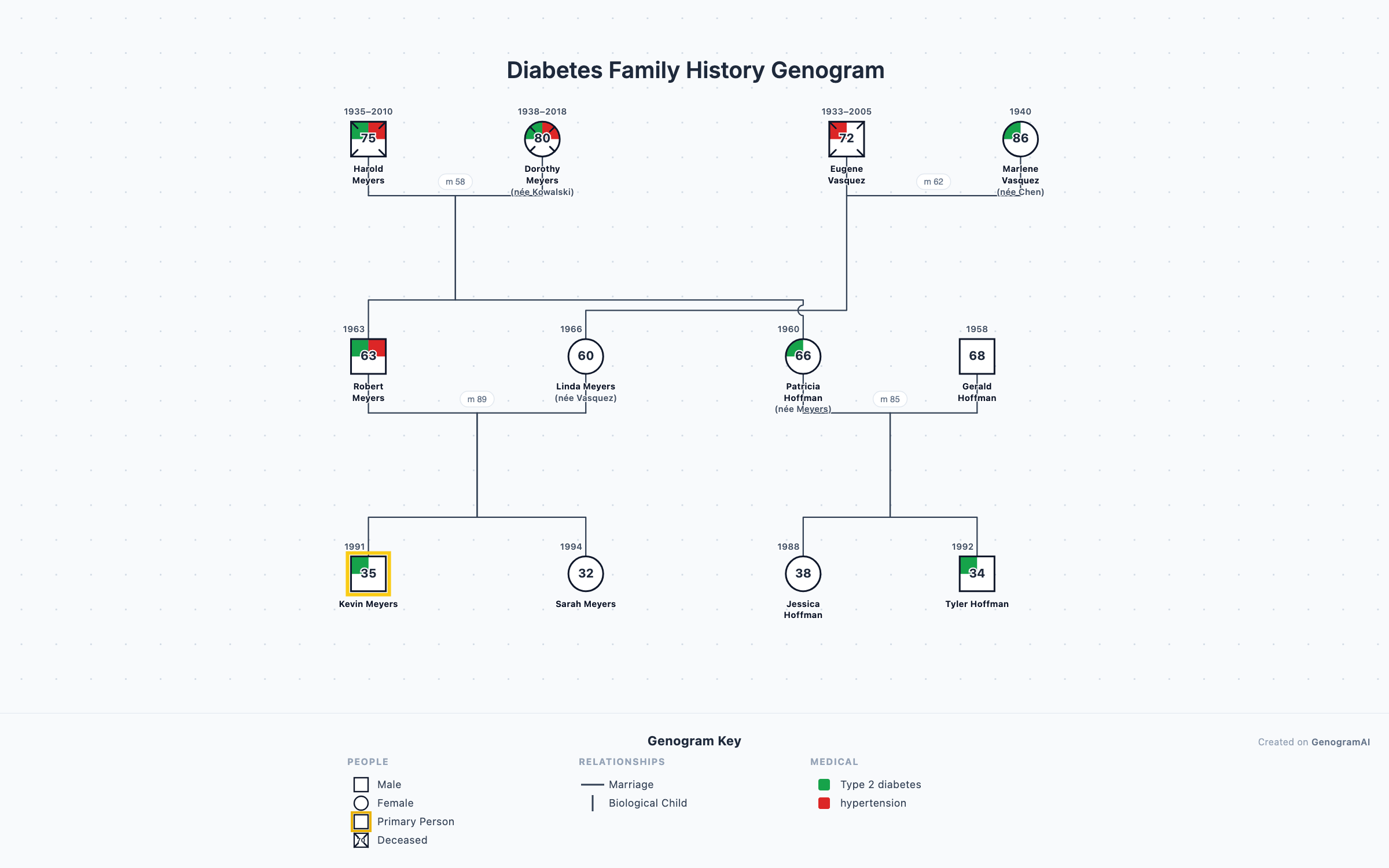
The index patient is a 52-year-old woman recently diagnosed with Type 2 diabetes mellitus. Her mother (76) has had T2DM for fifteen years and is currently at CKD Stage 3, a documented complication of poorly controlled diabetes over time. A maternal aunt (68) also has T2DM and underwent a below-knee amputation four years ago due to peripheral vascular disease.
Of the patient’s two siblings, both are annotated as pre-diabetic: a brother (49) and a sister (46). The patient’s own daughter (28) had gestational diabetes during her most recent pregnancy, a marker of elevated lifetime risk for T2DM.
The genogram shows both hereditary risk (maternal line with documented T2DM in two generations) and the disease trajectory pattern: the maternal aunt’s amputation and the mother’s CKD give the patient a concrete, personalized view of what uncontrolled diabetes looks like in her own genetic context. This specificity is more motivating in patient education than generic statistics. The nursing care plan uses the genogram to target education: A1c management, foot care, and nephrology surveillance. The siblings and daughter are flagged for preventive counseling. See medical genogram.
13. Cancer pedigree — hereditary breast/ovarian risk (BRCA)
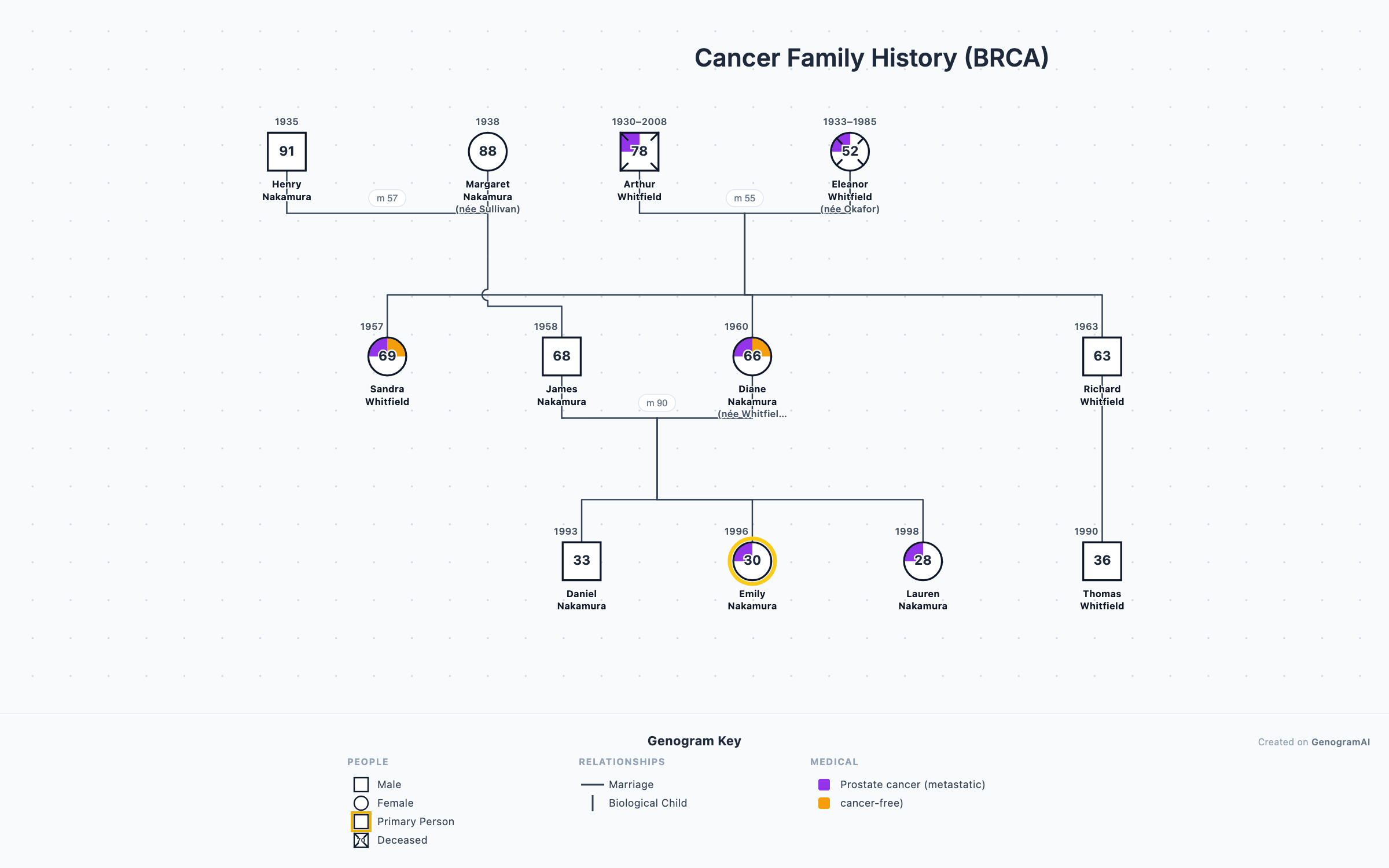
The index patient is a 44-year-old woman recently confirmed as BRCA1-positive following a diagnostic workup after her own breast cancer diagnosis. The nurse constructs a three-generation pedigree as part of genetic counseling preparation.
The patient’s mother died at age 48 from breast cancer. A maternal aunt, now 53, was diagnosed with ovarian cancer at age 49 and is currently in surveillance. The maternal grandmother died at age 52 from breast cancer. A maternal first cousin (39) has been informed of the family history and is currently in active screening but has not undergone genetic testing.
The index patient has two daughters: one aged 22 and one aged 19. Neither has been tested. The genogram — functioning here as a cancer pedigree chart, the form used in genetic counseling — makes the maternal transmission pattern explicit: breast cancer in the grandmother at 52, breast cancer in the mother at 48, ovarian cancer in the aunt at 49, and now breast cancer in the index patient at 44. The age of onset is trending younger across generations, a clinical observation that strengthens the case for urgent genetic counseling referral for both daughters. This is the example most directly relevant to nursing students covering the genogram-as-pedigree-chart intersection in their family health assessment coursework.
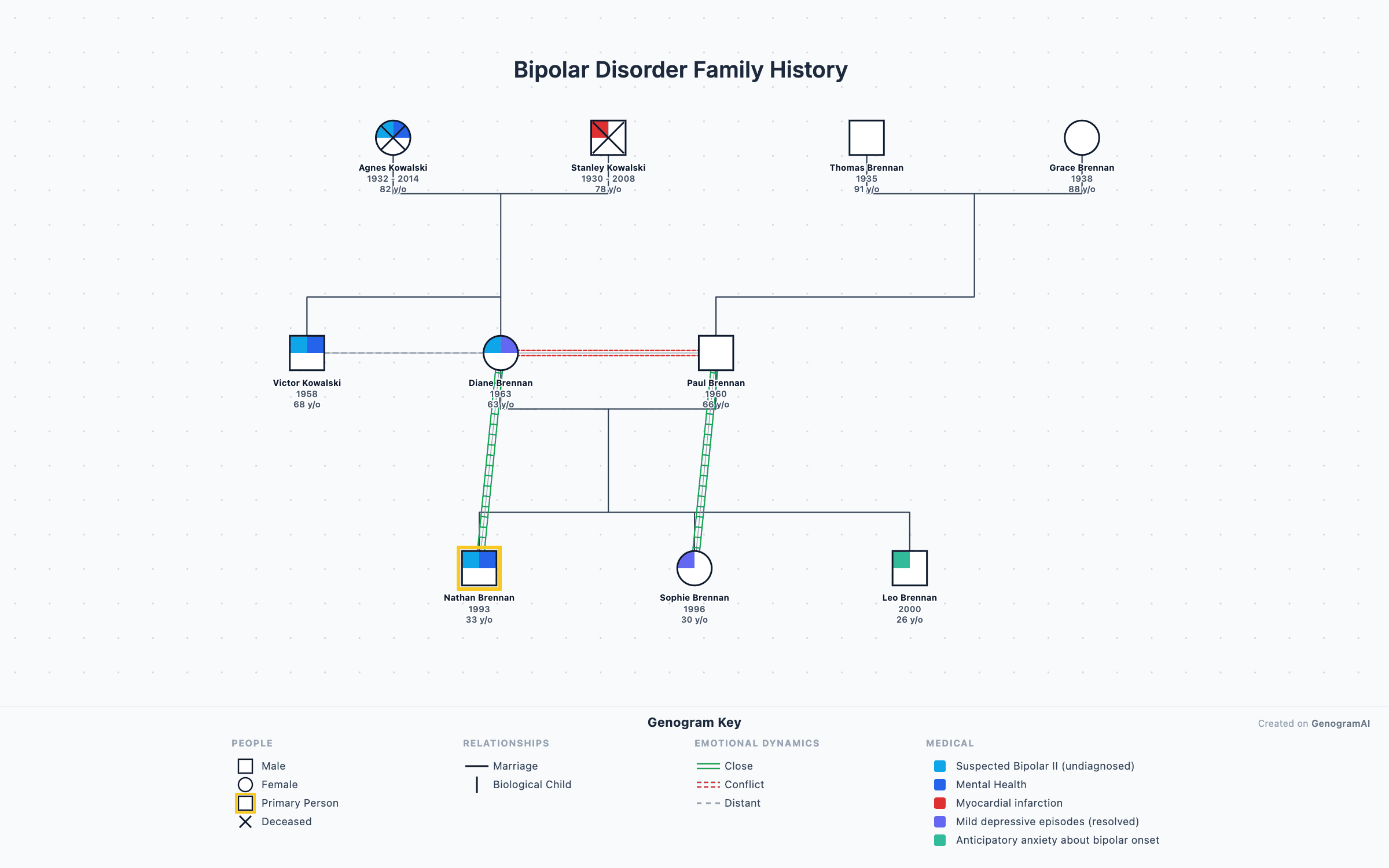
14. Mental health history — postpartum and mood disorders
The index patient is a 28-year-old woman, six weeks postpartum, referred for mental health screening after her midwife noted tearfulness and sleep disruption beyond expected adjustment. Her Edinburgh Postnatal Depression Scale score is 14, above the standard clinical threshold for further assessment.
The patient’s mother (55) is annotated on the genogram with a documented postpartum depression episode following her second child, treated with medication. She received a subsequent bipolar II diagnosis in her early forties. A maternal aunt (50) carries a bipolar I diagnosis and has had two inpatient admissions. No paternal mental health history was available.
The genogram compresses the risk picture into a single visual: mood disorder in the maternal line, including a direct parallel of postpartum depression in the generation immediately above. For the nursing care team, this diagram supports a more assertive monitoring protocol: Edinburgh rescreening at 10 weeks rather than discharge, a warm handoff to psychiatric services rather than watchful waiting, and a psychoeducation conversation with the patient about the hereditary component of mood disorders and what to watch for in the weeks ahead. The diagram is also useful for communicating risk to the obstetric team in a shared case review.
15. Nursing home admission — family decision-making dynamics
Edna is 81 years old with a confirmed diagnosis of vascular dementia at a moderate stage. Her husband, Walter (83), has mild cognitive impairment and has been her primary caregiver for the past 18 months. Walter is now overwhelmed and describing caregiver exhaustion; he has lost twelve pounds in the past four months.
Edna and Walter have three adult children. Patricia (58) lives locally and visits weekly; she is advocating for home care with increased professional support. Richard (55) lives two hours away; he visits monthly and is advocating for a memory care facility, citing safety concerns. Donna (51) lives across the country; she has delegated her position to her siblings and says she will support whatever decision they reach.
The genogram maps the communication architecture the social work and nursing team must navigate. Patricia and Richard are in direct conflict — a conflict notation on their relationship line. Walter is triangulated: both adult children appeal to him separately, but his own cognitive impairment limits his capacity to hold the decision-making role they are implicitly assigning him. Donna’s absence is noted but her position of non-participation is itself a structural factor, reducing the coalition available to either sibling.
The nursing team can use this diagram to structure a family meeting: acknowledge the conflict between Patricia and Richard directly, remove Walter from the triangulated position by centering Edna’s care needs and documented preferences, and invite Donna to participate by video to reduce her positional absence. The genogram is a tool not just for assessment but for facilitating the family process the team needs to complete a safe discharge plan.
How do you read these genogram examples?
| Symbol | What it means |
|---|---|
| Double border (square or circle) | The index person, identified patient, or presenting client. Every diagram should have exactly one. |
| Horizontal line between two symbols | A couple relationship. A single solid line is marriage; a double line is a very close bond; a broken line is a non-marital partnership; a line with one slash is separation; two slashes is divorce. |
| Vertical lines dropping to a horizontal bar | Children of a couple, displayed from oldest (left) to youngest (right). |
| X through a symbol | Deceased. Age at death and cause of death are typically annotated inside or beside the symbol. |
| Zigzag line | Conflict relationship. In high-conflict situations, an additional notation (e.g., physical violence) may be added. |
| Three parallel lines | Enmeshment or fused relationship, used most often in therapy contexts. |
| Dashed line | Emotional distance. Not estrangement but reduced closeness or limited contact. |
| Cut line | Emotional cutoff, a complete or near-complete cessation of contact. Annotated with approximate date when known. |
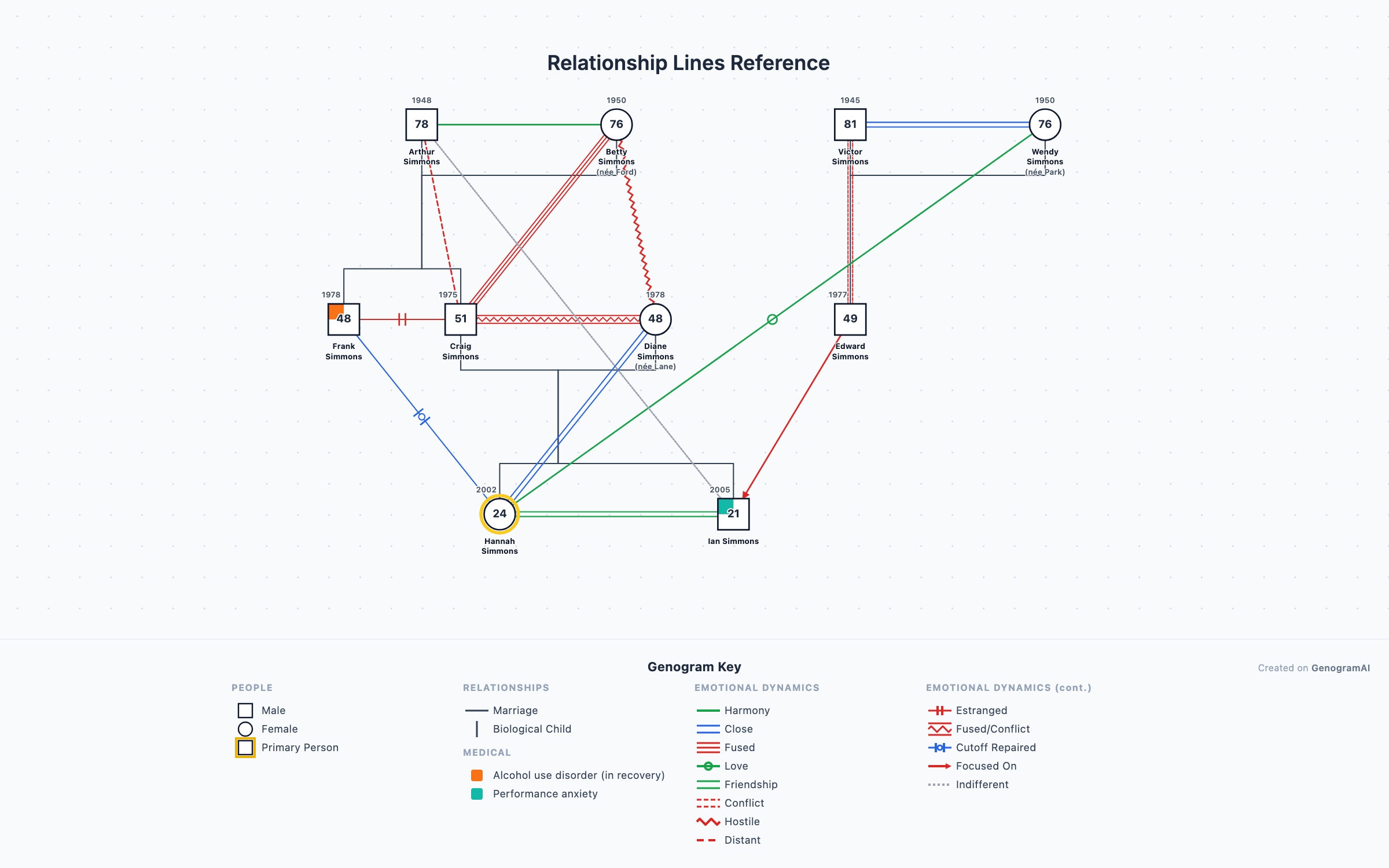
For a complete reference including dotted lines, adoption notation, twin notation, miscarriage and pregnancy loss symbols, and the full range of emotional relationship lines, see our genogram symbols guide and our how to read a genogram article.
How to create any of these genograms in minutes
- 1
Describe the family
For a social work case like the Rivera family: describe the three-generation structure, name the relationship status, note the DV history and incarceration, flag the children in foster placement. The AI produces the diagram. - 2
Refine it in the editor
Adjust emotional relationship lines, add annotations, and confirm the index person is double-bordered. The process takes minutes rather than the long drawing session a hand-drawn diagram usually needs. - 3
Export it
Export a PNG on the Free plan. PDF, SVG and GEDCOM export are on the Professional ($12/month) and Clinical ($29/month) plans, for case files, supervision documentation, assignment submissions, or multidisciplinary team presentations. The export preserves all notation, annotation, and emotional relationship lines.
For nursing students working on a family health assessment assignment: the AI builder is particularly useful for medical pedigree cases. You enter each family member, their relationship to the index person, their diagnoses, and their vital status. The tool handles the layout and notation so you can focus on the clinical analysis rather than the drawing.
Working with real client families
To start building, go to the genogram creator, or browse all 175 examples in the genogram examples gallery.
Frequently asked questions
What is a 3-generation genogram?
A three-generation genogram maps an individual (the index person), their parents and any siblings, and their grandparents. It represents the minimum depth recommended for clinical use because it provides enough history to identify intergenerational patterns (in health, behavior, relationships, and family structure) that would be invisible in a shallower diagram. Most academic assignments, clinical protocols, and social work assessments specify three generations as the required floor. Some contexts, such as hereditary cancer pedigrees, Bowen family systems work and migration histories, benefit from four or five generations.
How do social workers use genograms?
Social workers use genograms as assessment tools to document family structure, identify support networks (or the absence of them), map intergenerational patterns of risk, and communicate complex family histories to supervisors, courts, and multidisciplinary teams. In child welfare, genograms are used during intake, case planning, and court documentation. In community and clinical settings, they support safety planning, kinship assessment, and intervention design. Genograms make patterns visible that would take pages of narrative to describe and are more effective in supervision and team settings because they can be discussed visually.
What should a nursing genogram include?
A nursing genogram, sometimes called a family health history assessment or family health pedigree, should include at minimum: three generations, each person’s age or year of birth, vital status (living or deceased with cause of death), and any documented diagnoses relevant to the presenting concern or hereditary risk. For a cardiovascular patient, annotate MI, hypertension, stroke, and hyperlipidemia across all family members. For oncology, annotate cancer type, age of diagnosis, and status. For mental health, annotate diagnosed conditions, hospitalizations, and substance use. The index patient should be double-bordered. Many nursing programs also require a written narrative analysis that identifies patterns visible on the diagram.
What’s the difference between a genogram and a family tree?
A family tree records genealogical structure: who is related to whom, with dates of birth, death, and marriage. It is primarily biographical and historical. A genogram records the same structure but layers clinical information on top: diagnoses, cause of death, behavioral health history, substance use, emotional relationship quality, and family communication patterns. A genogram is a clinical assessment tool; a family tree is a record. Genograms are also typically centered on a living index person and oriented toward understanding the present clinical situation, whereas family trees may extend indefinitely backward in time with no clinical frame.
Can I use AI to create a genogram?
Yes. GenogramAI produces editable genograms from plain-text descriptions. You describe the family in natural language, including names, ages, relationships, diagnoses, and relevant history, and the AI generates a diagram using standard genogram notation. You can then edit any element of the genogram in the visual builder: add or remove people, adjust relationship lines, change emotional relationship notations, and add clinical annotations. The Free plan exports PNG; PDF, SVG and GEDCOM export are on the Professional and Clinical plans. Clinical Mode, on the Clinical plan, is available for settings where data privacy is a concern.
Genogram examples for social workers
Social work genograms tend to foreground structural factors: who is in the home, who has legal involvement, what the support network looks like, and where intergenerational risk patterns appear. The five examples below represent common case types in child welfare, domestic violence services, foster care, school-based practice, and elder care.
1. Child protective services removal — the Rivera family
Maria Rivera is 34 years old and the index person in this three-generation genogram. Her father, Eduardo Rivera, died at age 58 from a myocardial infarction; his alcoholism is annotated on the diagram and is a documented factor in the family’s history with child welfare services. Maria’s mother, Dolores, is living but estranged — a dashed emotional relationship line marks the distance. There is no paternal family involvement with Maria’s children.
Maria has two children: a daughter aged 8 and a son aged 5. Both children are currently in foster placement, shown on the genogram with a bracket notation indicating out-of-home placement. Maria’s current partner, Carlos (32), has a documented domestic violence history and is presently incarcerated. He is drawn on the genogram connected to Maria by a relationship line with a conflict notation; his family of origin is absent from the diagram because no information was available to the worker.
What the genogram reveals at a glance: Maria is functionally isolated. Her father is deceased, her mother is estranged, Carlos is incarcerated, and there is no paternal family involvement. The support system for reunification is nearly empty. The intergenerational pattern — an alcoholic, emotionally absent father in one generation; a partner with violence and legal involvement in the next — is visible structurally in a way it would not be in a written narrative alone. The CPS worker can use this diagram to document the pattern in supervision and to identify where kinship or community resources might be cultivated. See more on how social workers use genograms at genograms for social workers.
2. Domestic violence pattern — the Thompson family
The Thompson genogram spans three generations of documented intimate partner violence. The maternal grandmother, now 74, was physically abused by her husband throughout her marriage; he is deceased, with cause of death annotated as cardiac arrest at age 71. The conflict relationship line between them is drawn with the additional notation indicating physical violence.
The grandmother’s daughter — the index client’s mother, Barbara (52) — has been married three times. Each marriage is drawn on the genogram as a sequential relationship line. All three are annotated as abusive. Barbara’s current husband is her third partner; the notation shows ongoing conflict. Barbara has never sought shelter or legal protection.
The index client, Jessica (28), is Barbara’s daughter from her first marriage. Jessica is currently staying at a domestic violence shelter with her eight-month-old infant. Her own relationship history — two prior partners, both abusive — is annotated on her section of the diagram. The genogram makes the intergenerational transmission of violence visible across three generations of women in a single image. Without the genogram, a clinician reading case notes would have to construct this pattern mentally from scattered documentation. The diagram makes it explicit and discussable in ways that support both treatment planning and risk assessment.
For the psychological framework underlying these patterns, see genogram psychology.
3. Foster care kinship assessment — the Washington siblings
Three siblings — ages 11, 8, and 6 — were removed from the home of their biological parents after a substantiated neglect investigation tied to active substance use by both parents. The biological mother (34) and biological father (36) are each annotated with their substance use history: the mother with methamphetamine, the father with alcohol and opioids. The parents are not currently living together; their relationship ended two years before removal.
Two kinship placement candidates are mapped on the genogram. On the paternal side, the paternal grandmother — Gloria Washington, 62 — lives alone, has Type 2 diabetes, and is annotated as having limited mobility. She has expressed willingness to take all three children but has no prior caregiving experience with children in this age group. Her son’s substance use history, and the substance use annotation on her deceased husband (alcohol, cardiac death at 64), signals a paternal line pattern that the worker documents on the diagram.
On the maternal side, Aunt Diane (38) is married, has two children of her own (ages 10 and 7), and has been employed steadily for six years. Her household is annotated as stable. The genogram makes the assessment comparative and visual: the maternal aunt represents a stronger kinship placement, not only because of her individual circumstances, but because the paternal family line shows a multigenerational substance use pattern that the paternal grandmother has not acknowledged. The worker can present this diagram in court or in a staffing meeting to support the placement recommendation. See additional detail at family genogram.
4. School-based intervention — Maya, 15
Maya is a 15-year-old presenting with declining academic performance and increasing social withdrawal over the past six months. The school social worker constructed a three-generation genogram during the initial assessment meeting.
Maya’s parents divorced when she was 9. Her mother, Tricia (42), remarried two years ago. Tricia’s new husband, Derek (45), has a teenage son, Connor (17), from his own prior marriage. Connor lives with them full-time. Maya’s biological father, Robert (44), has limited involvement — the emotional relationship line between Maya and her father is drawn as a dashed line indicating distance. Robert has not attended a school meeting or responded to school communications in over a year.
On the maternal side, Maya’s grandparents are close and engaged — enmeshment lines connect Tricia to her mother, suggesting an intergenerational closeness pattern that likely extends to Maya. The paternal grandparents are marked as unknown; no information was available. Maya’s behavioral decline correlates almost exactly with the timing of her mother’s remarriage and Connor’s entry into the household. The genogram surfaces that connection structurally. The intervention plan addresses blended family adjustment, the loss of exclusive mother-daughter relationship, and the continued absence of the biological father in a single clinical frame. For therapy applications, see genograms in family therapy.
5. Elder care and caregiver burden — the Chen family
Both Chen parents are 78. The father, Henry, has a dementia diagnosis confirmed three years ago, currently at a moderate stage. The mother, Patricia, has congestive heart failure managed with medication. Neither parent can live independently without assistance.
The couple has four adult children. The eldest daughter, Linda (52), lives ten minutes away and has been the primary caregiver for two years. She is annotated on the genogram with a caregiver symbol. The second child, Michael (50), lives in another state and is described by Linda as “emotionally cut off” — a cut line separates him from the central family cluster on the diagram. The third child, Angela (48), lives nearby but has a conflicted relationship with both parents — a zigzag conflict line is used. The youngest child, Thomas (45), moved abroad five years ago and participates only by phone.
The genogram reveals a pattern the social worker recognized immediately: caregiver burden is entirely concentrated in Linda, with no structural support from three siblings who are either geographically distant, emotionally cut off, or in conflict. Linda is also triangulated between her parents — she is the person both Henry and Patricia turn to when they disagree about medical decisions. The diagram provides a clear visual argument for a family meeting focused on distributing care responsibilities and establishing a shared decision-making protocol.