Multigenerational mapping
3 generation genogram: example, template and how to make one
Quick answer
What is a 3 generation genogram?
A 3 generation genogram is a family diagram that maps three levels of a family: grandparents, parents, and children. This three-generation structure is the gold standard for family assessment because it provides enough depth to identify multigenerational patterns while remaining manageable to create and interpret.
Three generations reveal patterns that two generations cannot: health conditions that skip generations, relationship styles that repeat, career paths that run in families, and behavioral patterns passed down through modeling. For nursing students, therapists, and counselors, the 3 generation genogram is often the minimum required depth for clinical work.
The three generations explained
| Row | Who goes here | What to record |
|---|---|---|
| Generation 1 (top row) | Grandparents | Maternal and paternal grandparents. Include health history, occupations, causes of death, and relationship patterns. |
| Generation 2 (middle row) | Parents, aunts and uncles | Mother and father, plus aunts and uncles and their partners. Shows how patterns from grandparents influenced parents. |
| Generation 3 (bottom row) | Index person and siblings | You (or the focus person), siblings, and cousins. The generation being assessed. |
If the index person has children
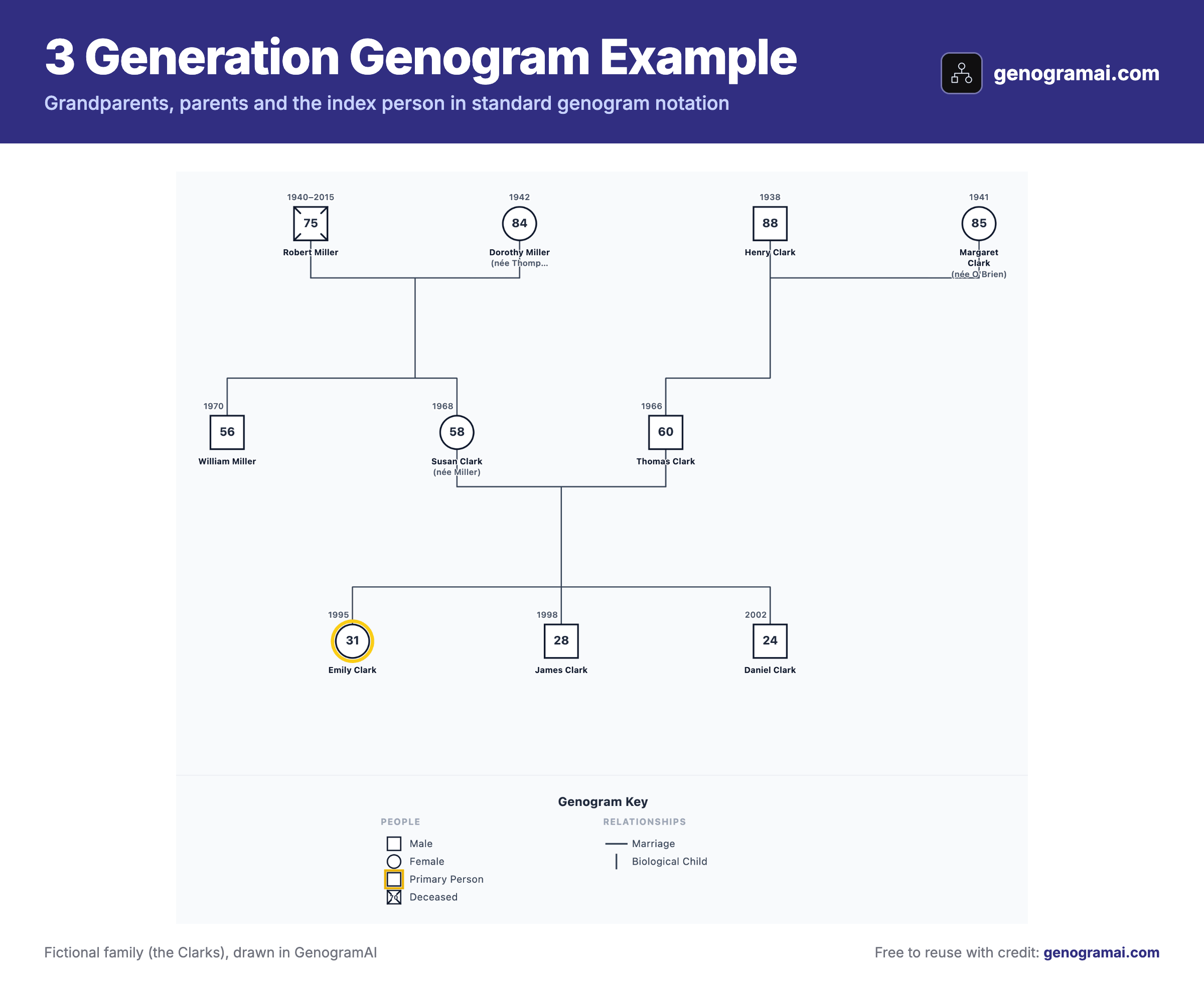
3 generation genogram example with explanation
| Generation | People shown | What the symbols tell you |
|---|---|---|
| Generation 1 | Robert Miller (1940-2015) and Dorothy Miller (b. 1942); Henry Clark (b. 1938) and Margaret Clark (b. 1941) | Two couples joined by marriage lines. The X through Robert's square means he has died; the number inside it (75) is his age at death. The other numbers are current ages. |
| Generation 2 | Susan Clark, née Miller (b. 1968), her brother William Miller (b. 1970), and Thomas Clark (b. 1966) | Vertical lines from each grandparent couple drop to their children. Susan and Thomas are joined by a marriage line, which makes them the parent couple for the bottom row. |
| Generation 3 | Emily Clark (b. 1995), James Clark (b. 1998), Daniel Clark (b. 2002) | Siblings run oldest to youngest from left to right. Emily is the index person, drawn with a highlighted outline. |
| Key | Male, female, primary person, deceased, marriage, biological child | Every symbol used on the chart is listed in the legend underneath, which most rubrics require. |
Read it like this: Emily (31) is the oldest of three children of Susan and Thomas Clark. Her maternal grandfather Robert died in 2015 at 75; her other three grandparents are living, in their 80s. Her mother has one brother, William. That one sentence is the "explanation" most assignments ask for. A clinical genogram adds the next layers on the same structure: health conditions, emotional relationship lines and dates of key events.
More 3 generation genogram examples
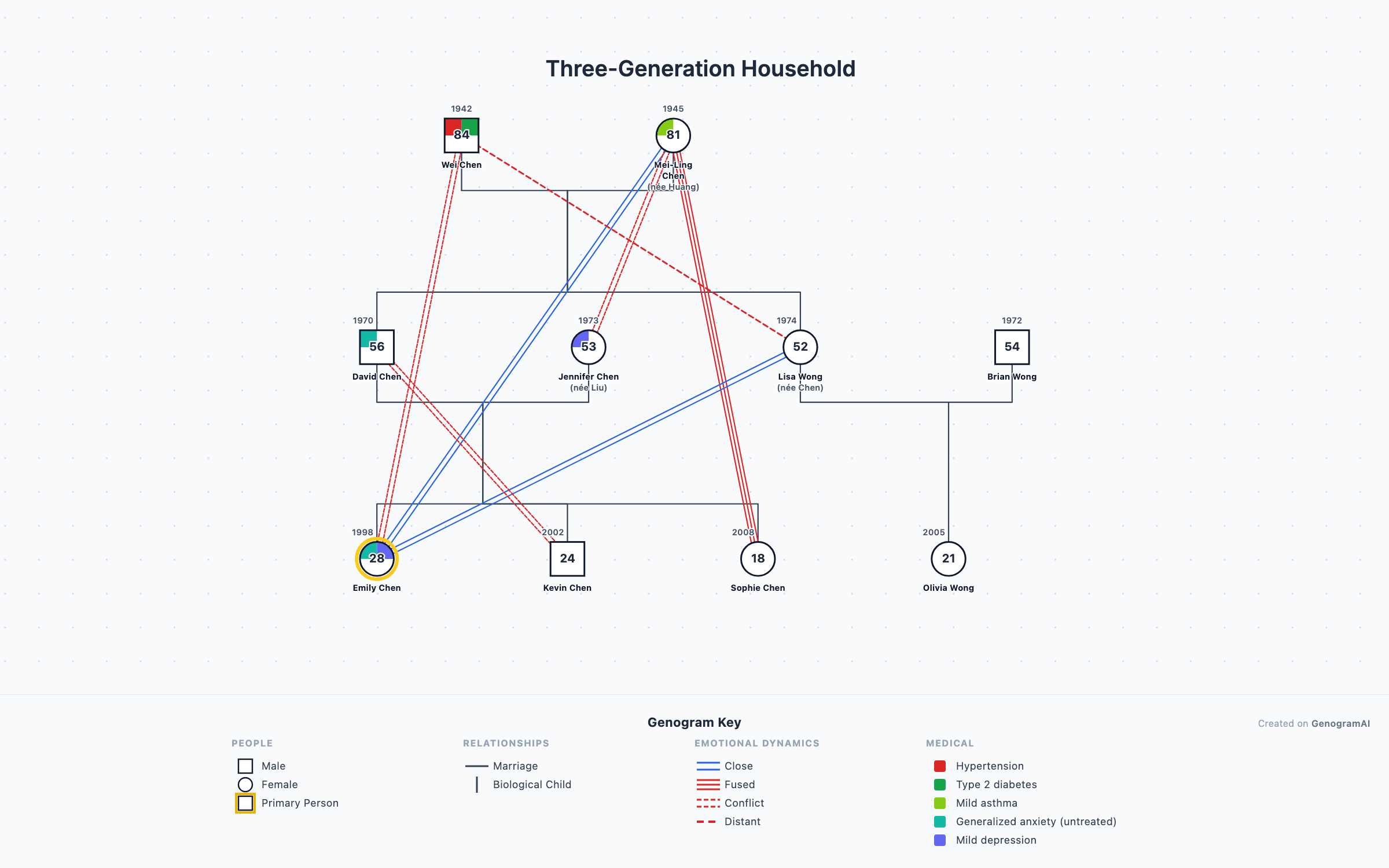
| Layer | What this example shows |
|---|---|
| Structure | Grandparents Wei (b. 1942) and Mei-Ling Chen (b. 1945); their children David, Lisa and David's wife Jennifer, plus Lisa's husband Brian Wong; four grandchildren including the index person, Emily Chen (b. 1998). |
| Emotional lines | Close (double blue line) between Emily and her grandmother and her aunt Lisa; fused (triple line) between Mei-Ling and Sophie; conflict (red dashed double line) between Wei and Emily; a distant line between Wei and Lisa. |
| Medical colours | Hypertension and type 2 diabetes in Wei, asthma in Mei-Ling, anxiety in David, depression in Jennifer, and both anxiety and depression in Emily, so the anxiety pattern is visible across two generations. |
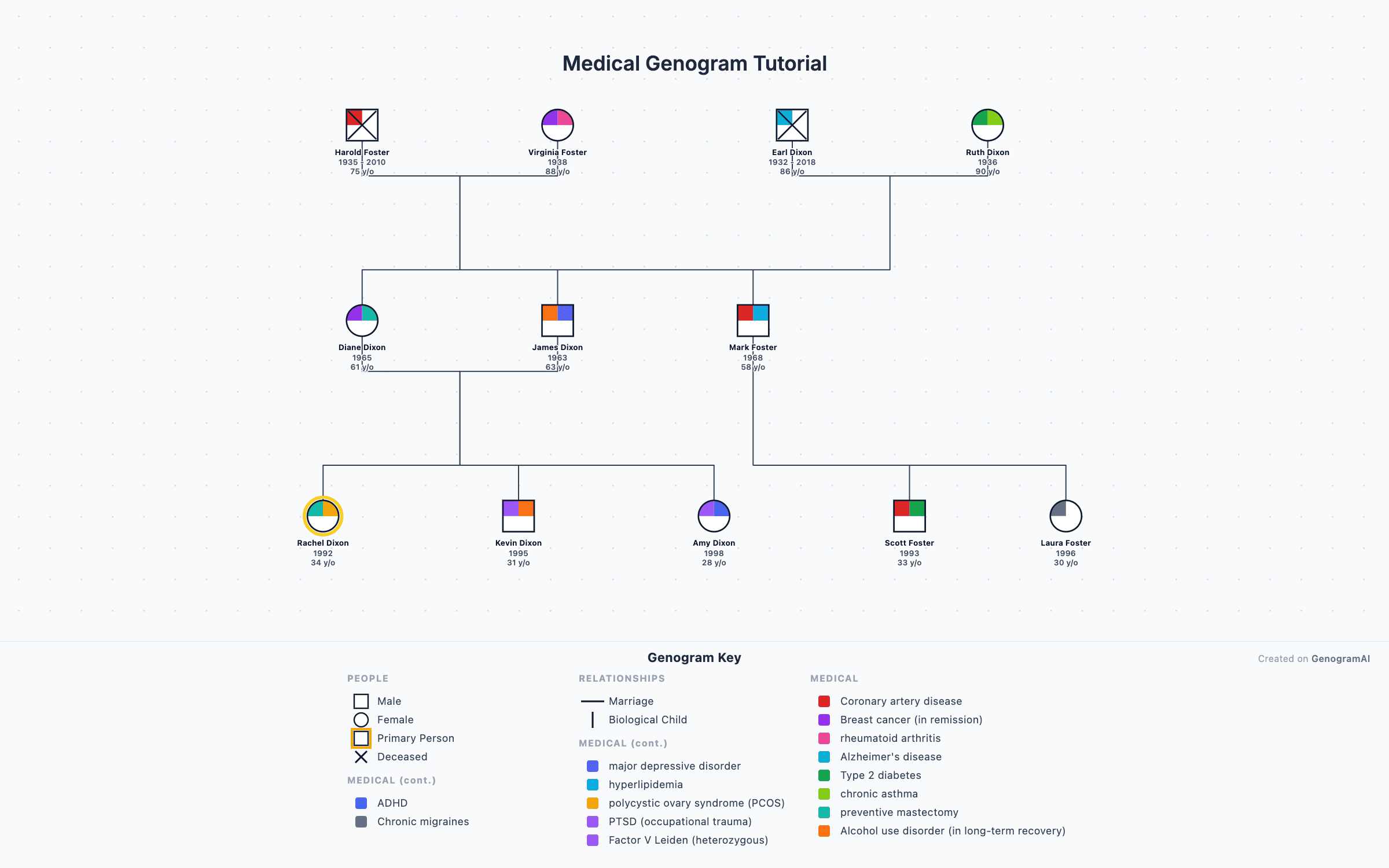
The medical example tracks 12 people across three generations with conditions coloured inside each symbol: cardiovascular disease in three relatives, cancer in two and diabetes in two, so the cardiovascular pattern down the family line stands out at a glance. For a four-generation version with a chronology, see the family-of-origin assignment example, or browse every example in the genogram examples gallery.
How to create a 3 generation genogram
- 1
Start with the index person
Add yourself or the main person in the bottom row (Generation 3), with brothers and sisters beside them, oldest on the left. Mark the index person with a double outline. This becomes the central reference point for your 3 generation genogram. - 2
Add parents (Generation 2)
Add the index person's mother and father in the row above. Connect them with a marriage line and drop a vertical line from it to each child. - 3
Add grandparents (Generation 1)
Add both sets of grandparents in the top row. Connect each set with marriage lines to their children (the parents). - 4
Add aunts, uncles and partners
Add the parents' brothers and sisters in the middle row next to them, and any divorces, remarriages or partners with their own line styles. - 5
Add dates, ages and deaths
Write birth years above each symbol and the current age inside it. Put an X through anyone who has died and note the year and cause of death. - 6
Add relationship details
Draw emotional relationship lines (close, distant, conflicted) and add health conditions, occupations, and other relevant information. - 7
Create your legend
Add a key explaining the symbols and colors used in your genogram for easy interpretation.
Faster: describe the family instead
GenogramAI turns a description like this into the three rows above, with symbols, ages and a legend. The free plan includes 2 genograms and 5 AI credits a month.
Free 3 generation genogram template
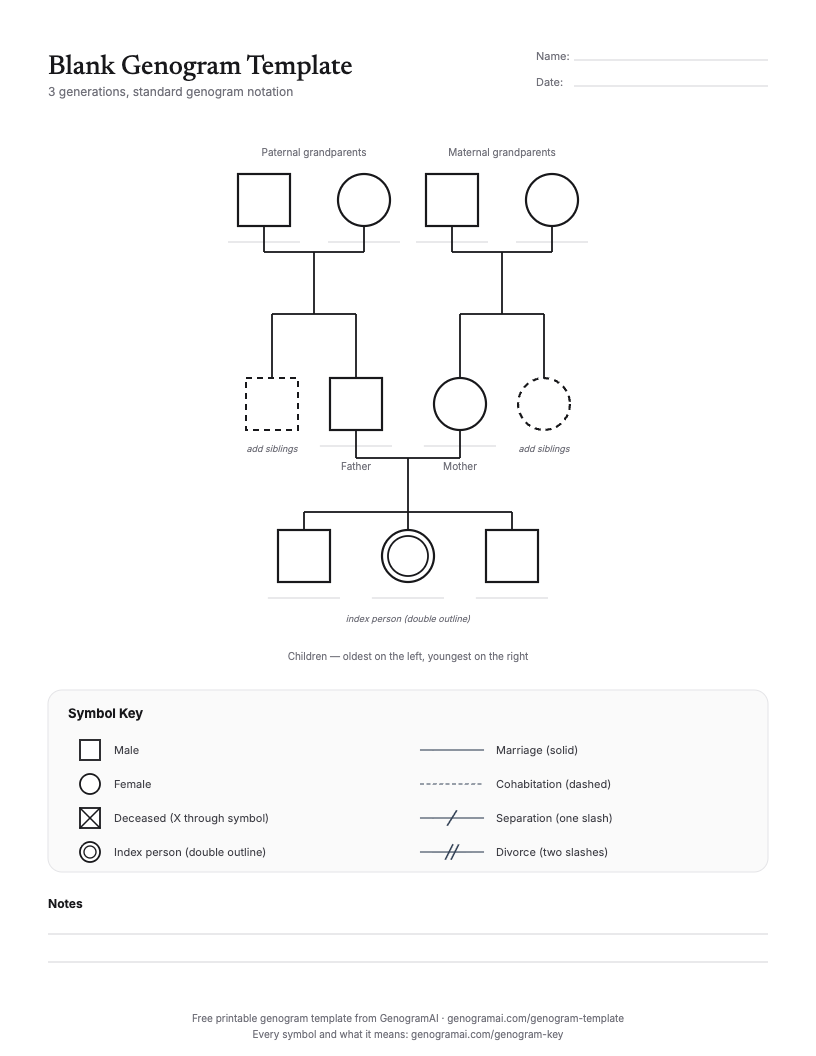
| Format | Best for | Download |
|---|---|---|
| Printing and filling in by hand | blank-3-generation-genogram-template.pdf | |
| PowerPoint (.pptx) | Editing in PowerPoint or Google Slides, or pasting into Word | blank-3-generation-genogram-template.pptx |
| SVG | Editing in a vector editor | blank-3-generation-genogram-template.svg |
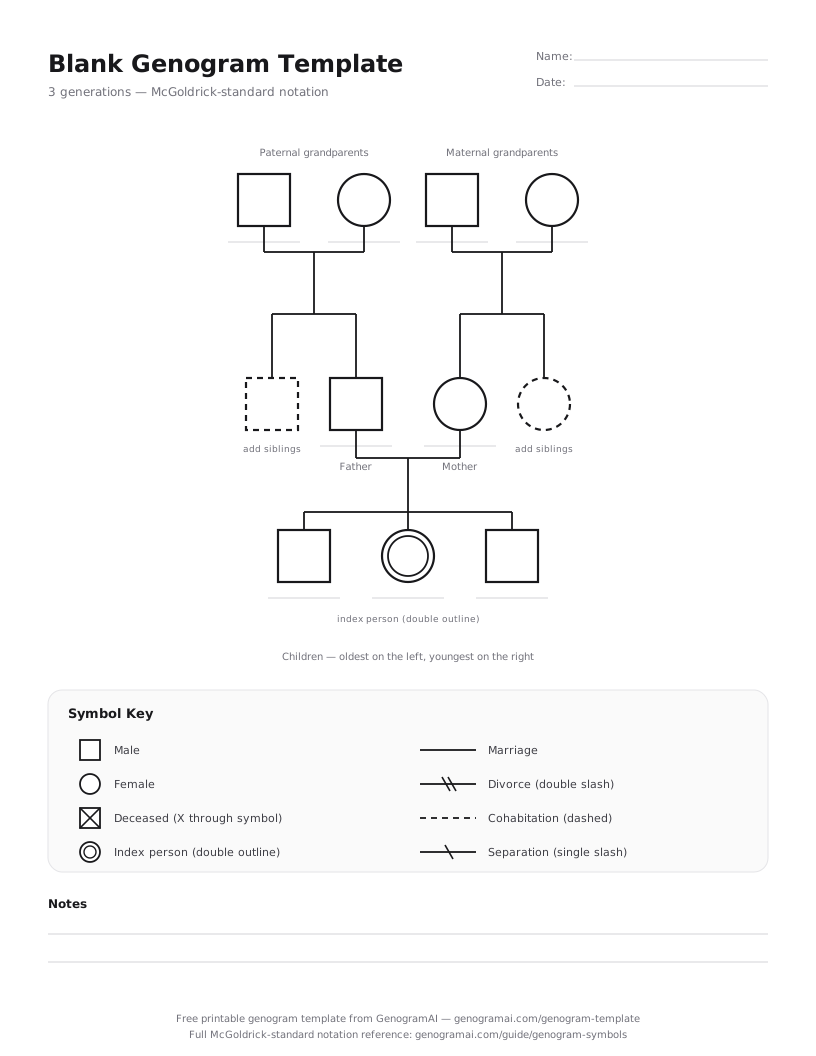
Need it in Word? Follow how to make a genogram in Word, or paste the PowerPoint shapes into a Word document. More starting points are on the genogram templates page.
3 generation genogram checklist for nursing assignments
| Requirement | What to show | Common mistake |
|---|---|---|
| Three generations | Grandparents, parents (with aunts and uncles), index person and siblings | Leaving out one side of the family |
| Standard symbols | Squares for males, circles for females, X for deceased | Using a family-tree layout with photos or boxes |
| Index person | Double or highlighted outline, or an arrow | Not marking who the genogram is about |
| Ages and dates | Birth year above, age inside each symbol; year of death | Ages that do not match the birth years |
| Cause of death | Written next to each deceased relative | Marking a death without the cause |
| Health conditions | Major conditions in each generation, coded consistently | Conditions listed in text but not on the chart |
| Relationship lines | Marriage, divorce, separation; emotional lines if asked | Divorce drawn as a broken line instead of two slashes |
| Legend | Every symbol and colour used on the chart | Missing key, or a key that lists symbols not used |
For the health side, see the medical genogram guide and the genogram guide for nursing students.
Who needs a 3 generation genogram?
Nursing students
Therapists and counselors
Psychology students
Families
In other languages
3 generation genogram FAQs
What is a 3 generation genogram?
A 3 generation genogram is a family diagram that shows three generations of a family: typically grandparents, parents, and the index person with their siblings (or parents, the individual, and their children). It's the standard minimum for most clinical and academic genogram assignments, providing enough depth to identify multigenerational patterns.
What is an example of a 3 generation genogram?
A simple example: the top row holds both sets of grandparents (one grandfather marked deceased with an X), the middle row holds the two parents and an uncle, and the bottom row holds the index person, drawn with a double or highlighted outline, and two brothers. Marriage lines join each couple and vertical lines drop to their children. Ages sit inside each symbol and birth years above it.
Why are 3 generations required for genograms?
Three generations is considered the minimum to identify meaningful family patterns. With only two generations, you can see direct relationships but miss recurring patterns. Three generations reveal patterns like inherited health conditions, relationship styles that repeat, occupational traditions, and behavioral patterns that span generations.
How do I create a 3 generation genogram?
Start with yourself or the index person in the bottom row, next to your siblings. Add your parents in the row above, then both sets of grandparents in the top row, and connect each couple to their children. Then add names, ages, deaths, health conditions, relationship lines and a legend. GenogramAI can generate a 3 generation genogram from a text description in seconds.
How many people are in a 3 generation genogram?
At minimum seven: four grandparents, two parents and the index person. Most real three-generation genograms have 10 to 20 people once siblings, aunts, uncles and partners are added. The two examples on this page have 10 people each.
What should be included in a 3 generation genogram for nursing school?
Nursing school 3 generation genograms typically require: names and ages, gender symbols (squares for males, circles for females), birth and death dates, major health conditions in each generation, relationship lines, and a legend explaining symbols used. Medical history across generations is especially important.
Is there a free 3 generation genogram template?
Yes. GenogramAI has a free blank three-generation genogram template as a printable PDF, an editable PowerPoint file (which also opens in Google Slides and can be pasted into Word) and an SVG. It has boxes for paternal and maternal grandparents, parents, siblings and the index person, plus a symbol key.
Can I extend a 3 generation genogram to more generations?
Yes! While 3 generations is the standard minimum, GenogramAI supports unlimited generations. You can easily add great-grandparents, great-grandchildren, or any additional family members to create 4, 5, or more generation genograms.