Community genogram · Shared by a GenogramAI user
Flor's Family Genogram
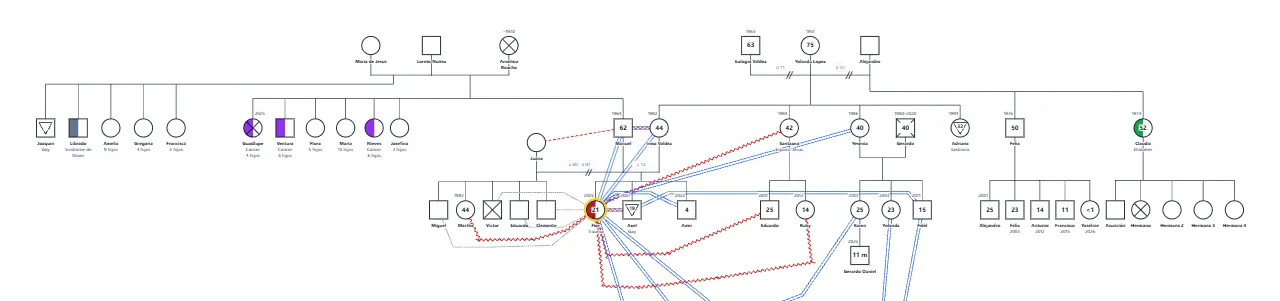
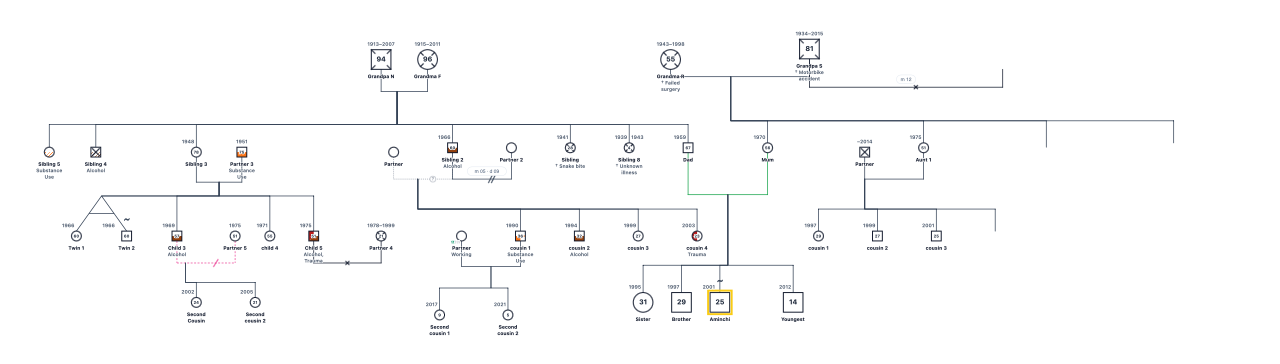
The Flor's Family Genogram maps 50 people across four generations. It records 5 deceased members and health history including cancer, trauma and diabetes. Relationship lines show close bonds, indifference and hostility, and the family structure includes divorce.
- 50 people
- 4 generations
- Cancer, trauma, diabetes
- Close bonds, indifference, hostility
What this genogram shows
- 50 family members across four generations.
- 7 partnerships, 3 of them ending in divorce or separation.
- 5 deceased people are marked with the deceased symbol.
- 5 people have recorded health conditions: cancer, trauma and diabetes.
- Emotional relationship lines: close bonds, indifference, hostility, close but hostile ties and emotional distance.
Symbols used
- Marriage
- A horizontal line joining two partners.
- Divorce / separation
- Slashes across the partner line: one for separation, two for divorce.
- Deceased
- An X drawn through the person symbol.
- Medical condition
- Filled or shaded segments inside the symbol mark recorded health conditions.
- Close relationship
- Parallel lines between two people with a warm, close bond.
- Conflict / hostility
- A red zigzag line for ongoing conflict or hostility.
See the full genogram symbols guide for every notation.
Generation by generation
Generation 1 (oldest)
The top row has 6 people (3 men and 3 women). 1 is marked deceased. The row contains 4 partnerships: 2 married and 2 divorced. Between them, 4 sets of parents have 18 children in the next row; the largest sibling group has 7.
Generation 2
The second row holds 20 people (6 men and 14 women). 2 of them have died, shown with an X. 2 partners marry in from outside the family. 3 couples are drawn here: 2 married and 1 divorced. 6 sets of parents account for 23 children one row down; the largest sibling group has 5.
Generation 3
There are 23 people on the third row (13 men and 10 women). The deceased symbol appears on 2 people here. 1 child descends from one set of parents here.
Generation 4 (youngest)
The bottom row has 1 person.
Emotional relationships
Beyond the family structure, the author drew 19 emotional lines touching 18 people: 8 close bonds, 4 hostile relationships, 4 indifferent relationships, 2 close but hostile relationships and 1 distant relationship. Of these, 15 stay within one generation and 4 cross between generations.
Health history
The author shaded medical history into 5 symbols, covering cancer (3 people), diabetes (1 person) and trauma (1 person). Each condition stays within a single generation here.
How to read this genogram
- Start at the top row: the 6 people of the oldest generation. Squares are males and circles are females; this chart has 23 squares and 27 circles.
- Follow the horizontal lines between partners. There are 7 partner lines, and 3 are crossed by slashes: one slash for a separation, two for a divorce.
- Trace the vertical lines that drop from each couple to their children. 42 people have parents drawn in this genogram.
- Look for an X through a symbol: it marks a person who has died. 5 people are marked that way here.
- Read the coloured or patterned lines last. They describe how people get along: two parallel lines for close bonds, a red zigzag for hostile relationships, a dotted line for indifferent relationships and parallel lines with a zigzag for close but hostile relationships.
- Finish at the bottom row, the youngest generation, with 1 person.
Start from this genogram
Open it in GenogramAI, make a copy, and edit the people, relationships and health history to fit your own family or case. Or describe a family in plain words and let the AI draw it.
Questions about this genogram
How many people and generations are in the Flor's Family Genogram?
It shows 50 people across four generations, from 6 people in the oldest row to 1 person in the youngest. It includes 7 couples, 3 of which ended in divorce or separation. 5 people are marked deceased.
What do the lines in this genogram mean?
Solid horizontal lines join partners, and vertical lines connect parents to children. The other lines are emotional relationship lines: 8 close bonds, 4 hostile relationships, 4 indifferent relationships and 2 close but hostile relationships. The genogram symbols guide on genogramai.com shows every line style.
Can I use this genogram as a template?
Yes. Choose "Use this template" to copy it into a free GenogramAI account, then replace the people and relationships with your own.
How do I make a genogram like this one?
Open the GenogramAI genogram maker and describe the family in plain words, for example how many generations, who is married or divorced, and who the children are. The AI draws it with the same notation, and you can edit every person and line afterwards. For a four-generation chart like this, start with the oldest couple and work down one row at a time.
More community genograms
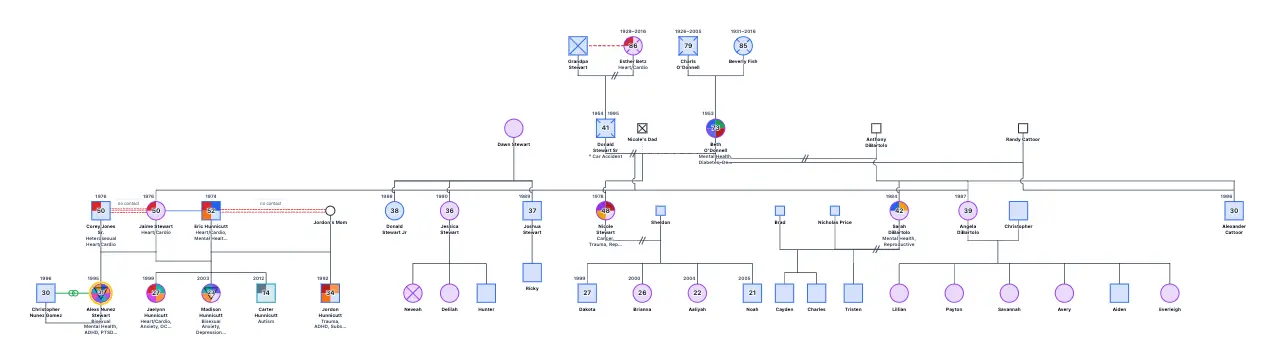
ANS Family Tree Genogram
48 people · 4 generations · Blended family, 5 divorces/separations
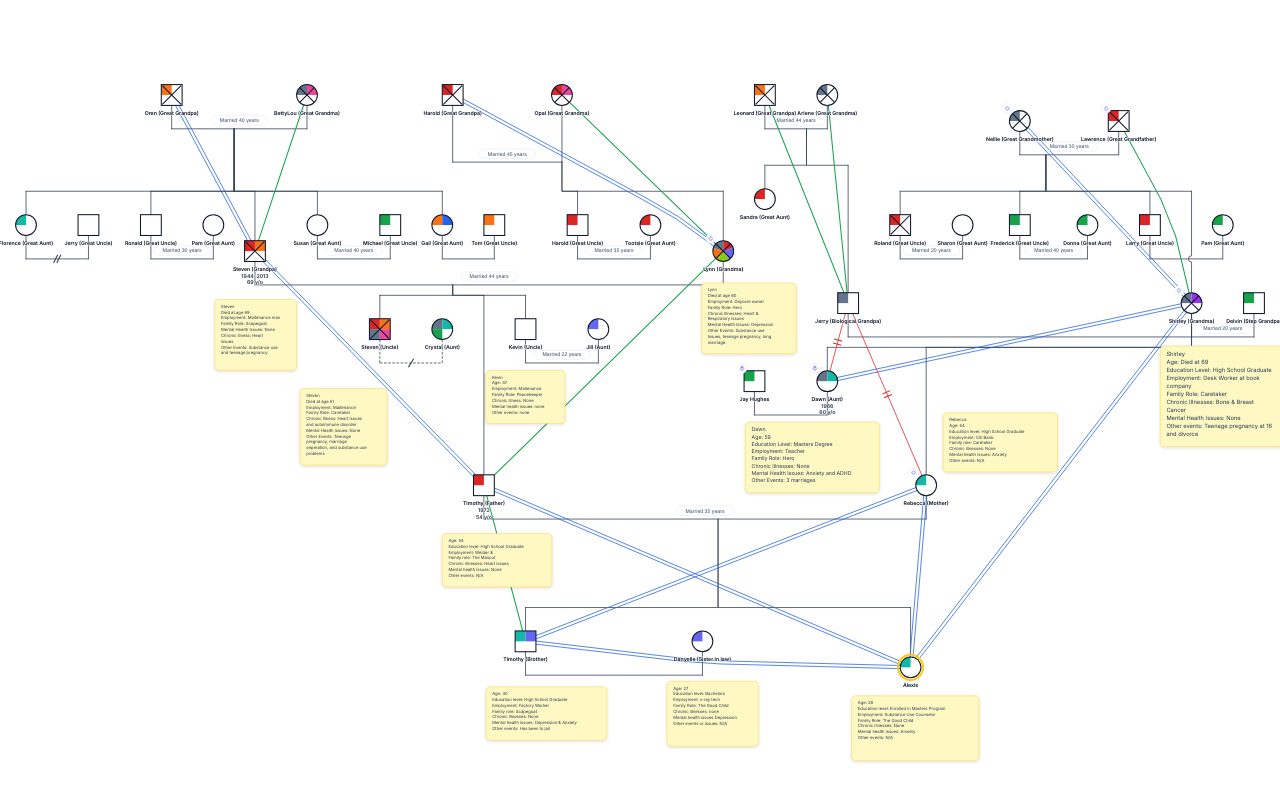
Alexis's Family Genogram
41 people · 4 generations · Blended family, 2 divorces/separations
Brooklyn Starr's Family Genogram
50 people · 5 generations · Blended family, 6 divorces/separations
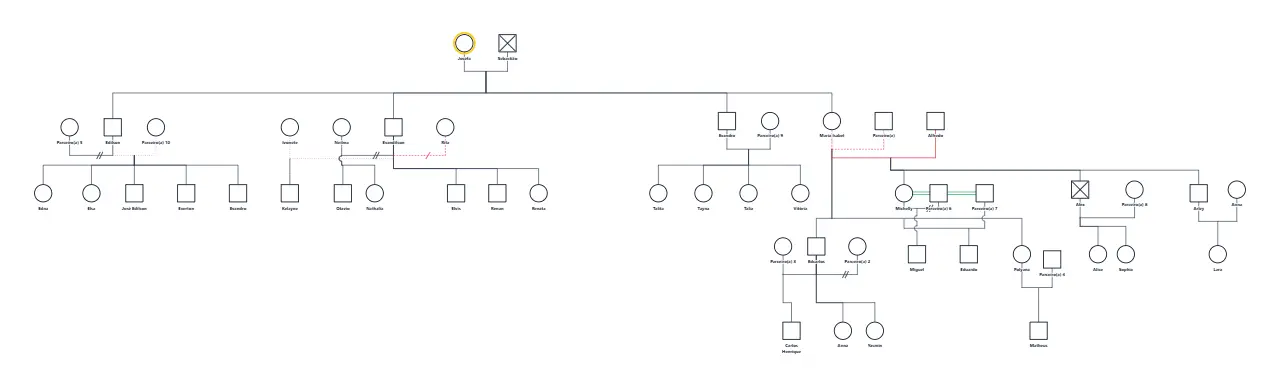
Joséfa's Family Genogram
50 people · 4 generations · Blended family, 5 divorces/separations
Adolfo Sánchez familia Genogram
50 people · 4 generations · Blended family, 4 divorces/separations
Aminchi's Family Genogram
50 people · 4 generations · Blended family, 2 divorces/separations
About community genograms: a GenogramAI user published this genogram to the community gallery and chose to feature it on genogramai.com. It is shown as an illustration of genogram notation, not a clinical record. The owner can remove it at any time.