For writers
Fictional family tree maker
Quick answer
What is a fictional family tree maker?
A fictional family tree maker lets writers map the families in a story — who is related to whom, which marriages produced which children, and where the alliances and feuds run — so the cast stays consistent across chapters, drafts, and sequels. Unlike a photo-centric genealogy app, a diagram-first tool draws character relationships as a clean chart you can change as the story does.
What does a finished tree look like?
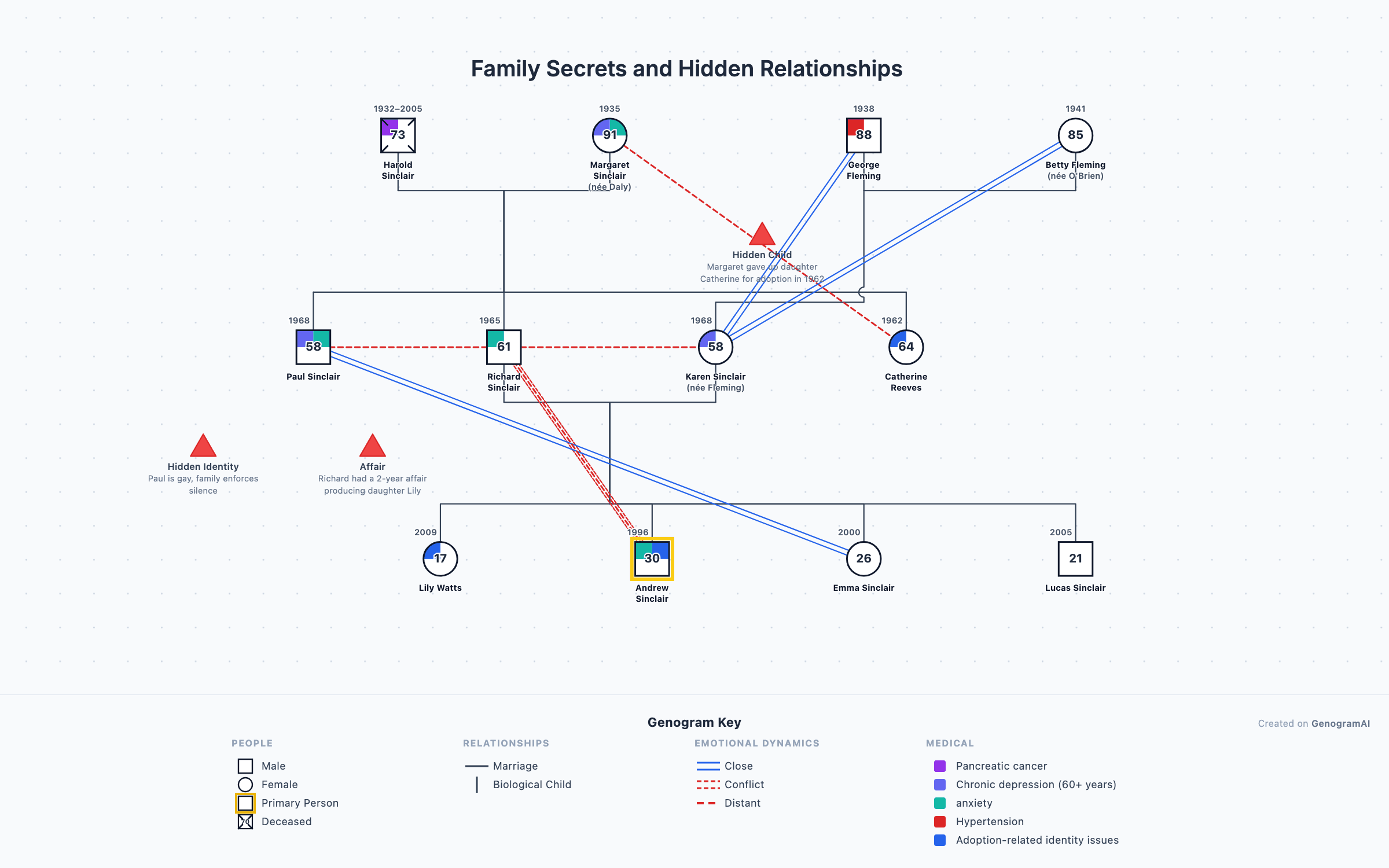
Can AI build the tree from my lore?
Sample prompt
Make a family tree for the Ashcombe family in my novel. Edmund Ashcombe (1931–1998) married Clara Vane in 1955. They had three children: Henry (1956), Margaret (1959) and Thomas (1962). Henry married Ruth Okafor; their children are Leo (1988) and Isla (1991). Thomas had an affair with Ruth, and Isla is secretly Thomas’s daughter. Margaret is estranged from Henry. Edmund and Thomas had a hostile relationship.
Paste a paragraph like this into Create with AI (paid plans) or Ask AI in the editor (any plan). The AI places three generations, the marriage, the affair and the estranged and hostile lines, and you edit anything it got wrong by hand or with a follow-up chat request.
Built for this kind of family
Relationship lines, not just descent
Revise as you draft
Describe it, AI draws it
Export for your story bible
How do I make a fictional family tree?
- 1
Start with your protagonist
Add your main character, then build outward — parents, siblings, spouses, children. Or paste a paragraph of backstory and let the AI draw the first draft. - 2
Layer the drama
Add the relationship lines that matter to the plot: conflict, closeness, cutoffs, affairs, secrets. - 3
Keep it beside your draft
Auto-saved in the cloud — check parentage and ages in two clicks while you write.
Relationship lines for fiction
| Line | Name | What it does in a story |
|---|---|---|
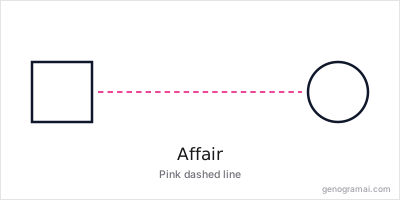 | Affair | The secret that explains a hidden child or a ruined marriage. |
 | Estranged | Siblings who stopped speaking before chapter one. |
 | Hostile | The father and son whose feud drives the plot. |
 | Close | The one ally a character can count on. |
 | Deceased | Who is already dead when the story opens, and who dies on the page. |
What is free, and what is paid?
| Free | Professional ($12/month) | |
|---|---|---|
| Trees (projects) | 2 | Up to 25 |
| AI builds and chat edits | 5 AI credits a month | Unlimited |
| Relationship types | All 64 | All 64 |
| Export | PNG | PNG, PDF, SVG, GEDCOM |
| Import a GEDCOM or other file | Not included | Included |
| Turn a photo of a hand-drawn tree into a chart | Not included | Included |
| Share | View-only link, embed code, PNG image | View-only link (optional password), embed code, PNG, PDF or SVG |
When Professional makes sense
Study a finished tree
Succession — the Roy family
Game of Thrones
Harry Potter
Star Wars — the Skywalkers
Frequently asked questions
What is the best way to make a fictional family tree?
Start from your protagonist and build outward one generation at a time, then add relationship lines (conflict, closeness, secrets) rather than only parent-child links — for fiction, the relationships are the plot. A diagram tool like GenogramAI keeps the chart clean as the cast grows and lets you revise instantly when the story changes.
Can I map spoilers like secret parentage?
Yes — that is exactly what relationship overlays are for. Draw the public family structure, then add the hidden parentage or affair as its own line. You can keep one "reader-known" tree and one "author-truth" tree as separate files (that uses both trees on the Free plan).
Is it free for writers?
Yes, to start. The Free plan includes 2 trees, 5 AI credits a month (enough to have the AI draw a tree from a paragraph of backstory), all 64 relationship types and PNG export, with no card. Professional ($12/month) adds up to 25 projects, unlimited AI and PDF/SVG export, which helps if you are mapping a whole series.
Can I make trees for an existing series or fandom?
Yes — many users map published works to study structure (see the Succession, Game of Thrones, and Harry Potter examples). For fan fiction, map canon first, then branch your AU from it in a copy.