Genogram example · Cultural
African American Multi-Generational Family
Quick answer
At a glance
| This example | |
|---|---|
| Generations | 3 |
| Family members | 12 (6 male, 6 female) |
| Birth years | 1926 to 1988 |
| Deceased | 3 |
| Index person | Marcus Washington |
| Emotional relationships | Close |
| Conditions marked | Anxiety Conditions, Depressive Disorders, Cardiovascular Conditions, Cancer, Diabetes and Respiratory Conditions |
| Category | Cultural |
| Tags | Cultural, Family Structure, Educational |
About this genogram
A three-generation African American family genogram tracing roots from the rural South through the Great Migration to Chicago. Demonstrates strong extended family bonds, church as a central institution, educational advancement across generations, and the enduring impact of systemic racism and civil rights activism on family identity.
Family analysis
Overview
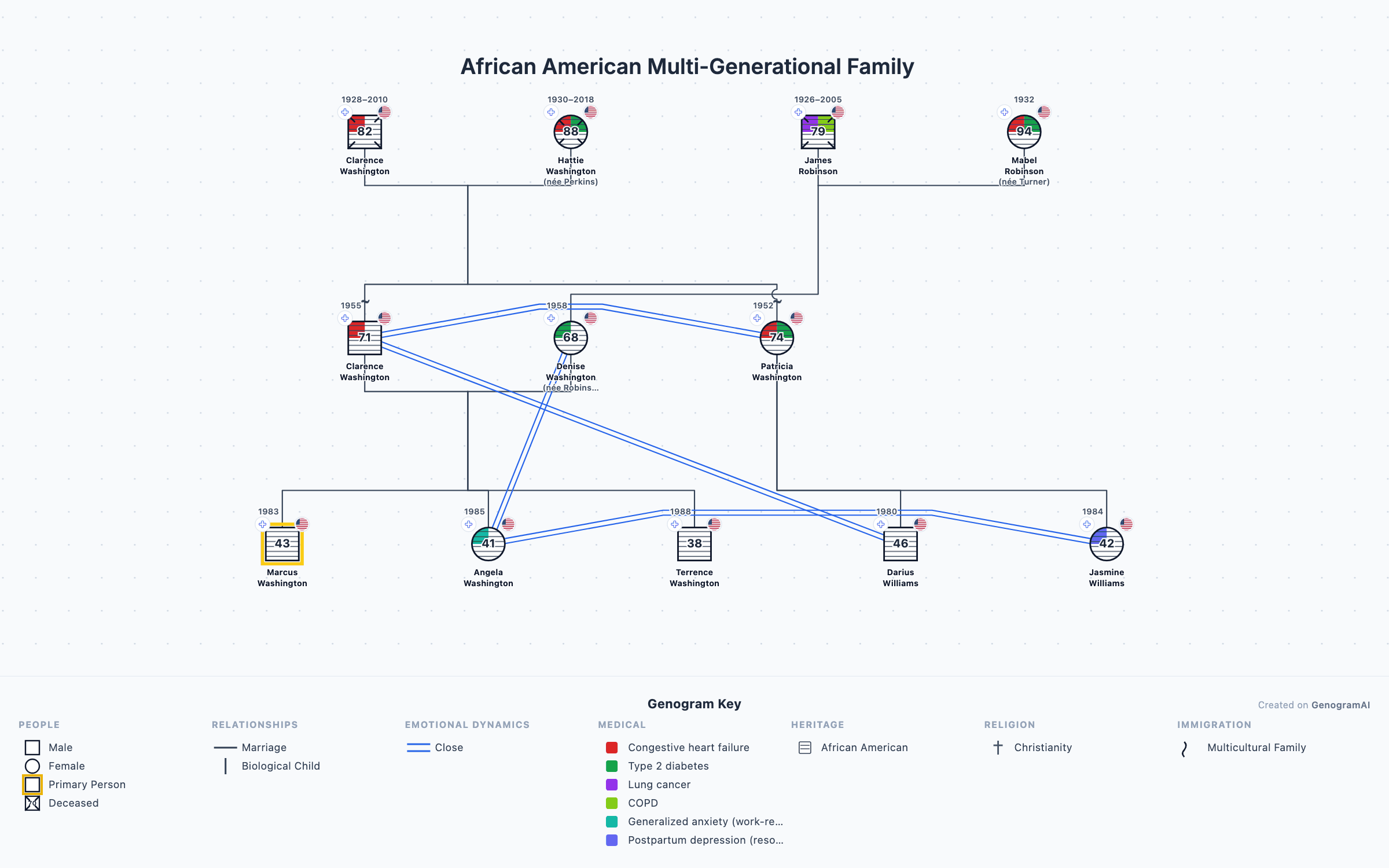
This 3-generation genogram maps 12 family members with birth years spanning from 1926 to 1988, comprising 6 males and 6 females (3 deceased). The genogram tracks 6 medical/psychological condition categories and 1 emotional relationship type across 4 documented dyads. The index patient is Marcus Washington (b. 1983), high school principal.
Cultural context
This culturally-informed genogram captures family dynamics across 3 generations, representing African American heritage. Occupational roles across generations — Clarence as sharecropper, then steel mill worker, Hattie as domestic worker, then hospital aide, James as pullman porter, then post office clerk, Mabel as retired school cafeteria worker — illustrate the family's socioeconomic trajectory.
Emotional relationships
Emotional relationship mapping reveals 4 close relationships. Specific patterns include a close relationship between Clarence and Patricia, a close relationship between Denise and Angela, a close relationship between Clarence and Darius.
Health conditions
Medical and psychological conditions are documented in 9 of 12 family members (75%). Cardiovascular conditions appear in 5 members (Clarence, Hattie, Mabel...), affecting 3 females and 2 males. Diabetes appear in 4 members (Hattie, Mabel, Denise...). Cancer diagnoses appears in 1 member (James). Comorbidity is observed in 4 family members, with Hattie presenting 2 concurrent condition categories. The multigenerational prevalence of cardiovascular conditions suggests both genetic predisposition and possible environmental or behavioral transmission pathways.
This genogram demonstrates the importance of culturally-informed clinical practice. The African American cultural context shapes family expectations, gender roles, and help-seeking behaviors in ways that must be understood before clinical interpretation. Cultural genograms help practitioners avoid ethnocentric assumptions and recognize how migration, acculturation, and cultural identity intersect with family dynamics and psychological well-being.
How do you read the African American Multi-Generational Family genogram?
- 1
Find each person and generation
Squares are males and circles are females, and each row is one generation, oldest at the top. This one has 6 males and 6 females across 3 generations. - 2
Check the status markers
Markers on a symbol add facts about that person: Deceased (X) and Index Patient (Arrow). 3 people are marked deceased. The index person, the focus of the assessment, is Marcus Washington. - 3
Follow the family lines
Horizontal lines join partners and vertical lines drop to their children, born left to right in birth order. This genogram uses Marriage and Parent-Child lines. - 4
Read the emotional lines
Lines drawn between two people show how they relate: Close. Notice who has several lines converging on them, and which patterns repeat from one generation to the next. - 5
Read the shading
Shaded symbols mark health conditions: Anxiety Conditions, Depressive Disorders, Cardiovascular Conditions, Cancer, Diabetes and Respiratory Conditions. Trace each line of descent to see where a condition recurs and where it stops.
Genogram symbols used in this example
| Symbol | Type | What it means |
|---|---|---|
| Male (Square) | Person Symbols | A square represents a male family member in standard genogram notation. |
| Female (Circle) | Person Symbols | A circle represents a female family member in standard genogram notation. |
| Deceased (X) | Status Markers | An X drawn through the symbol indicates the person is deceased. |
| Index Patient (Arrow) | Status Markers | An arrow pointing to a person identifies them as the index patient — the individual who is the focus of the clinical assessment. |
| Marriage | Structural Relationships | A solid horizontal line connecting two individuals represents a marriage or committed partnership. |
| Parent-Child | Structural Relationships | A vertical line descending from a couple line to a child symbol represents a parent-child relationship. |
| Close | Emotional Relationships | Two parallel lines between individuals represent an emotionally close relationship. |
| Anxiety Conditions | Medical Conditions | Shading in the genogram symbol indicates anxiety-spectrum diagnoses (GAD, panic disorder, phobias, OCD). |
| Depressive Disorders | Medical Conditions | Shading indicates depressive conditions (major depression, dysthymia, bipolar disorder). |
| Cardiovascular Conditions | Medical Conditions | Shading indicates heart disease, hypertension, stroke, or other cardiovascular conditions. |
| Cancer | Medical Conditions | Shading indicates any cancer diagnosis, with specifics noted in the individual's record. |
| Diabetes | Medical Conditions | Shading indicates Type 1 or Type 2 diabetes. |
| Respiratory Conditions | Medical Conditions | Shading indicates chronic respiratory conditions (asthma, COPD, etc.). |
Build a genogram like this one
Example prompt
- 1
Start from the dashboard
Sign in to GenogramAI and choose Create with AI (paid plans), or open a blank genogram and use Ask AI (any plan). To start from this exact chart instead, use Open as template. - 2
Describe your family
Paste a description like the one above, with your own names, dates, relationships and health history. - 3
Check and adjust
Edit people and lines by hand, or ask the AI for one change at a time. - 4
Export
Download a PNG on the free plan. PDF and SVG export are on paid plans.
The free plan includes 2 genograms and 5 AI credits a month. See the AI genogram creator for what else it can do.
Related resources
- Explore our guide to cultural genograms for mapping heritage and cultural context.
- See how genograms in social work practice incorporates cultural assessment.
- This example uses the close relationship symbol to denote emotional closeness between family members.
- The deceased symbol (X through the shape) marks family members who have passed away.
Frequently asked questions
What clinical patterns does the African American Multi-Generational Family genogram reveal?
The African American Multi-Generational Family genogram maps multigenerational transmission of psychological patterns, emotional dynamics, and relationship structures. Clinicians use it to identify recurring cycles of behavior, attachment styles, and communication patterns that may inform diagnosis and treatment planning in family therapy.
What cultural factors does the African American Multi-Generational genogram highlight?
The African American Multi-Generational genogram highlights culturally specific family structures, values, and intergenerational dynamics. It demonstrates how cultural context influences family roles, relationships, and expectations across generations.
What genogram symbols are used in the African American Multi-Generational Family example?
This genogram uses Male (Square), Female (Circle), Deceased (X), Index Patient (Arrow), Marriage, Parent-Child, Close, Anxiety Conditions, Depressive Disorders, Cardiovascular Conditions, Cancer, Diabetes and 1 more. All of them follow standard genogram notation, so the chart reads the same way in any genogram program or textbook.
Can I build a genogram like the African American Multi-Generational Family example?
Yes. Open GenogramAI, choose Create with AI on the dashboard (paid plans) or open a blank genogram and use Ask AI in the editor (any plan), and describe the family in plain words: who is in it, how they are related, key dates and the relationships or health conditions you want to show. The AI draws the symbols and lines, and you can then edit by hand or ask for one change at a time. A family of 12 people like this one takes a short paragraph to describe. The free plan includes 2 genograms and 5 AI credits a month, with PNG export.
About this example