Elder Care Caregiving Dynamics
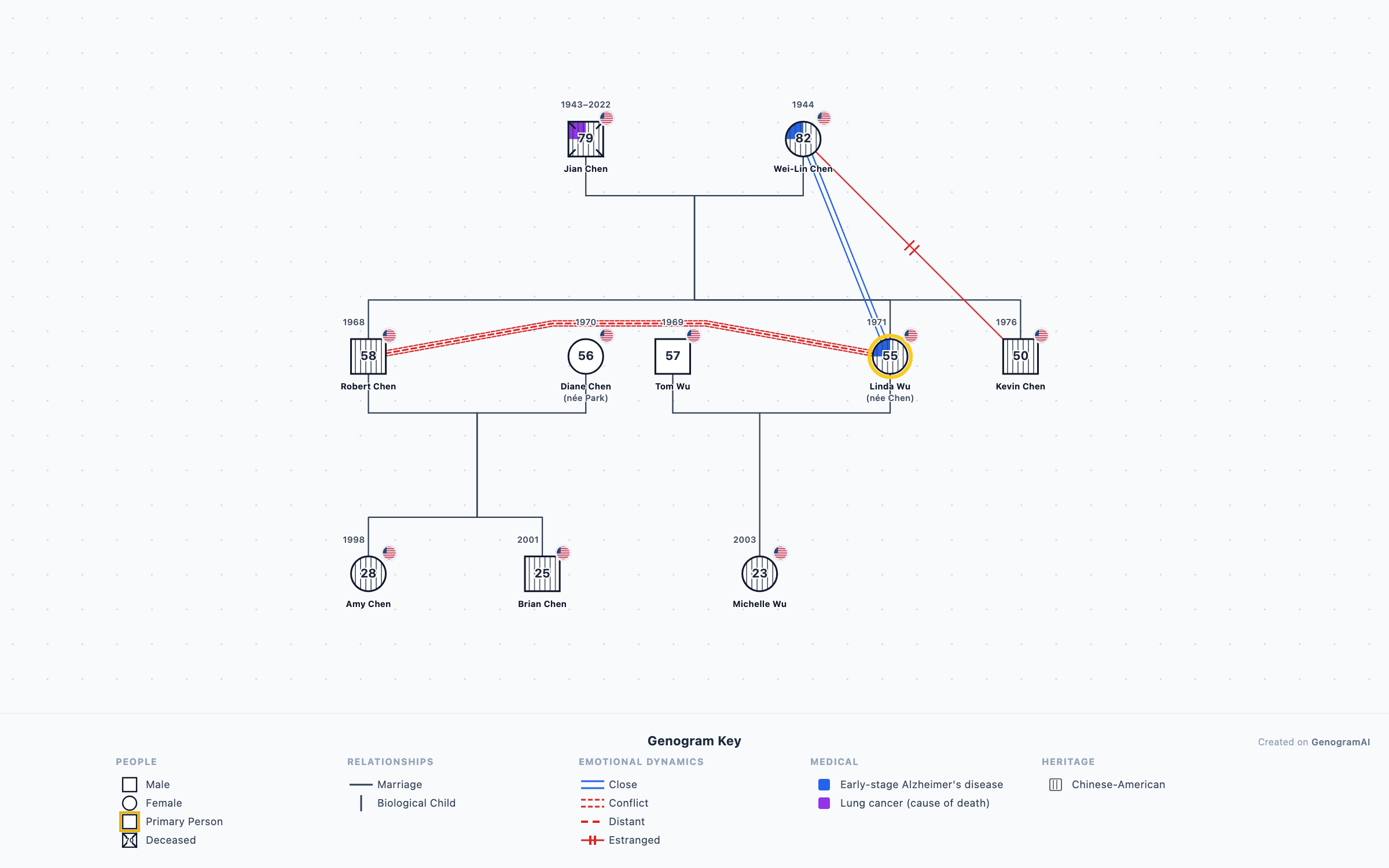
A 3-generation Chinese-American family genogram centered on an 82-year-old grandmother with early Alzheimer's disease.
Interactive Elder Care Caregiving Dynamics
Click and drag to explore. Zoom with scroll.
Can't see the genogram? View in the GenogramAI Gallery
About This Genogram
A 3-generation Chinese-American family genogram centered on an 82-year-old grandmother with early Alzheimer's disease, mapping the complex caregiving dynamics among three adult siblings. Explores cultural expectations about filial piety, caregiver burnout, sibling resentment, inheritance anxiety, and how dementia reshapes the entire family power structure.
How to Read This Genogram
Standard genogram notation follows the conventions established by McGoldrick, Gerson, and Petry, which are widely adopted across social work, marriage and family therapy, psychology, and medicine. Squares represent male-identified individuals, circles represent female-identified individuals, and an X through either symbol indicates the person is deceased. Horizontal lines connect partners, with a single slash for separation and a double slash for divorce. Vertical and diagonal lines descend to children, who are arranged in birth order from left to right within a generation. A three-generation diagram is the minimum recommended for clinical use because it provides enough generational depth to identify repeating patterns.
Clinical applications range from intake assessment to treatment planning and outcome review. In a first session, a clinician sketching a genogram with a client gathers structural and historical data while simultaneously building rapport through collaborative storytelling. The resulting diagram then guides the clinician toward hypotheses about symptom function, family roles, and relational resources available to the client. In subsequent sessions the genogram can be updated as new information surfaces, and tracking those additions over time often reveals how the client's understanding of their own family history shifts in parallel with therapeutic progress.
Key Patterns in This Genogram
Family Structure
How this family structure is represented using standard genogram notation.
Relationship Patterns
Key relationship dynamics and emotional bonds within the family system.
Clinical Application
How professionals use this type of genogram in assessment and treatment.
Family Analysis
This 3-generation genogram maps 14 members of the Chen family, centering on the caregiving crisis precipitated by the Alzheimer's diagnosis of the family matriarch, Mei-Ling Chen (b. 1944). The index patient is Linda Chen-Morrison (b. 1970), the eldest daughter and primary caregiver, who presents with insomnia, weight loss, chronic back pain, and escalating conflict with her siblings over caregiving responsibilities. The genogram reveals that Mei-Ling's cognitive decline has not simply created a medical challenge but has fundamentally destabilized a family system that was organized around her authority for over four decades. As the matriarch's capacity diminishes, the family structure built around her centrality is collapsing, and no one has been prepared to assume her role.
The caregiving burden distribution in the Chen family follows a pattern that geriatric family therapists will recognize as both culturally inflected and structurally predictable. Linda, who lives 15 minutes from her mother's home, provides daily hands-on care: bathing, medication management, meal preparation, medical appointment coordination, and the emotionally grueling work of managing confusion, agitation, and the grief of watching her mother disappear. Her brother Michael (b. 1967), a surgeon in another city, contributes financially but visits only quarterly, and his visits are characterized by criticism of Linda's care decisions — particularly her reluctance to move their mother to a memory care facility. Jennifer (b. 1975), the youngest, has effectively withdrawn, citing her own family obligations and geographic distance. The genogram reveals that this caregiving distribution mirrors the family's pre-existing emotional structure: Linda was always the responsible, self-sacrificing child; Michael was the high-achieving, emotionally detached one; Jennifer was the baby who was never expected to carry adult burdens.
The cultural dimension of this caregiving crisis cannot be separated from its clinical presentation. Mei-Ling emigrated from Taiwan in 1972 and raised her children with a clear cultural framework: children owe their parents care in old age, the eldest son bears primary filial responsibility, and placing a parent in institutional care is a source of family shame. The genogram shows that Michael's failure to fulfill the eldest-son caregiving role creates a cultural rupture that the family cannot openly discuss. Linda has assumed the role by default, but she carries resentment that her sacrifice is neither culturally honored (because she is a daughter, not a son) nor practically supported by her siblings. Meanwhile, Michael has resolved his cultural guilt through financial generosity and by advocating for professional care — reframing institutionalization as 'better medical support' rather than filial failure. Jennifer, the most acculturated sibling, has largely rejected the filial piety framework but feels guilty about her rejection, leading to avoidant behavior that her siblings interpret as abandonment.
The genogram also maps the impact of Mei-Ling's decline on the third generation. Linda's two teenage children have lost significant maternal attention as their mother's caregiving duties have expanded, and they show early signs of their own caretaking behavior — the 16-year-old daughter has begun staying with her grandmother after school so her mother can rest, replicating the parentification pattern. Michael's children, insulated by distance, have a sanitized understanding of their grandmother's condition and experience family visits as uncomfortable obligations. The intergenerational transmission of caregiving roles is already visible: Linda's daughter is being shaped into the next generation's responsible caretaker, while Michael's children are learning emotional distance as a coping strategy. Without intervention, these patterns will repeat when Linda and Michael themselves age.
Clinical work with the Chen family requires navigating the intersection of systemic family therapy, culturally responsive practice, and geriatric care coordination. The therapist must create a space where caregiving inequity can be named without triggering shame or cultural betrayal narratives. A family conference — facilitated by a clinician who understands both Bowen systems theory and Chinese-American cultural values — can help redistribute caregiving responsibilities in a way that honors filial piety without destroying Linda's health. Specific interventions include: establishing a rotating respite schedule, connecting Michael's financial contributions to concrete care services rather than abstract guilt management, re-engaging Jennifer through defined and boundaried contributions, and beginning the family conversation about eventual memory care placement with cultural sensitivity. The genogram itself serves as the therapeutic tool: when the family can see the caregiving imbalance mapped visually, it becomes harder to maintain the fiction that the current arrangement is sustainable or fair.
Build a Similar Genogram
A practitioner documenting a family similar to this one would typically record three generations of household composition, significant life events such as births, deaths, marriages, and separations, any relevant medical or mental health history, and the quality of key relationships between members. That information comes from a combination of the client's verbal account, intake questionnaires, and, where available, collateral records. The completed diagram captures both the factual structure of the family and the practitioner's clinical observations about relational patterns, making it a reference that can be shared across disciplines or reviewed at future stages of treatment.
GenogramAI's AI genogram generator allows you to build a diagram like this one from a plain-language description of the family. You type or paste a narrative, such as the basic structure and any key relationships or health history you want to include, and the AI parses that text, places the correct symbols, draws the appropriate relationship lines, and arranges the layout automatically. The result is a fully editable diagram that you can refine, annotate, and export for clinical records or educational use. Try the AI genogram creator to generate your own genogram from a text description in seconds.
Genogram Symbols Used in This Example
The following standard genogram symbols appear in the Elder Care Caregiving Dynamics. Each symbol follows McGoldrick and Gerson clinical notation conventions.
Person Symbols
- Male (Square)
- A square represents a male family member in standard genogram notation.
- Female (Circle)
- A circle represents a female family member in standard genogram notation.
Status Markers
- Deceased (X)
- An X drawn through the symbol indicates the person is deceased.
- Index Patient (Arrow)
- An arrow pointing to a person identifies them as the index patient — the individual who is the focus of the clinical assessment.
Structural Relationships
- Marriage
- A solid horizontal line connecting two individuals represents a marriage or committed partnership.
- Divorce
- A horizontal line with two diagonal slashes represents a divorced relationship.
- Parent-Child
- A vertical line descending from a couple line to a child symbol represents a parent-child relationship.
Emotional Relationships
- Close
- Two parallel lines between individuals represent an emotionally close relationship.
- Enmeshed
- Three parallel lines indicate a fused or enmeshed relationship with poor boundary differentiation.
- Distant
- A dotted line represents an emotionally distant or disengaged relationship.
- Conflict
- A zigzag line between individuals represents an openly conflictual relationship.
Medical Conditions
- Alzheimer's/Dementia
- Shading indicates Alzheimer's disease or other neurodegenerative cognitive conditions.
- Anxiety Conditions
- Shading in the genogram symbol indicates anxiety-spectrum diagnoses.
- Cardiovascular Conditions
- Shading indicates heart disease, hypertension, or other cardiovascular conditions.
Related Resources
- Learn how genograms in social work professionals use genograms to coordinate elder care planning.
- Explore how cultural genograms capture the influence of filial piety and cultural caregiving expectations.
- This example uses the enmeshed relationship symbol to indicate the fused caregiver-patient dynamic.
- The distant relationship symbol marks siblings who have disengaged from caregiving responsibilities.
Frequently Asked Questions
How does a genogram help clinicians understand caregiving dynamics in families dealing with Alzheimer's disease?
What role does filial piety play in the Chen family's caregiving genogram?
How does dementia change the family power structure as shown in this genogram?
What clinical interventions does this genogram suggest for families managing elder care?
Related Genogram Examples
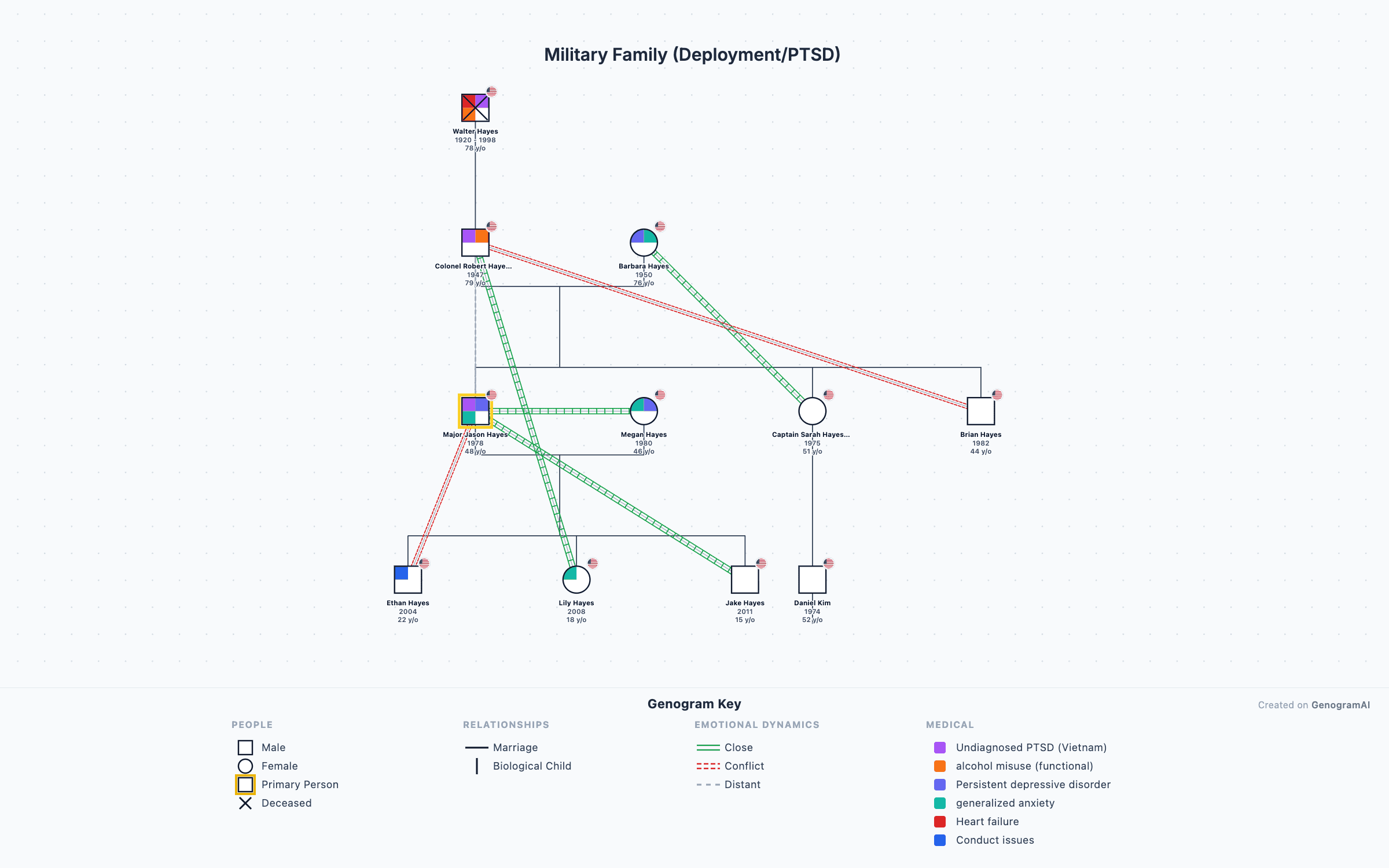
Military Family (Deployment/PTSD)
A multi-generational military family genogram illustrating the cumulative effects of combat deployment across three generations: Vietnam, Iraq, and Afghanistan.
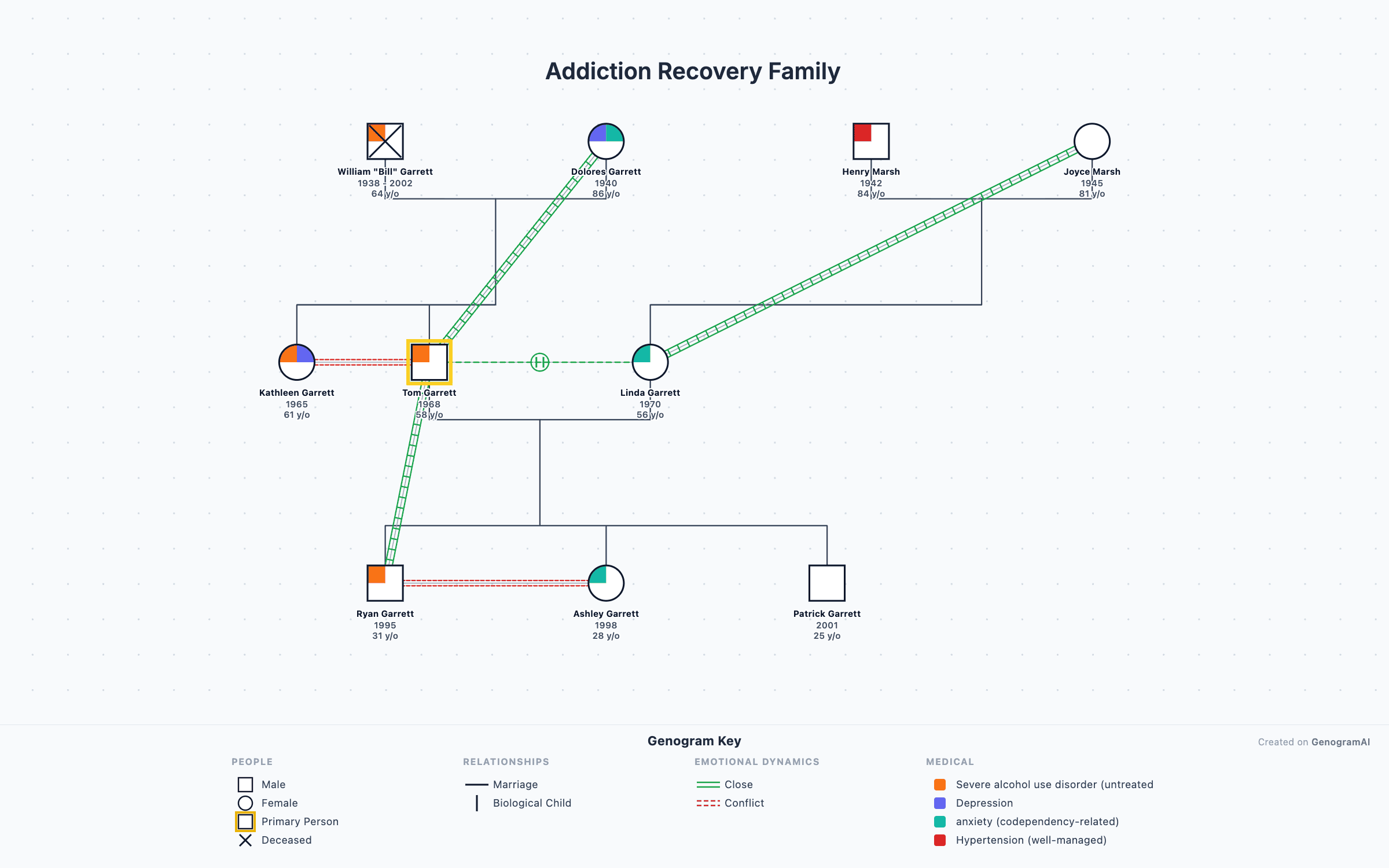
Addiction Recovery Family
A family genogram illustrating multiple generations of addiction and recovery, showing the full spectrum from active addiction to long-term sobriety.
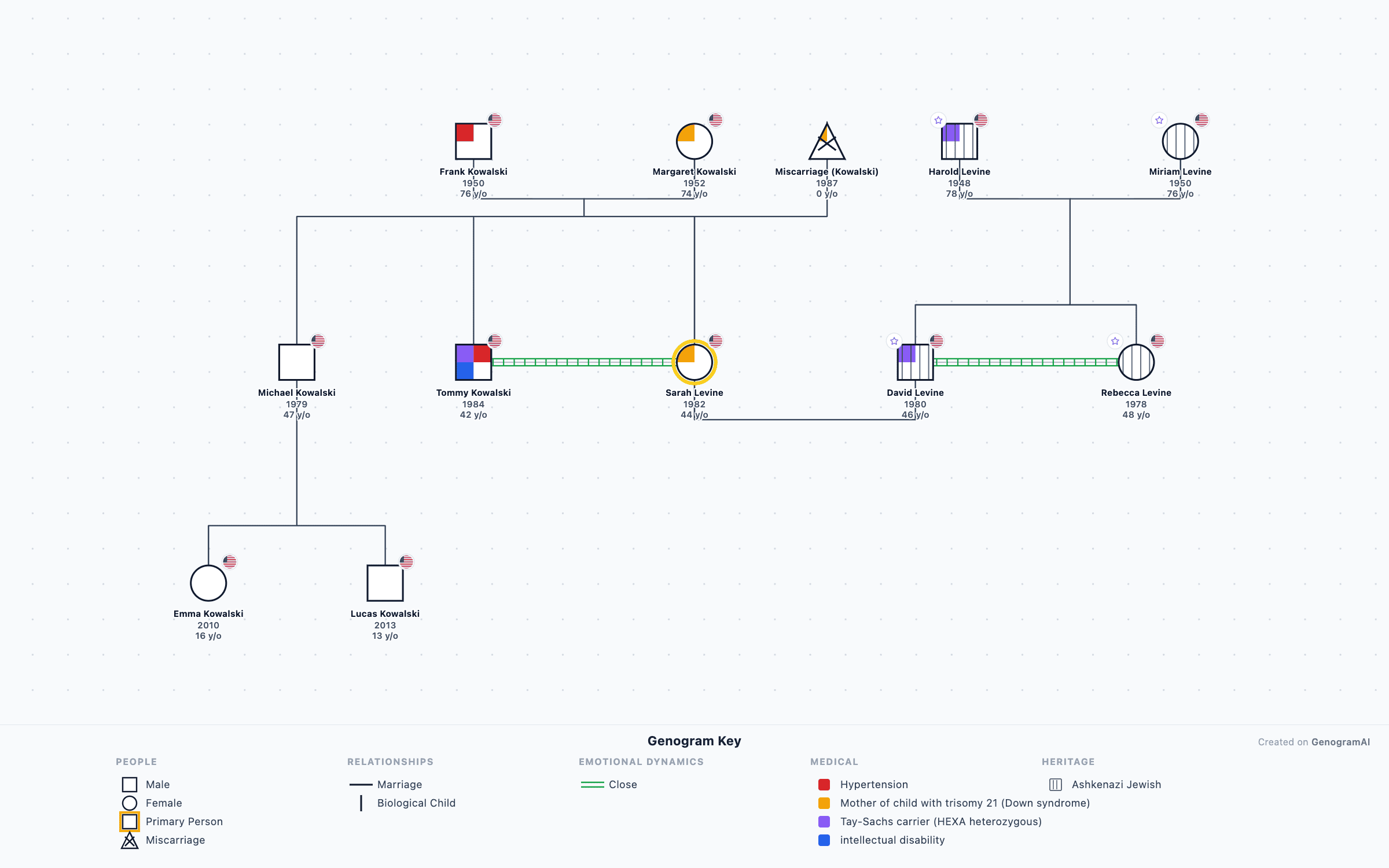
Genetic Counseling Genogram
A genetic counseling genogram for a couple seeking pre-conception genetic counseling.
Create Your Own Genogram
Use GenogramAI to build your own family genogram with AI assistance. Describe your family and let AI do the rest.
Educational disclaimer: This genogram example is an educational illustration of genogram notation and family systems concepts. Examples based on public figures use publicly available information. They are not clinical documents. All examples are intended for learning genogram symbols and patterns.