Emotional Cutoff and Reconciliation
A 3-generation genogram mapping patterns of emotional cutoff and attempted reconciliation across a family system.
Interactive Emotional Cutoff and Reconciliation
Click and drag to explore. Zoom with scroll.
Can't see the genogram? View in the GenogramAI Gallery
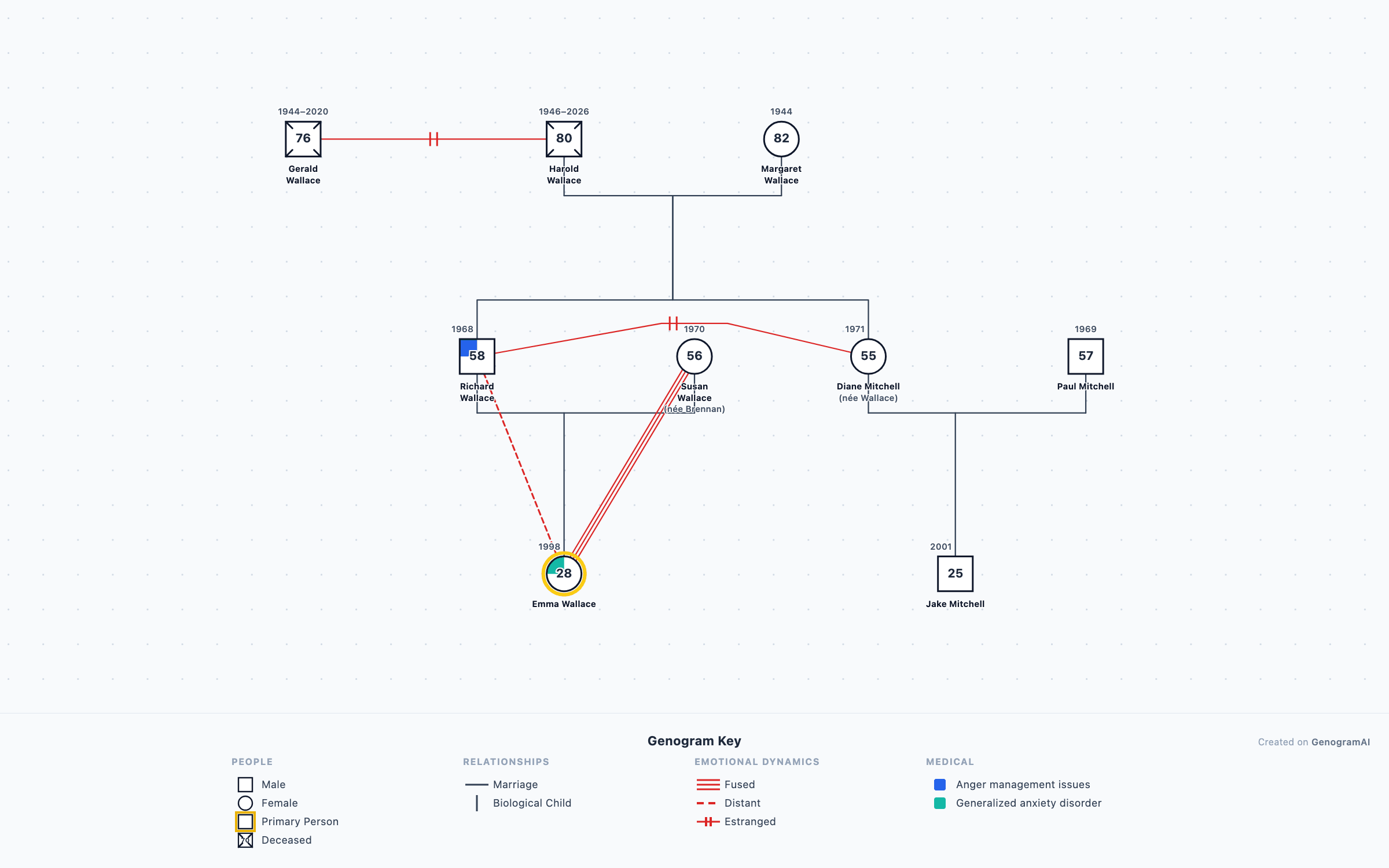
About This Genogram
A 3-generation genogram mapping patterns of emotional cutoff and attempted reconciliation across a family system. Illustrates how estrangement, silent treatment, and relationship severing in one generation create anxiety about abandonment and enmeshment in the next, with the presenting client caught between fusion and flight.
How to Read This Genogram
An emotional or relational genogram adds a second layer of notation on top of structural lines to indicate the quality of relationships between family members. Clinicians following McGoldrick and Gerson conventions use distinct line styles: a thick unbroken line for a close relationship, a wavy line for a conflictual one, parallel lines for enmeshment, a dashed line for distance, and a broken line with a gap for cutoff. These relationship lines are drawn between pairs of individuals anywhere on the diagram, not only between couples, so sibling rivalries, parent-child enmeshment, and grandparent-grandchild bonds all become visible on the same map.
Reading this type of genogram clinically means identifying clusters of relationship quality rather than looking at individual pairs in isolation. A family where most lines converge on one central person often signals a focal triangle or an emotionally overloaded family member whose symptoms may be partly systemic in origin. A pattern of multiple cutoffs across generations points toward a family culture that resolves conflict through emotional distance rather than negotiation. Therapists use these patterns to form early hypotheses about what the family will need in treatment and which relationships may serve as resources or as barriers when change begins.
Key Patterns in This Genogram
Emotional Patterns
Recurring patterns of emotional connection, distance, and conflict in the family.
Relationship Lines
How genogram notation captures the quality and nature of family relationships.
Therapeutic Insight
How visualizing emotional patterns helps in clinical assessment and treatment planning.
Pattern Analysis
This 3-generation genogram maps 15 members of the Wallace family, revealing a pervasive pattern of emotional cutoff that has left the family fragmented across geographic, relational, and emotional dimensions. The index patient is Sarah Wallace (b. 1988), a 37-year-old marketing professional who presents with relationship anxiety, difficulty maintaining close friendships, and a recent estrangement from her younger brother that triggered a depressive episode. The genogram reveals that Sarah is not simply experiencing a sibling conflict — she is enacting a multigenerational script in which relationships are experienced as all-or-nothing: either enmeshed closeness or total severance, with no sustainable middle ground. The family's emotional repertoire lacks the capacity for what Bowen termed 'differentiated relating' — the ability to remain emotionally connected while maintaining a separate sense of self.
The cutoff pattern begins in the oldest mapped generation with Margaret Wallace (b. 1935), Sarah's paternal grandmother, who severed contact with her only sister in 1978 over a dispute about their mother's estate. Margaret never spoke to her sister again — even when the sister was diagnosed with terminal cancer, Margaret refused contact, and the sister died without reconciliation. This original cutoff established the family's emotional template: when relationships become painful, you amputate them. Margaret's son Robert (b. 1958) absorbed this template and deployed it with devastating efficiency. After his wife Karen (b. 1961) refused to host Margaret for holidays, Robert cut off his parents for six years. When a reconciliation was attempted after Margaret's husband died, it lasted only eight months before collapsing. On Karen's side, the pattern was equally entrenched: Karen's mother Dorothy (b. 1937) maintained a 20-year silent treatment with her own brother, and Karen herself has been estranged from her college-aged nephew since a family argument at Thanksgiving in 2019.
The genogram reveals the compensatory enmeshment pattern that cutoff generates. Karen, having witnessed and participated in multiple family severances, developed an intense, anxious attachment to her children — particularly Sarah, the eldest daughter. The mother-daughter relationship was characterized by daily phone calls, shared decision-making about Sarah's personal life, and Karen's emotional reliance on Sarah for validation and companionship after Robert's emotional withdrawal. Sarah experienced this closeness as both comforting and suffocating, creating the core ambivalence that defines her adult relational pattern: she craves intimacy but panics when relationships become close, fearing both the engulfment of enmeshment and the annihilation of cutoff. Her romantic relationships follow a predictable cycle — intense early fusion, growing claustrophobia, emotional withdrawal, the partner's confused pursuit, and finally Sarah's abrupt termination of the relationship.
The precipitating crisis — Sarah's estrangement from her brother Jake (b. 1992) — illuminates the system's operating logic. Jake confronted Sarah about their mother's intrusiveness, and Sarah, unable to tolerate the implicit criticism of her primary attachment figure, defended Karen and accused Jake of ingratitude. Jake responded with the family's signature move: he blocked Sarah's phone number and ceased all contact. For Sarah, this cutoff activated every abandonment fear embedded in her family system. She simultaneously recognizes that she and Jake are replaying their grandparents' pattern and feels powerless to stop it. The genogram makes visible what Sarah intuitively senses — that this is not a disagreement between two siblings but a multigenerational wave that is carrying them both toward the same estranged shore where their grandmother and great-aunt ended up.
Therapeutic work with Sarah requires a two-track approach grounded in Bowen's differentiation framework. The first track focuses on Sarah's internal differentiation: helping her develop the capacity to hold multiple emotional truths simultaneously — that her mother's love was real AND suffocating, that Jake's cutoff is painful AND understandable, that she can love her family AND maintain boundaries. The second track focuses on coached contact with the family system, beginning with low-stakes interactions designed to practice differentiated relating. The genogram serves as the roadmap: Sarah can see that every previous reconciliation attempt in her family failed because it was driven by crisis rather than intentional skill-building. With therapeutic support, Sarah can attempt a different kind of reconnection with Jake — one that acknowledges the cutoff pattern, takes responsibility for her role in it, and proposes a new relational framework that is neither enmeshed nor estranged. The genogram's power lies in its ability to externalize the pattern: it is not Sarah or Jake who is the problem — it is the multigenerational script they inherited.
Build a Similar Genogram
A practitioner documenting a family similar to this one would typically record three generations of household composition, significant life events such as births, deaths, marriages, and separations, any relevant medical or mental health history, and the quality of key relationships between members. That information comes from a combination of the client's verbal account, intake questionnaires, and, where available, collateral records. The completed diagram captures both the factual structure of the family and the practitioner's clinical observations about relational patterns, making it a reference that can be shared across disciplines or reviewed at future stages of treatment.
GenogramAI's AI genogram generator allows you to build a diagram like this one from a plain-language description of the family. You type or paste a narrative, such as the basic structure and any key relationships or health history you want to include, and the AI parses that text, places the correct symbols, draws the appropriate relationship lines, and arranges the layout automatically. The result is a fully editable diagram that you can refine, annotate, and export for clinical records or educational use. Try the AI genogram creator to generate your own genogram from a text description in seconds.
Genogram Symbols Used in This Example
The following standard genogram symbols appear in the Emotional Cutoff and Reconciliation. Each symbol follows McGoldrick and Gerson clinical notation conventions.
Person Symbols
- Male (Square)
- A square represents a male family member in standard genogram notation.
- Female (Circle)
- A circle represents a female family member in standard genogram notation.
Status Markers
- Deceased (X)
- An X drawn through the symbol indicates the person is deceased.
- Index Patient (Arrow)
- An arrow pointing to a person identifies them as the index patient — the individual who is the focus of the clinical assessment.
Structural Relationships
- Marriage
- A solid horizontal line connecting two individuals represents a marriage or committed partnership.
- Divorce
- A horizontal line with two diagonal slashes represents a divorced relationship.
- Parent-Child
- A vertical line descending from a couple line to a child symbol represents a parent-child relationship.
Emotional Relationships
- Close
- Two parallel lines between individuals represent an emotionally close relationship.
- Enmeshed
- Three parallel lines indicate a fused or enmeshed relationship with poor boundary differentiation.
- Distant
- A dotted line represents an emotionally distant or disengaged relationship.
- Conflict
- A zigzag line between individuals represents an openly conflictual relationship.
- Cutoff
- A line with a break or fence marks indicates a severed or estranged relationship.
Related Resources
- The cutoff relationship symbol is central to this genogram, marking multiple severed relationships across generations.
- This example uses the enmeshed relationship symbol to show the compensatory fusion that develops after cutoff.
- The conflict relationship symbol marks the confrontations that precede emotional severing in this family.
- The distant relationship symbol indicates the emotional withdrawal that often precedes full cutoff.
Frequently Asked Questions
What is emotional cutoff in Bowen family systems theory and how does this genogram illustrate it?
How does emotional cutoff in one generation create enmeshment in the next?
What does failed reconciliation look like on a genogram?
How can therapy help break the cutoff-enmeshment cycle shown in this genogram?
Related Genogram Examples
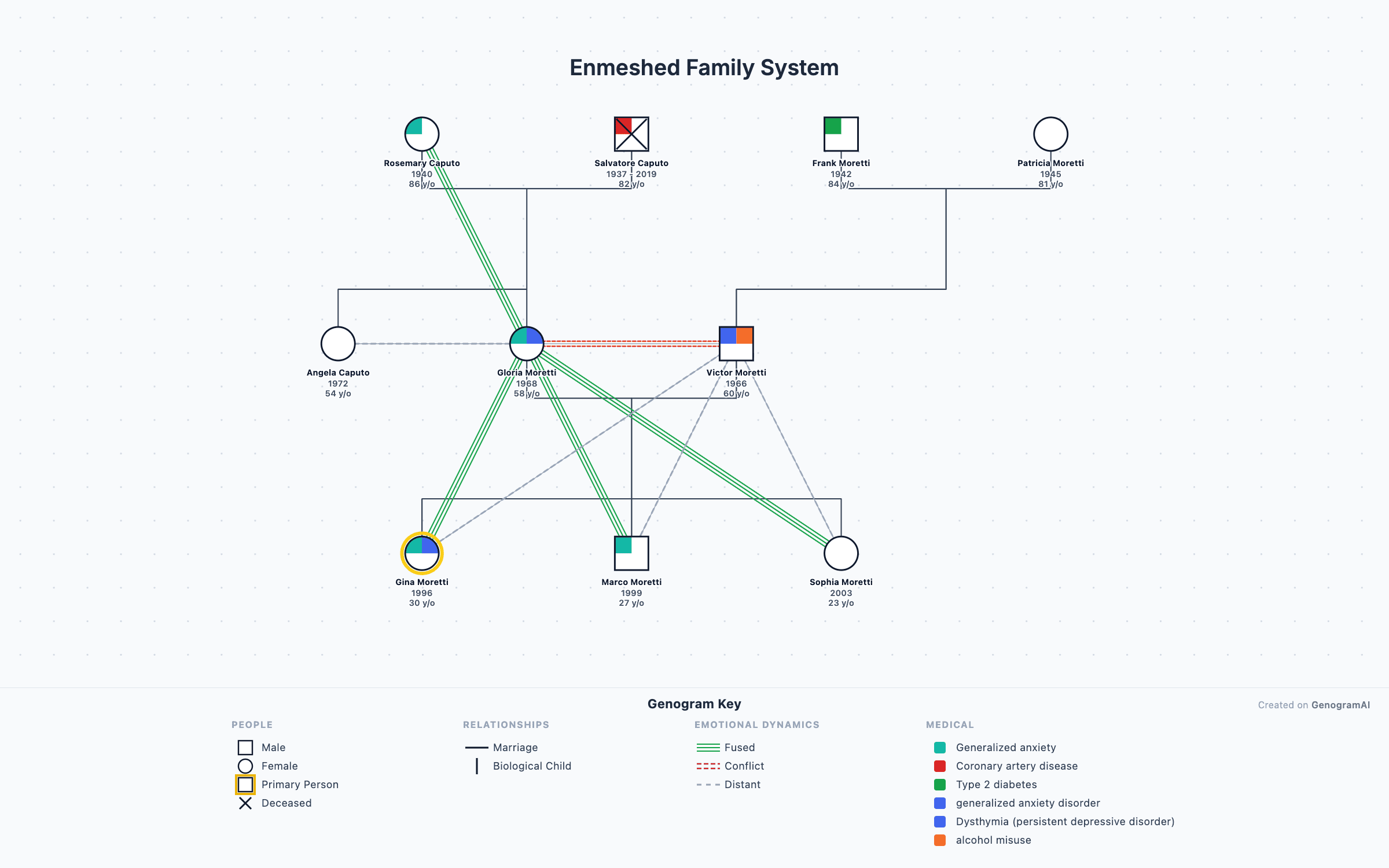
Enmeshed Family System
A three-generation genogram illustrating a classic enmeshed family system with blurred boundaries, fused mother-child relationships, and a peripheral father.
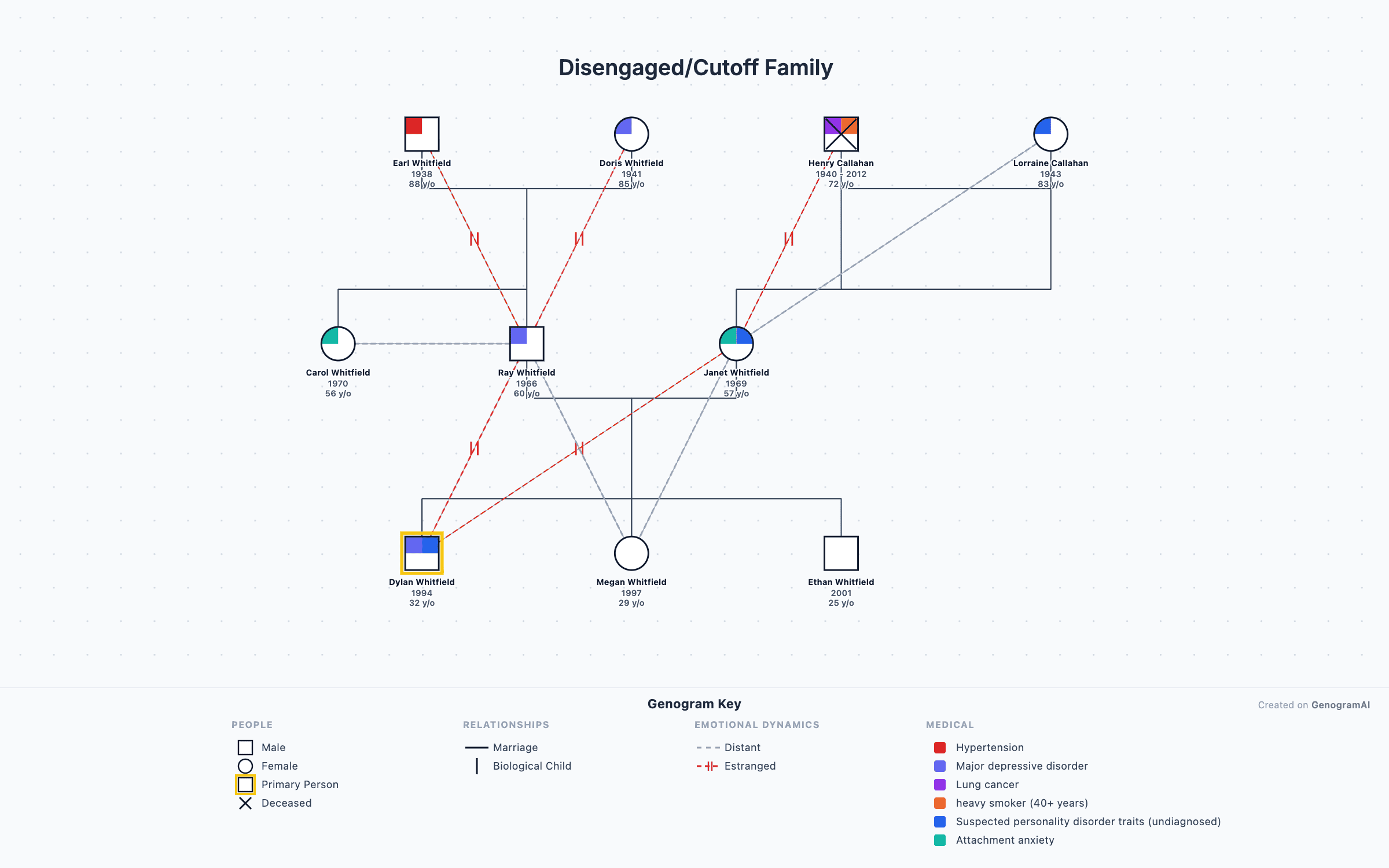
Disengaged/Cutoff Family
A three-generation genogram depicting a family system characterized by emotional cutoffs, estrangements, and patterns of disengagement.
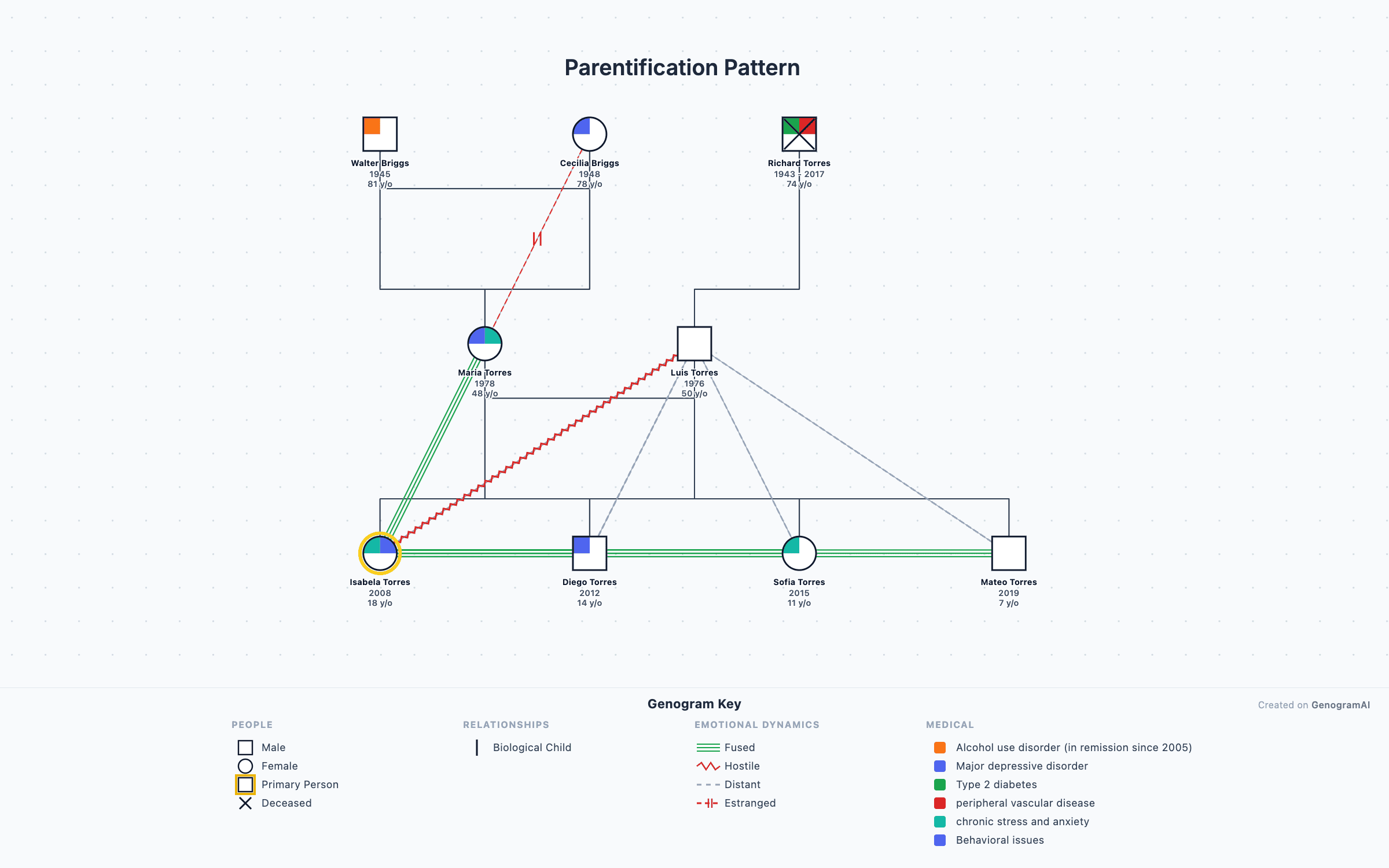
Parentification Pattern
A three-generation genogram illustrating the parentification of the eldest daughter in a single-mother household following divorce.
Create Your Own Genogram
Use GenogramAI to build your own family genogram with AI assistance. Describe your family and let AI do the rest.
Educational disclaimer: This genogram example is an educational illustration of genogram notation and family systems concepts. Examples based on public figures use publicly available information. They are not clinical documents. All examples are intended for learning genogram symbols and patterns.