Military Veteran Transition Family
A genogram of a 3-generation military family focused on the transition from active duty to civilian life.
Interactive Military Veteran Transition Family
Click and drag to explore. Zoom with scroll.
Can't see the genogram? View in the GenogramAI Gallery
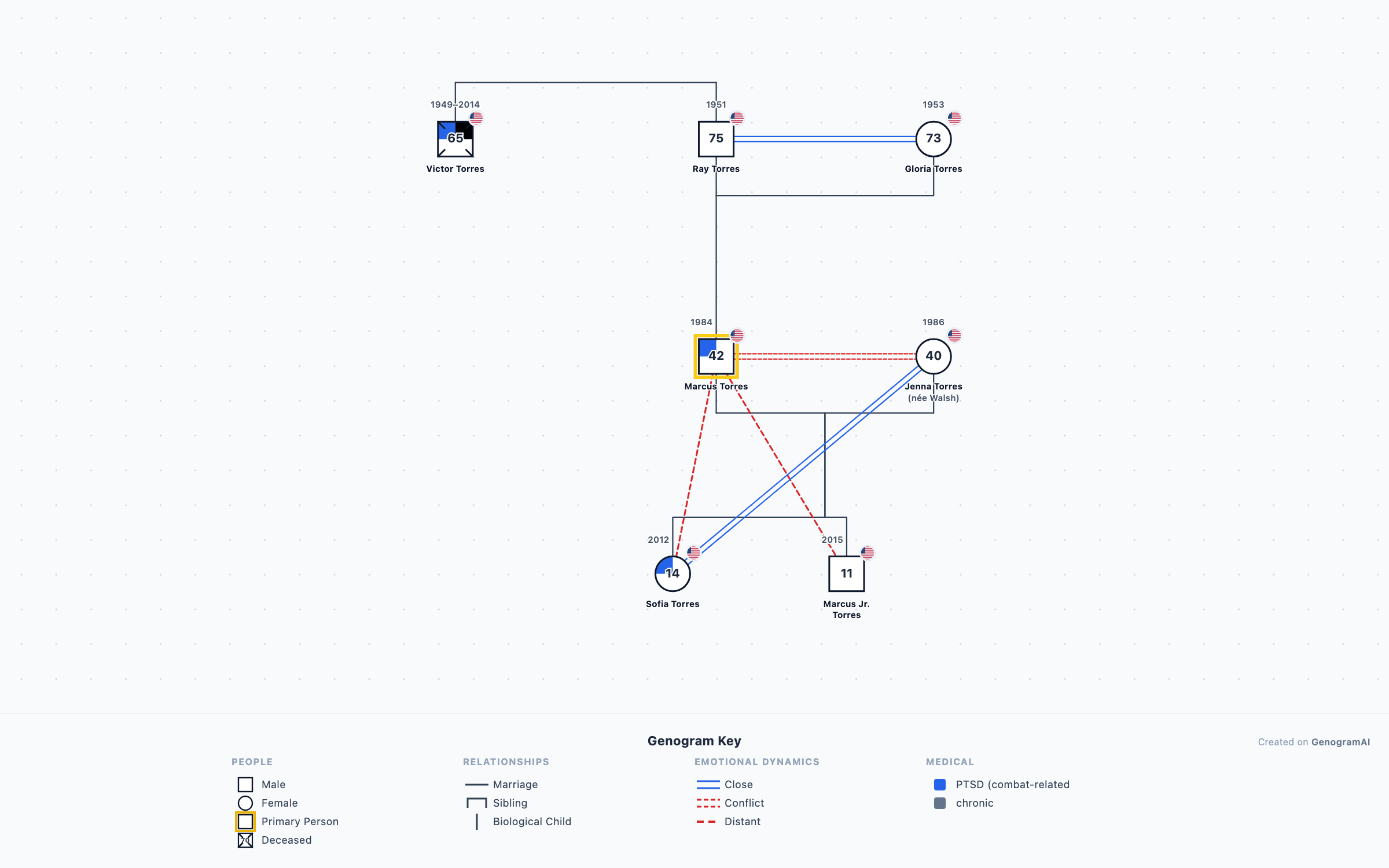
About This Genogram
A genogram of a 3-generation military family focused on the transition from active duty to civilian life. Maps a Marine veteran struggling with identity loss, moral injury, and civilian reintegration while his wife manages household autonomy shifts, and their children navigate a father who is physically present but emotionally deployed. Contrasts with grandfather's successful transition and uncle's failed one (homelessness, substance use).
How to Read This Genogram
Standard genogram notation follows the conventions established by McGoldrick, Gerson, and Petry, which are widely adopted across social work, marriage and family therapy, psychology, and medicine. Squares represent male-identified individuals, circles represent female-identified individuals, and an X through either symbol indicates the person is deceased. Horizontal lines connect partners, with a single slash for separation and a double slash for divorce. Vertical and diagonal lines descend to children, who are arranged in birth order from left to right within a generation. A three-generation diagram is the minimum recommended for clinical use because it provides enough generational depth to identify repeating patterns.
Clinical applications range from intake assessment to treatment planning and outcome review. In a first session, a clinician sketching a genogram with a client gathers structural and historical data while simultaneously building rapport through collaborative storytelling. The resulting diagram then guides the clinician toward hypotheses about symptom function, family roles, and relational resources available to the client. In subsequent sessions the genogram can be updated as new information surfaces, and tracking those additions over time often reveals how the client's understanding of their own family history shifts in parallel with therapeutic progress.
Key Patterns in This Genogram
Family Structure
How this family structure is represented using standard genogram notation.
Relationship Patterns
Key relationship dynamics and emotional bonds within the family system.
Clinical Application
How professionals use this type of genogram in assessment and treatment.
Family Analysis
This 3-generation genogram maps 13 members of the Torres family, centering on the military-to-civilian transition of Marcus Torres (b. 1985), a Marine sergeant who served three combat deployments (two to Iraq, one to Afghanistan) before medically separating due to a traumatic brain injury sustained by an IED blast. The index patient is Marcus, who was referred to family therapy by the VA after his wife Elena (b. 1987) threatened separation, citing his emotional unavailability, explosive anger at minor frustrations, and refusal to engage with their two children. The genogram reveals that Marcus's transition difficulties are not merely individual psychological symptoms but a family system crisis occurring within a multigenerational military context where military service is the family's primary source of identity, meaning, and masculine definition.
The Torres family's military legacy spans three generations and shapes every member's understanding of duty, sacrifice, and manhood. Marcus's grandfather, Héctor Torres (b. 1930, d. 2018), served in Korea, came home, used the GI Bill to become an electrician, raised four children, and never spoke about combat. In the family mythology, Héctor is the template for successful veteranhood: stoic, productive, uncomplaining. What the genogram reveals beneath this mythology, however, is that Héctor's 'successful' transition involved significant emotional costs that were invisible to the family — his wife Alma confided to Elena before her death that Héctor had nightmares for 40 years, self-medicated with alcohol nightly, and was emotionally unavailable in ways the family normalized as 'just how Dad was.' The family's definition of successful transition, then, is itself a clinical problem: it equates functioning with health and silence with strength.
The genogram's most powerful clinical feature is the contrast between three transition trajectories within a single family. Héctor's compartmentalized stoicism was sustainable in an era when veterans were expected to simply resume civilian life without psychological processing. Marcus's uncle Danny (b. 1955, d. 2003), a Vietnam veteran, represents the catastrophic end of the transition spectrum: he returned from Vietnam to a hostile cultural reception, developed severe PTSD and substance use disorder, cycled through homelessness and incarceration, and died of exposure on a San Diego street. The family narrates Danny as the cautionary tale — the one who 'couldn't handle it' — but the genogram reveals that Danny received no VA support, no family understanding of combat trauma, and encountered active cultural hostility toward Vietnam veterans. Marcus occupies the terrifying middle ground: he has more resources than Danny but more complex injuries than Héctor, and the family's binary framework (you either transition like Héctor or you fail like Danny) leaves no conceptual space for his actual experience.
The family system reorganized during Marcus's deployments in ways that now impede his reintegration. Elena, by necessity, became the sole household authority — managing finances, parenting, home maintenance, and her own career while maintaining emotional stability for the children. She developed competence, confidence, and an autonomous identity that she values deeply. Marcus's return creates what clinicians call the 'returning authority' problem: he expects to resume a co-leadership role in a household that has functioned without him, and his attempts to reassert authority feel to Elena not like partnership but like demotion. Their daughter Sofia (b. 2012) clings to her mother and regards her father with anxious wariness — she has more memories of his absence than his presence. Their son Diego (b. 2015) barely knows his father and has begun imitating Marcus's emotional withdrawal, which the genogram flags as an early intergenerational transmission of military-style affect regulation. The family is caught in a paradox: they wanted Marcus home, but the Marcus who came home is not the Marcus who left, and the family he came home to is not the family he left behind.
Clinical intervention with the Torres family requires a trauma-informed, military-culturally competent approach that addresses multiple levels simultaneously. Marcus needs individual work on moral injury — specifically, the civilian casualty incident in Helmand Province that he has disclosed to no one, including his VA therapist — using frameworks like Adaptive Disclosure Therapy that are designed for moral repair rather than exposure-based PTSD treatment. The couple needs support renegotiating household roles in a way that honors Elena's developed autonomy while creating genuine space for Marcus's participation, which requires moving past the binary of 'in charge' versus 'irrelevant.' The children need age-appropriate psychoeducation about military transition and opportunities to express their confusion and grief about the father they expected versus the father who arrived. The genogram serves as a crucial therapeutic tool because it externalizes the multigenerational military narrative that constrains Marcus: he can see that his grandfather's 'success' was actually suppression, his uncle's 'failure' was actually abandonment by systems that should have helped, and his own struggle is neither weakness nor destiny but a treatable condition occurring in a family system that can learn new ways of supporting its veterans.
Build a Similar Genogram
A practitioner documenting a family similar to this one would typically record three generations of household composition, significant life events such as births, deaths, marriages, and separations, any relevant medical or mental health history, and the quality of key relationships between members. That information comes from a combination of the client's verbal account, intake questionnaires, and, where available, collateral records. The completed diagram captures both the factual structure of the family and the practitioner's clinical observations about relational patterns, making it a reference that can be shared across disciplines or reviewed at future stages of treatment.
GenogramAI's AI genogram generator allows you to build a diagram like this one from a plain-language description of the family. You type or paste a narrative, such as the basic structure and any key relationships or health history you want to include, and the AI parses that text, places the correct symbols, draws the appropriate relationship lines, and arranges the layout automatically. The result is a fully editable diagram that you can refine, annotate, and export for clinical records or educational use. Try the AI genogram creator to generate your own genogram from a text description in seconds.
Genogram Symbols Used in This Example
The following standard genogram symbols appear in the Military Veteran Transition Family. Each symbol follows McGoldrick and Gerson clinical notation conventions.
Person Symbols
- Male (Square)
- A square represents a male family member in standard genogram notation.
- Female (Circle)
- A circle represents a female family member in standard genogram notation.
Status Markers
- Deceased (X)
- An X drawn through the symbol indicates the person is deceased.
- Index Patient (Arrow)
- An arrow pointing to a person identifies them as the index patient — the individual who is the focus of the clinical assessment.
Structural Relationships
- Marriage
- A solid horizontal line connecting two individuals represents a marriage or committed partnership.
- Parent-Child
- A vertical line descending from a couple line to a child symbol represents a parent-child relationship.
Emotional Relationships
- Close
- Two parallel lines between individuals represent an emotionally close relationship.
- Distant
- A dotted line represents an emotionally distant or disengaged relationship.
- Conflict
- A zigzag line between individuals represents an openly conflictual relationship.
- Cutoff
- A line with a break or fence marks indicates a severed or estranged relationship.
Medical Conditions
- Trauma/PTSD
- Shading indicates post-traumatic stress disorder or complex trauma responses.
- Substance Use
- Shading indicates alcohol or drug use disorders.
- Traumatic Brain Injury
- Shading indicates TBI or other neurological conditions resulting from physical trauma.
- Depressive Disorders
- Shading indicates depressive conditions (major depression, dysthymia, bipolar disorder).
Related Resources
- Explore how career genograms map military service patterns and occupational identity across generations.
- Learn how genograms in social work professionals use genograms in veteran reintegration programs.
- The distant relationship symbol in this genogram indicates the emotional deployment that persists after physical return.
- The cutoff relationship symbol marks the uncle's complete disconnection from the family system.
Frequently Asked Questions
How does a military veteran transition genogram differ from a standard military family genogram?
What is 'ambiguous presence' and how does it appear in this genogram?
How does this genogram contrast successful and failed military transitions across generations?
What role does moral injury play in the veteran's family dynamics shown in this genogram?
Related Genogram Examples
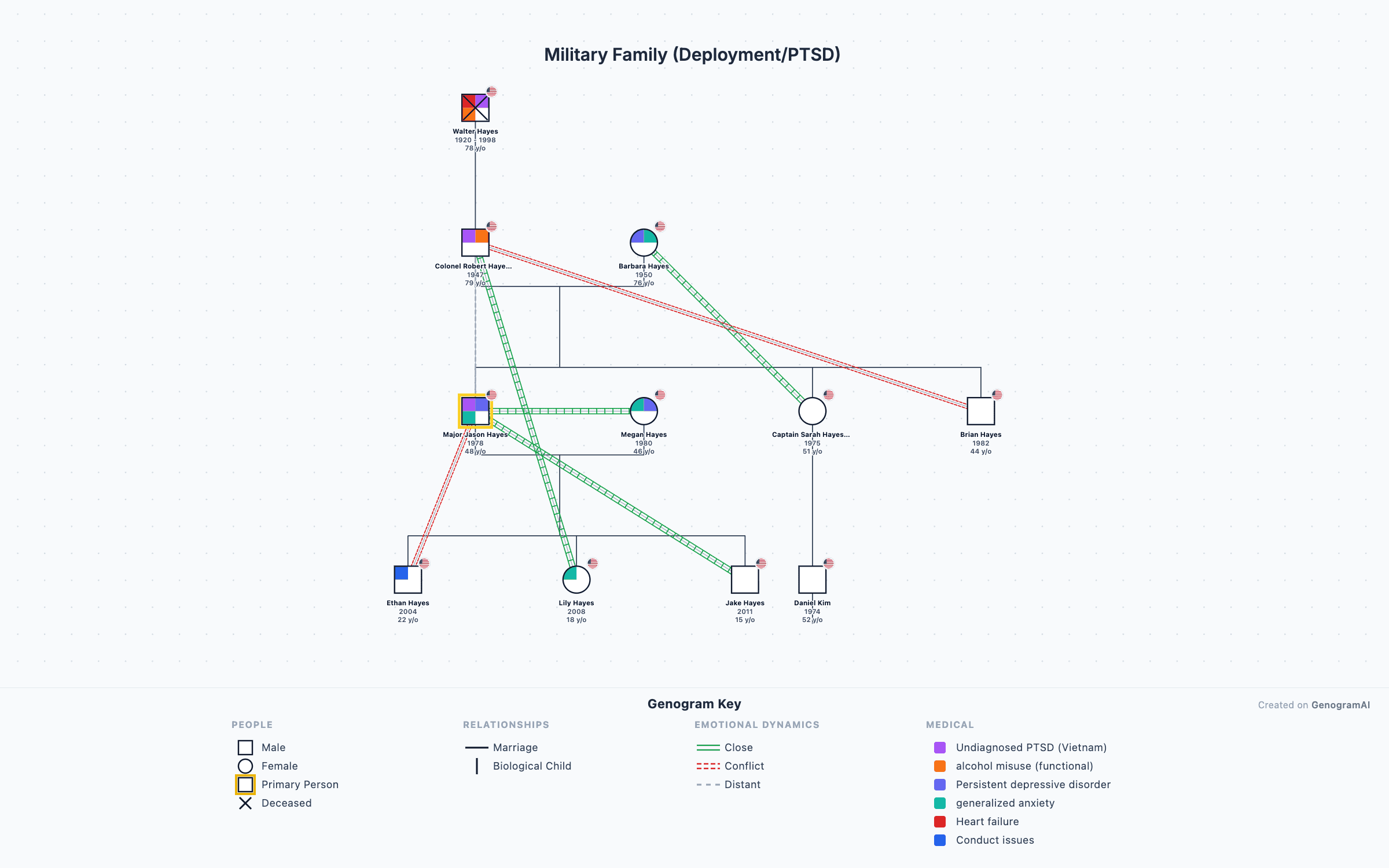
Military Family (Deployment/PTSD)
A multi-generational military family genogram illustrating the cumulative effects of combat deployment across three generations: Vietnam, Iraq, and Afghanistan.
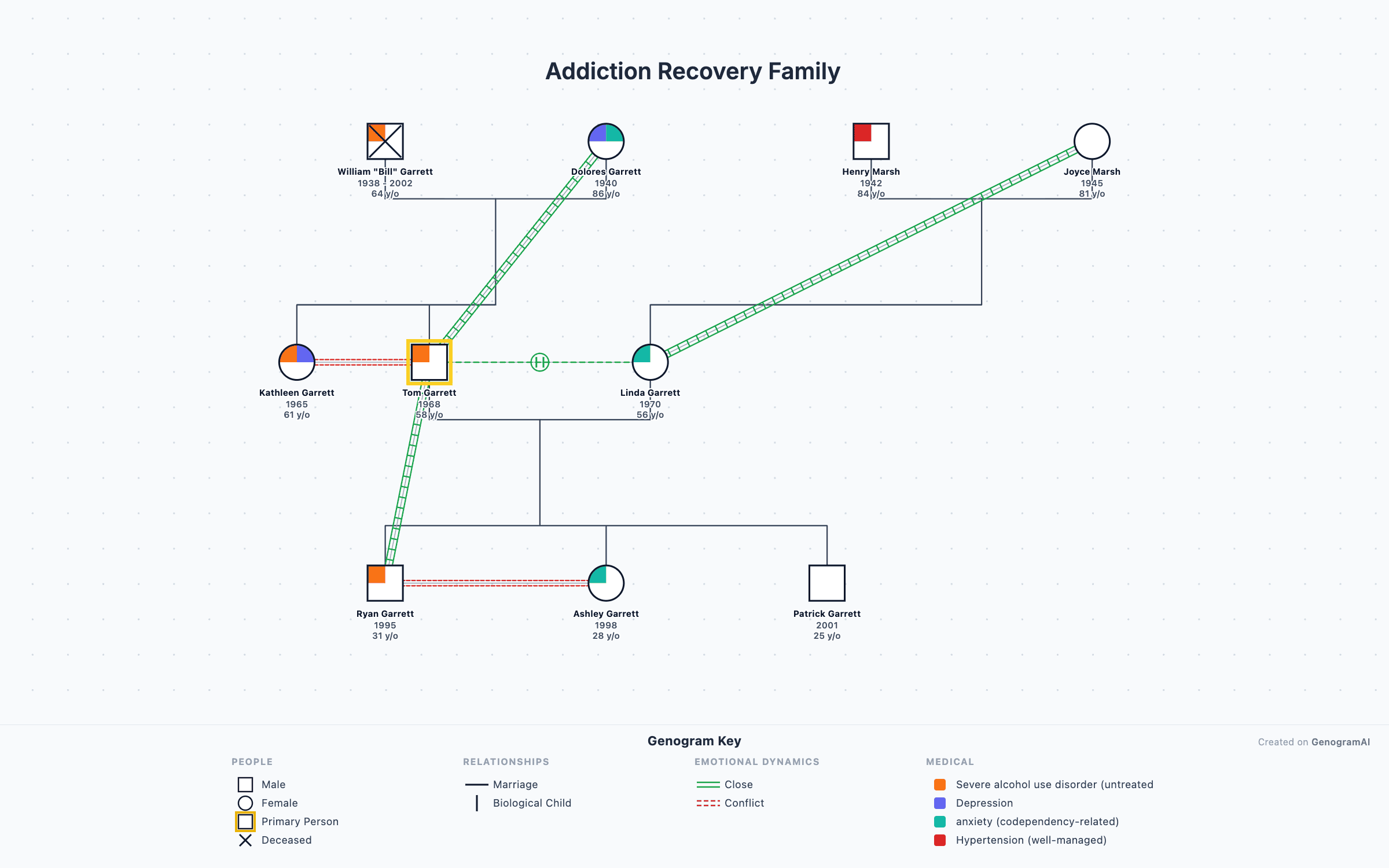
Addiction Recovery Family
A family genogram illustrating multiple generations of addiction and recovery, showing the full spectrum from active addiction to long-term sobriety.
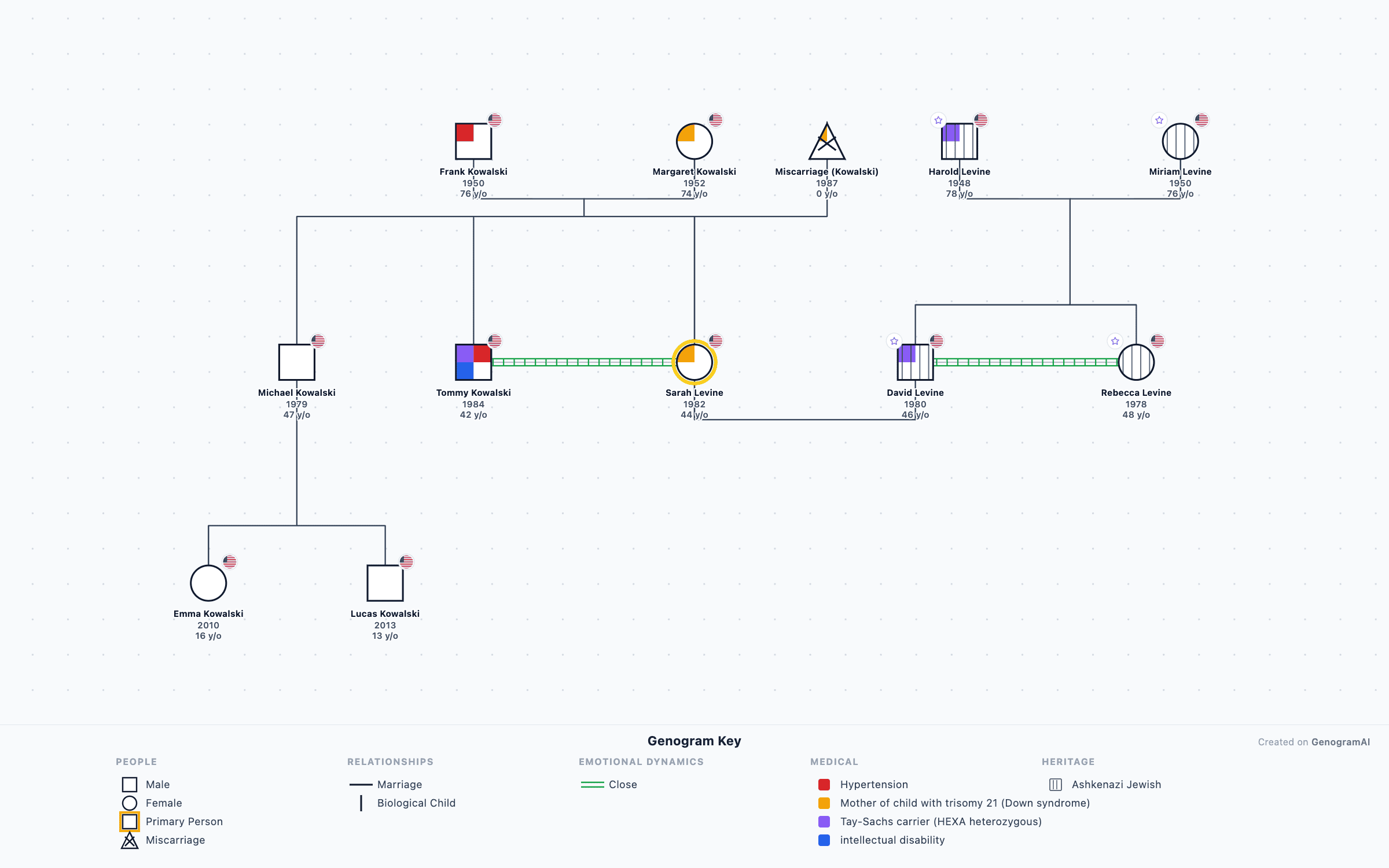
Genetic Counseling Genogram
A genetic counseling genogram for a couple seeking pre-conception genetic counseling.
Create Your Own Genogram
Use GenogramAI to build your own family genogram with AI assistance. Describe your family and let AI do the rest.
Educational disclaimer: This genogram example is an educational illustration of genogram notation and family systems concepts. Examples based on public figures use publicly available information. They are not clinical documents. All examples are intended for learning genogram symbols and patterns.