Genogram for Genealogists
See the Patterns in Your Family History
You already have the names and the dates. A genogram is how you finally see the patterns hiding in them — naming traditions, immigration waves, remarriages, and hereditary conditions. Bring your GEDCOM. Keep your research.
Your Family Tree Has the Facts. A Genogram Has the Story.
Every genealogist reaches the same wall. You have spent years assembling a meticulous family tree — names verified against parish registers, dates cross-checked in census returns. And yet the tree only answers who. It cannot hold how.
A genogram is the answer. It takes the same structural skeleton as a family tree and adds the layers genealogists spend their lives reconstructing: the quality of relationships, remarriages, adoptions, migration events, and hereditary medical patterns. As sources like Genealoger and Cynthia Doxey Green’s FamilySearch lecture “Tracing Family Traits Using a Genogram” have long argued, it is genealogy’s natural next tool. See our full genogram vs. family tree comparison for exactly what each format holds.
Tree vs. Genogram, in one line
A family tree tells you
Johanna arrived from Bremen in 1884 and married Peter in 1887.
A genogram tells you
- •Third of five siblings to emigrate in a single decade
- •Raised Peter’s two children from his first marriage as her own
- •The estrangement that explains the gap in the letters
- •The firstborn-“Peter” naming pattern that runs unbroken until 1921
Six Patterns a Genogram Surfaces
The layers a genealogist reconstructs from records — finally mapped in one place
Naming Patterns
The same given name repeating down a lineage — or disappearing abruptly after a rift. Naming traditions are one of the oldest genealogical tells, and a genogram makes them visible across the whole chart instead of buried in a hundred index cards.
Immigration Waves
A cluster of arrivals in a single decade, chain migration where one sibling sponsors the next, or a branch that stayed behind. Annotate births and deaths by place and the migration story of the whole family emerges from the layout.
Remarriages & Step-Families
Widowhood, remarriage, and blended households were the norm, not the exception, before modern medicine. A genogram draws each marriage and its children explicitly, so the half-siblings and step-relations your tree flattens become clear.
Adoptions & Guardianship
Informal adoptions, children raised by grandparents, and wardships appear constantly in older records. Genogram notation distinguishes biological, adopted, and foster relationships so the household a child actually grew up in is on the page.
Relationship Dynamics
The estrangement that explains why one branch vanishes from the letters, the close bond that explains an unexpected inheritance. Emotional relationship lines let you record the family texture that census data never captures.
Hereditary Conditions
A cause of death that repeats down one lineage, a condition that traces a clear maternal or paternal path. Recording medical history on the shapes turns generations of records into a map of hereditary risk your descendants can actually use.
GEDCOM In, One Upload
You are not starting over. The universal .ged file every genealogy tool exports carries your entire lineage into GenogramAI in seconds.
Export a GEDCOM from your current software
Ancestry, RootsMagic, Gramps, Family Tree Maker, GenoPro — every serious genealogy tool exports the universal .ged format. Your individuals, families, marriages, and parent-child links are all in that one file.
Upload it to GenogramAI
One upload. GenogramAI parses the GEDCOM and reconstructs your research as a genogram — the right shapes for each person, marriage lines between spouses, and sibship lines to children. Optional AI enrichment can infer sibling order and tidy the structure.
Layer in the patterns
Add the things a family tree could not hold: emotional relationship lines, medical conditions, migration notes, occupations. Use color tags and background regions to group a lineage or highlight a branch. This is where research becomes insight.
Read the story, then export it
Step back and read the patterns across generations. When you are ready, export to PDF or SVG for a book or wall chart, or back out to GEDCOM to sync your enriched work — GEDCOM and SVG export are included on Professional.
Full detail on formats, enrichment, and round-tripping lives on the GEDCOM to genogram guide. Your source citations come with you too: turn on Research view to see which facts they prove.
Real Families Are a Mess. The Chart Shouldn’t Be.
Three marriages, a child from each, cousins who married cousins — the deeper you dig, the denser the chart. Most tree software either hides that complexity or turns it into an unreadable tangle. GenogramAI is built for the mess.
Separated child lines
Every marriage gets its own child line, so a person with three spouses has three distinct sets of children rather than one ambiguous cluster of descendants.
Automatic line tunneling
When lines must cross, a small semicircular hop lifts one over the other automatically. Real connections never hop — the first genogram maker we know of to do this fully automatically.
The hop borrows the “wire hop” convention draftsmen have used in hand-drawn circuit diagrams for a century, so a crowded pedigree stays legible.
Users of older desktop tools have asked for this for years without getting it. If you are coming from GenoPro, the side-by-side on our GenogramAI vs. GenoPro page walks through exactly what changes — and see how we stack up against Family Tree Maker too.
Clinical-Grade Privacy for Sensitive Branches
Adoptions kept quiet, health conditions living relatives never disclosed, estrangements still raw — the material that makes a genogram valuable is exactly what you never want exposed. The Clinical plan, built for therapists handling protected health information, gives genealogists the same safeguards:
- Clinical Mode is HIPAA-ready
- Zero-knowledge encryption
- Mac & Windows desktop app with local saving
Even on the free plan, your genograms are private to your account by default.
Pricing
Start free. Upgrade when you want GEDCOM export, PDF and SVG output, or private local saving.
Free
$0
- 2 genograms, up to 50 people each
- 5 AI credits per month
- PNG export and print
- All symbols & relationship types
Professional
$12/mo
$8.25/mo billed annually
- 25 genograms
- GEDCOM import
- Unlimited AI
- PDF, SVG & GEDCOM export
- Priority support
Clinical
$29/mo
- Unlimited genograms & AI
- Clinical Mode (HIPAA-ready)
- Zero-knowledge encryption
- Mac & Windows desktop app, local saving
Why Genealogists Reach for a Genogram
Frequently Asked Questions
How is a genogram different from the family tree I already have?
A family tree records structure — who descended from whom, with names and dates. A genogram keeps all of that and adds the layers a genealogist reconstructs from letters, censuses, and family stories: the quality of relationships, remarriages and step-families, adoptions, hereditary medical conditions, and life events like immigration. You already have the facts; a genogram is how you see the patterns those facts form across generations. See our full breakdown of a genogram vs. a family tree for a side-by-side comparison.
Can I import my existing GEDCOM file?
Yes. Upload your .ged export from Ancestry, RootsMagic, Gramps, Family Tree Maker, or GenoPro and GenogramAI reconstructs the individuals, families, marriages, and parent-child links as a genogram — one upload, no re-keying. You can optionally let the AI enrich the import by inferring sibling order and relationship structure. Years of research come with you. GEDCOM export is available on the Professional plan when you want to take your work back out.
Is GenogramAI a good GenoPro alternative for genealogists?
It is built for the same job — mapping real, messy family structures — without the desktop-only friction. GenogramAI runs in the browser, imports your GEDCOM, and draws automatic line tunnels where unrelated lines cross, so dense multi-marriage charts stay readable without any manual fixes.
What patterns can a genogram actually reveal in my research?
The ones genealogists care about most: naming patterns (the same given name repeating down a lineage, or vanishing after a family rift), immigration waves (a cluster of arrivals in one decade), remarriage and step-family structures that a tidy tree flattens, adoption and guardianship, and hereditary conditions that trace a clear path through one branch. Seeing them mapped visually turns a spreadsheet of dates into a story you can read at a glance.
How does it handle families with multiple marriages and lots of children?
Real families are not tidy. GenogramAI draws separated child lines for each marriage so a person with three spouses and children from each does not collapse into one ambiguous cluster. When the chart gets dense and lines have to cross, automatic line tunneling adds small semicircular hops where an unrelated line passes over another, borrowing the wire-hop convention from hand-drawn circuit diagrams so a crowded chart stays readable.
Can I keep sensitive family information private?
Yes. Family history often includes information living relatives would not want public — health conditions, adoptions, estrangements. The Clinical plan adds Clinical Mode with zero-knowledge encryption and a Mac and Windows desktop app that saves locally, so the most sensitive branches of your research never leave your control. Even on the free plan your genograms are private to your account.
Free Downloadable Guides
Print-ready PDFs you can reference anytime — no sign-up required.
Related Resources
Genogram vs. Family Tree
Exactly what each format holds — and where they diverge
GEDCOM to Genogram
Import your existing research in a single upload
Research View
Cite a source for every fact and see what is proven
GenogramAI vs. GenoPro
The GenoPro alternative built for messy real families
Genogram Symbols Guide
Every shape and line, explained
Symbol Reference
The quick visual key to genogram notation
What’s New
Separated child lines, line tunneling, and more recent ships
Bring Your Family History to Life
Upload your GEDCOM, layer in the patterns your tree could never hold, and finally see the story your research has been telling all along. Start free — no card required.
158 Genogram Examples & Templates
Browse real genogram examples — from clinical case studies to famous families. Use any as a starting template for your own genogram. Every example is generated using the McGoldrick-Gerson-Petry 4th edition standard with full symbol notation.
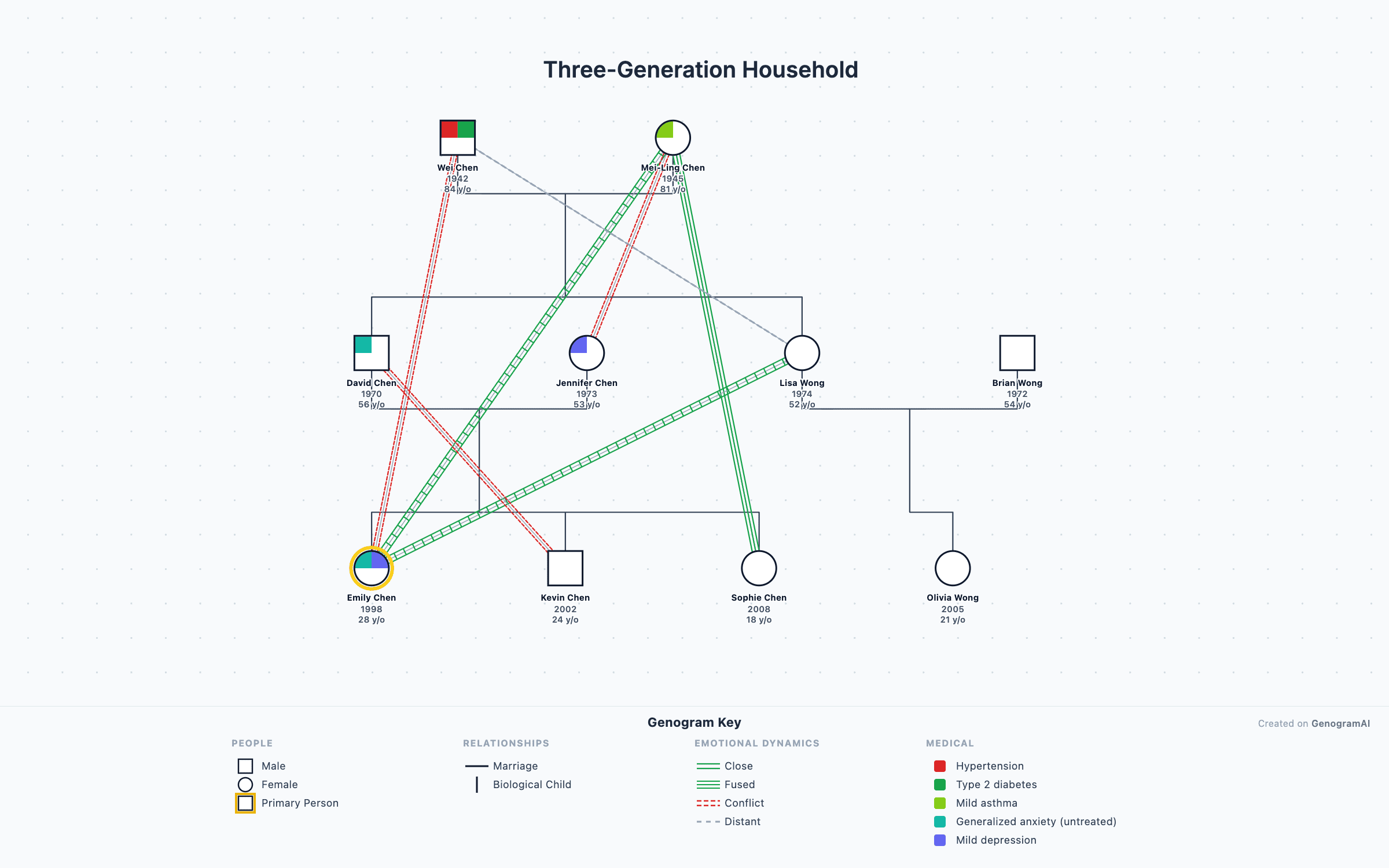
3-Generation Family Genogram
Classic three-generation genogram with marriage, children, and grandchildren — the standard layout used in family therapy assessment.
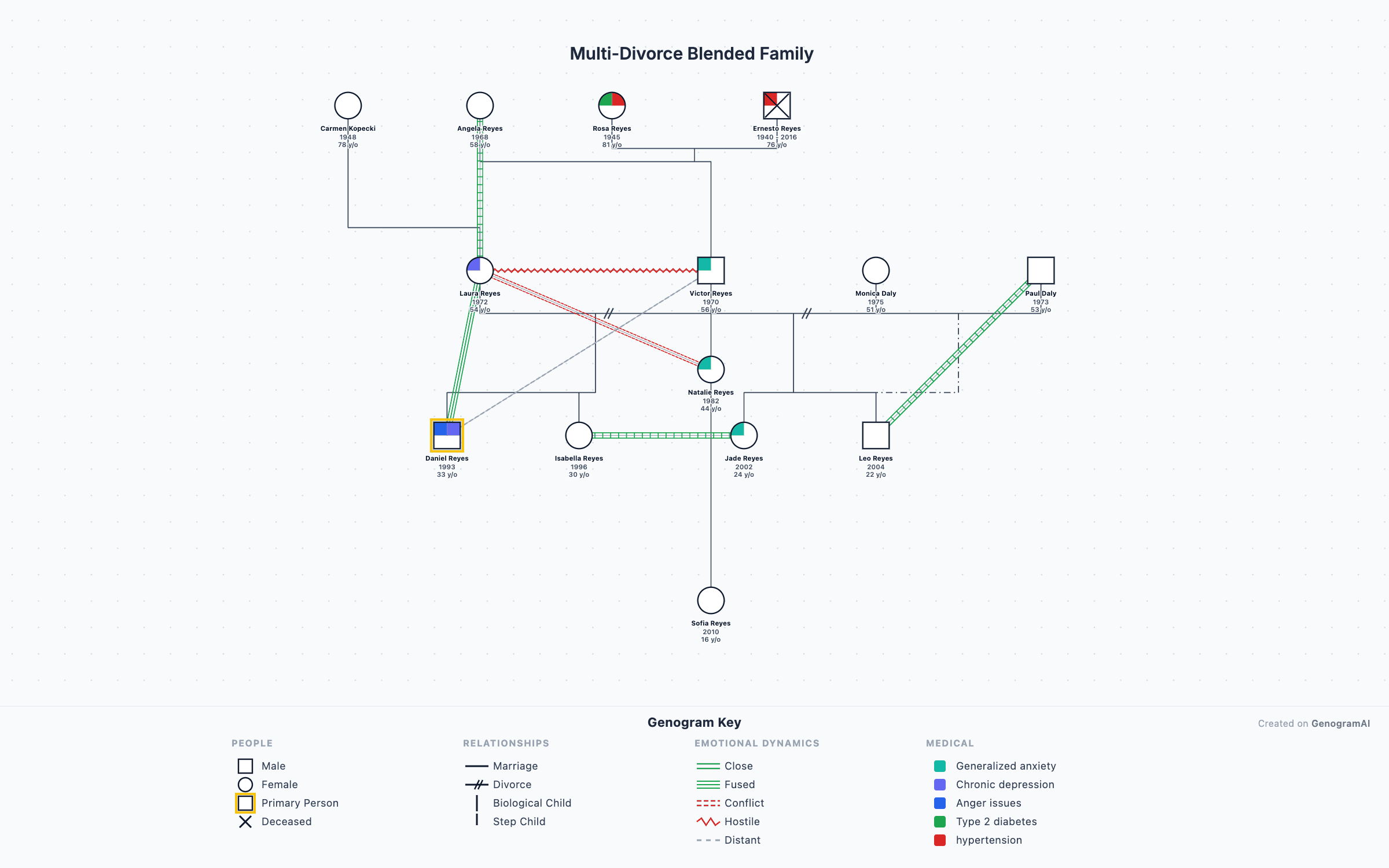
Blended Family Genogram
Step-parents, half-siblings, and multiple marriages mapped across generations using McGoldrick blended-family notation.
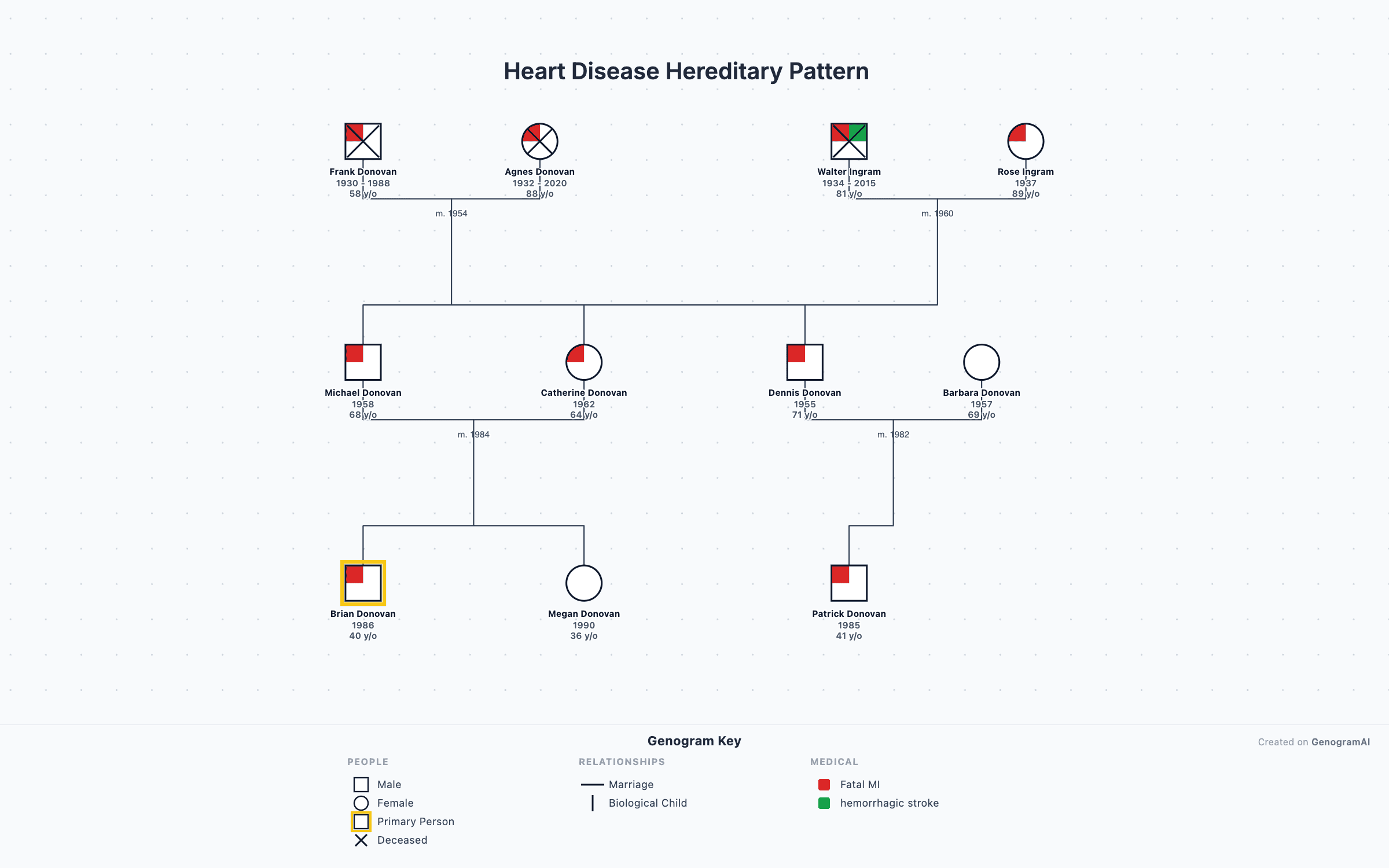
Medical Family History Genogram
Track hereditary conditions like heart disease, cancer, and diabetes with the four-quadrant medical notation system.
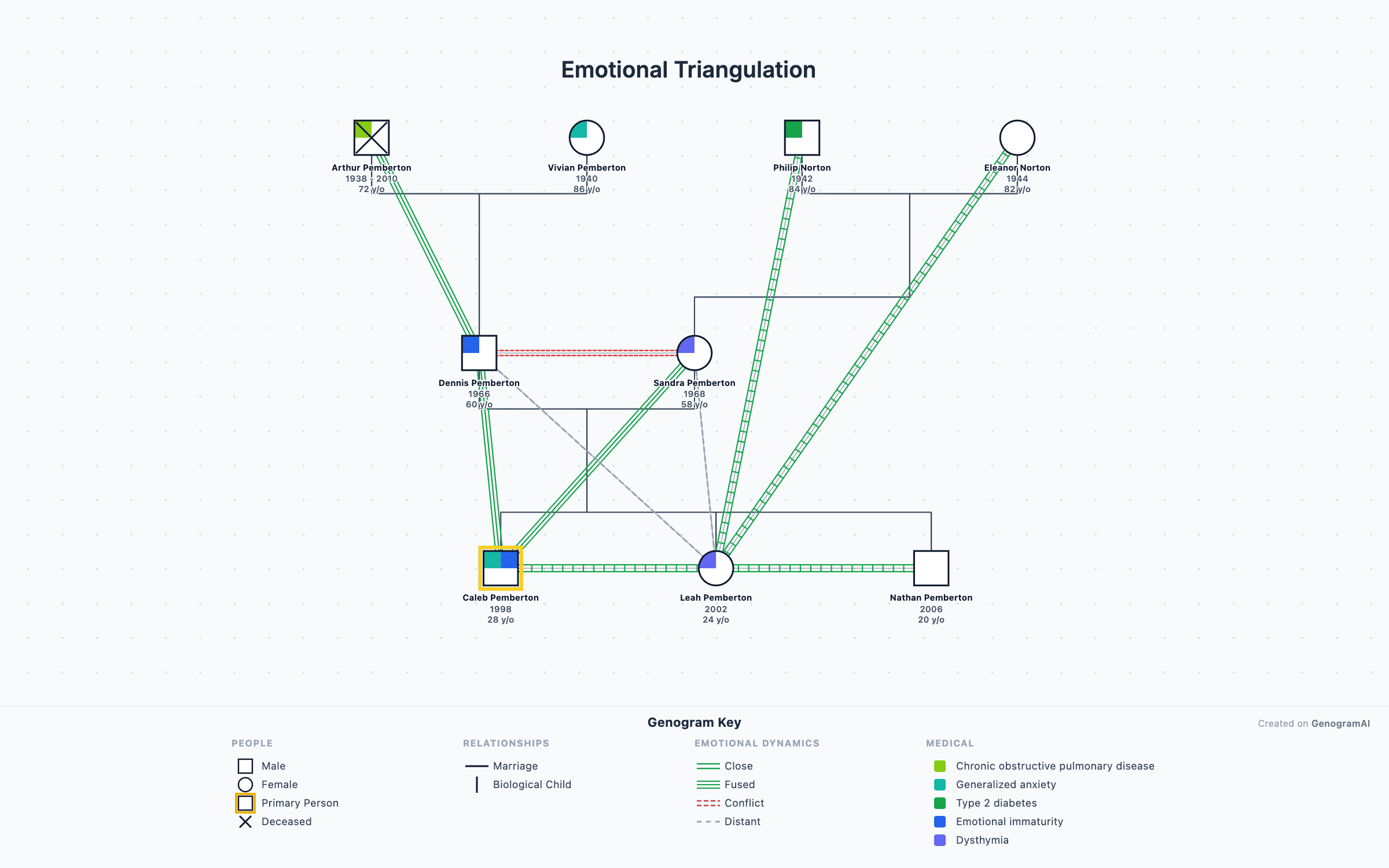
Emotional Patterns Genogram
Map conflict, enmeshment, cutoff, and closeness with 38 emotional relationship overlays from the McGoldrick standard.
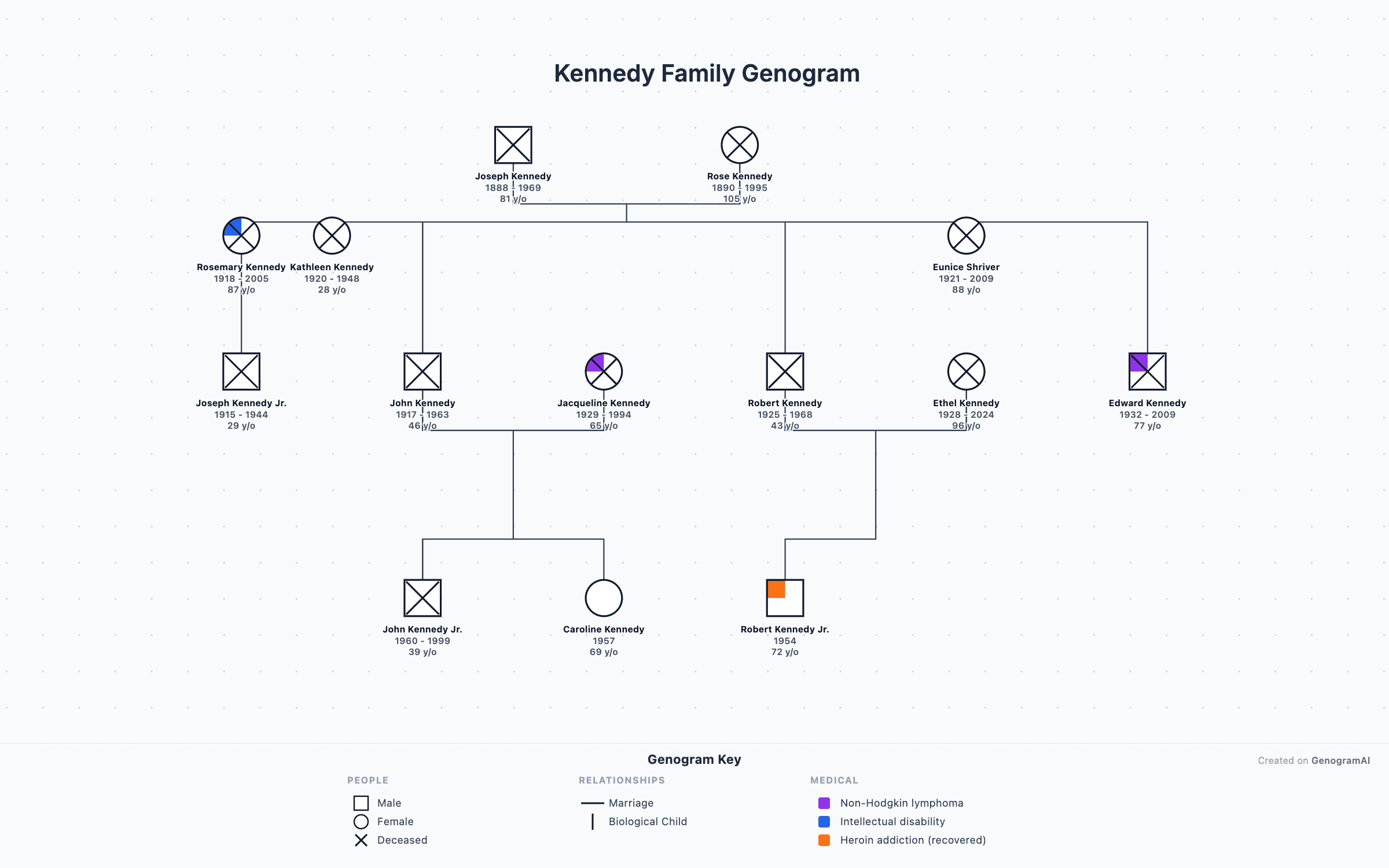
Kennedy Family Genogram
The Kennedy political dynasty mapped across four generations — a teaching example for genogram construction.
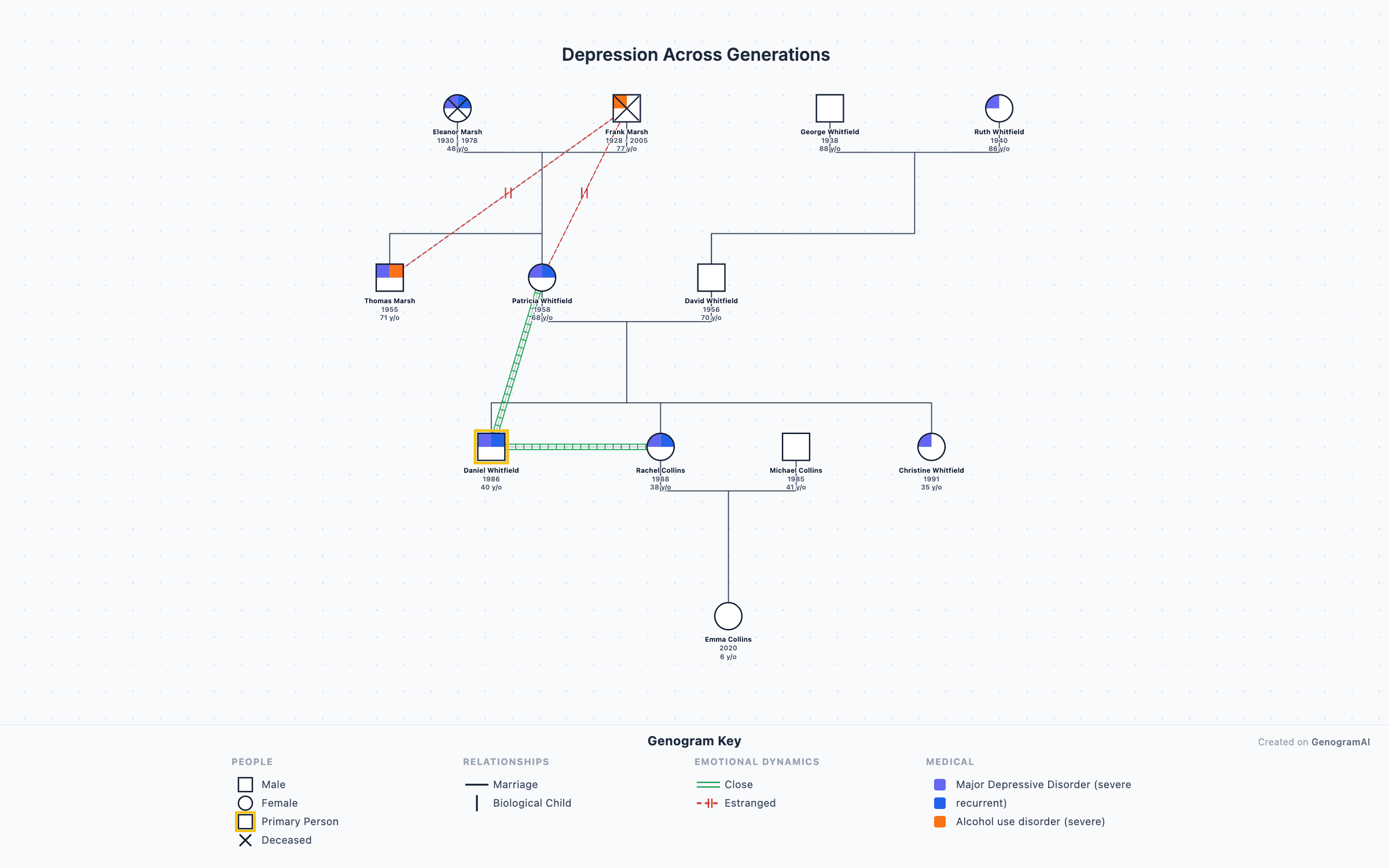
Depression Across Generations
Multigenerational transmission of depression and mood disorders visualized using clinical genogram symbols.
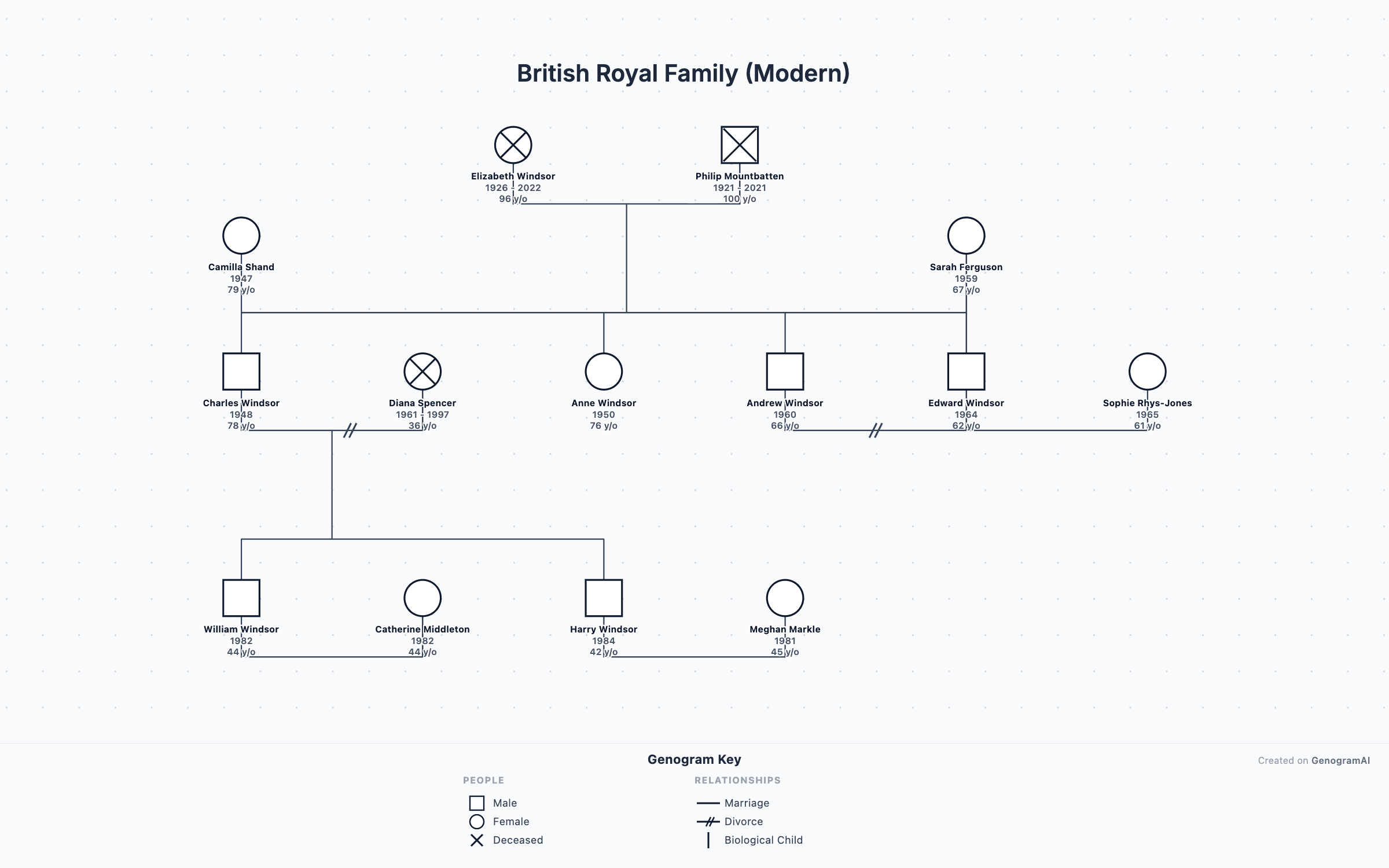
British Royal Family
The modern British royal family from Elizabeth II to present — useful as a template for complex multigenerational genograms.
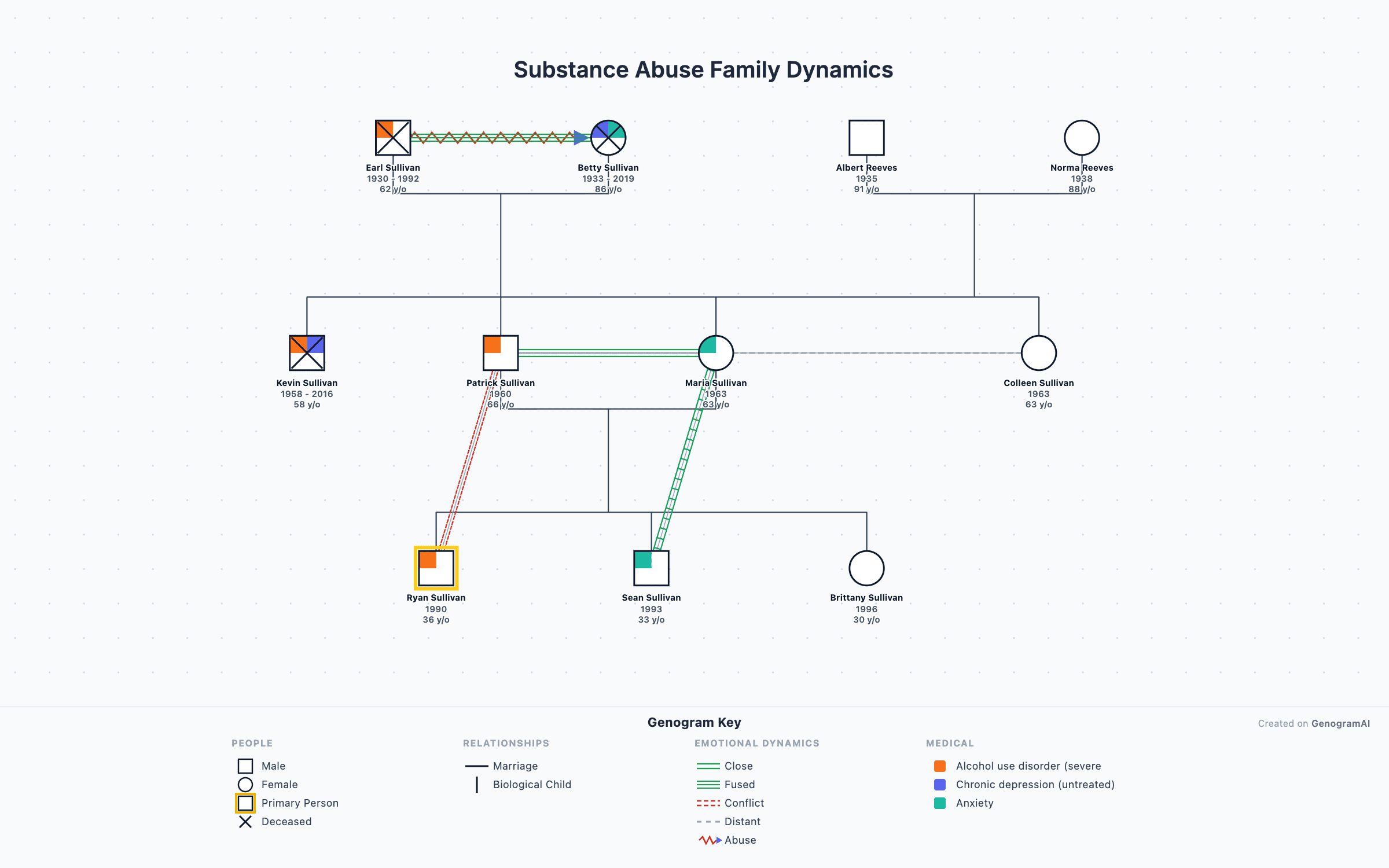
Substance Abuse Dynamics
Family patterns around addiction, codependency, and recovery — clinical genogram example for therapy training.