For genetic counseling programs
Genogram and pedigree tool for genetic counseling
Quick answer
Why genetic counselors need specialized tools
Pedigree Standards Are Precise
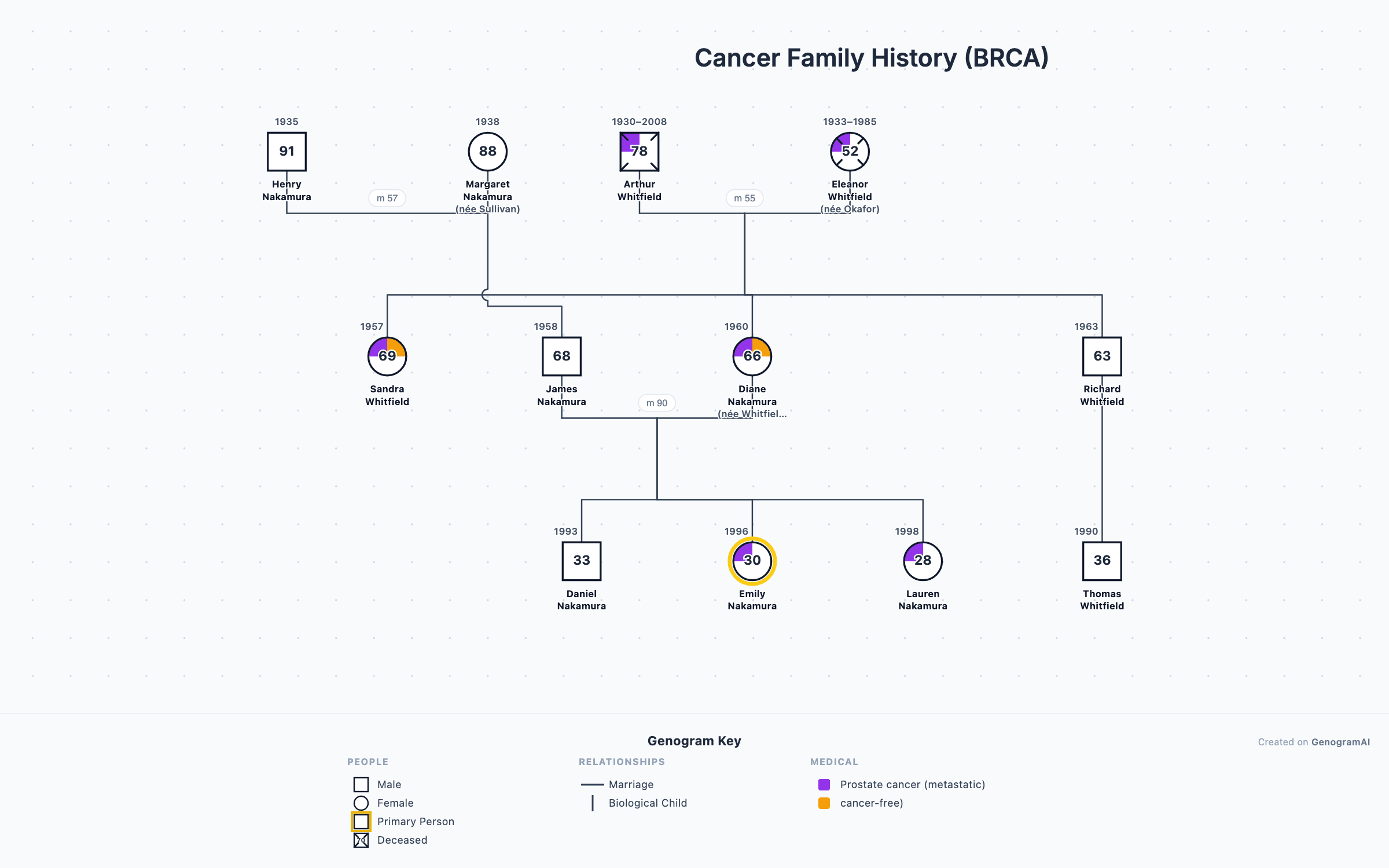
Your genetics program requires standardized pedigree notation. Shaded quadrants for affected individuals, carriers with half-fills, consanguinity loops: generic tools can't handle this.
Genetic counseling demands precision. A misdrawn pedigree can lead to incorrect risk calculations and clinical decisions.
Risk Calculations Depend on Accuracy
You're calculating Mendelian inheritance probabilities. If your pedigree doesn't accurately show who's affected, who's a carrier, and who's been tested, your math is meaningless.
When families are making decisions about BRCA testing or Huntington's predictive testing, every symbol matters.
Complex Family Structures
Your patient has multiple consanguineous relationships, half-siblings from different partners, and unknown paternity. Standard tools break down with real clinical families.
Real genetic counseling cases are messy. You need tools that handle the complexity you actually encounter.
Program Documentation Requirements
Your MSc program needs pedigrees for case logs, competency assessments, and board certification. They need to be professional-quality and standardized.
From Cardiff to Melbourne to the US, genetic counseling programs have strict documentation standards.
Built for medical genetics
Medical Quadrants
Hereditary Pattern Tracking
Consanguinity Support
Secure Patient Data
How does genogram notation differ from NSGC pedigree notation?
| Mark | NSGC pedigree | GenogramAI |
|---|---|---|
| Male / female / unknown sex | Square, circle, diamond | Square, circle; other identities have their own symbols |
| Affected individual | Fully shaded symbol | Shade a medical quadrant per condition |
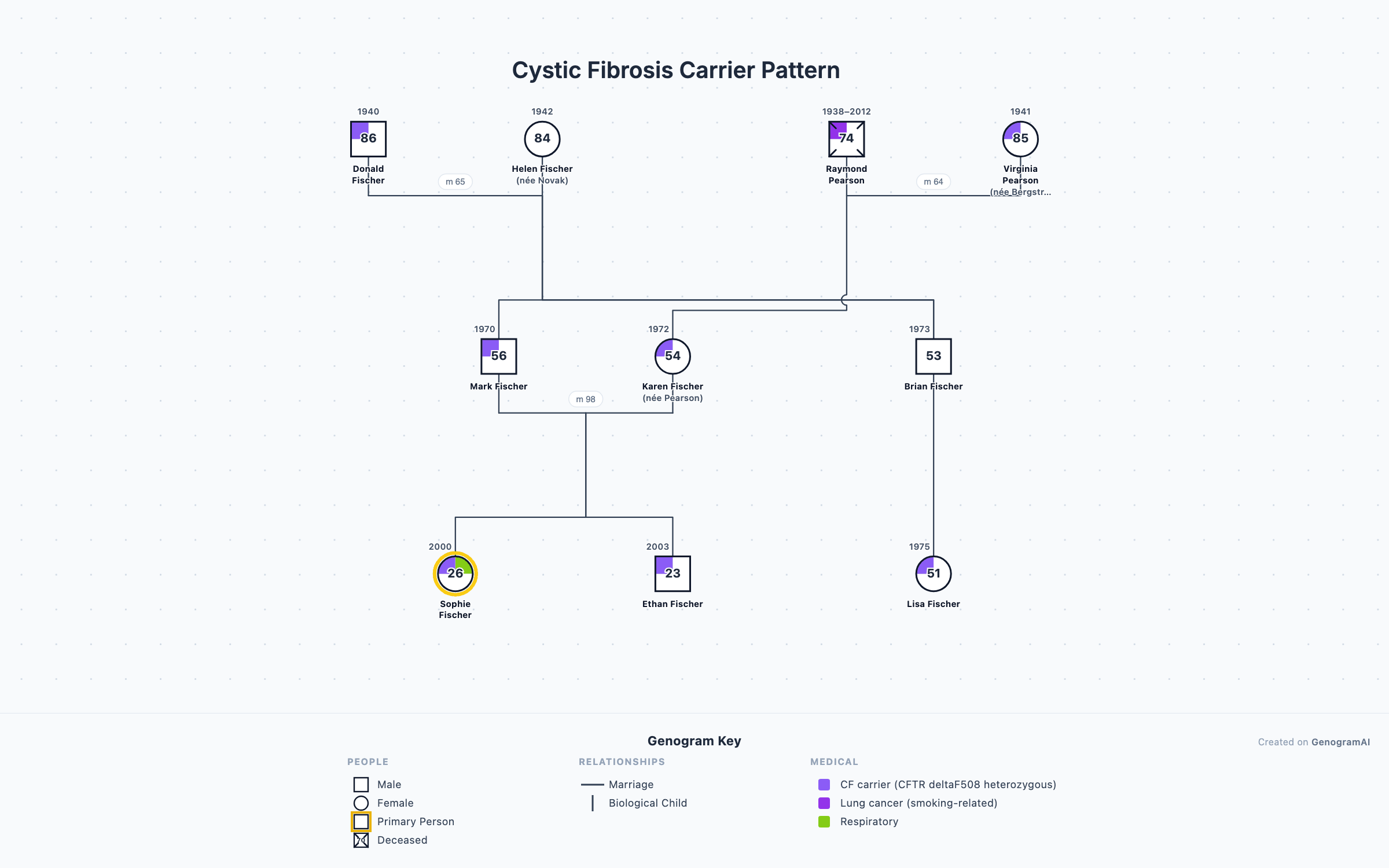
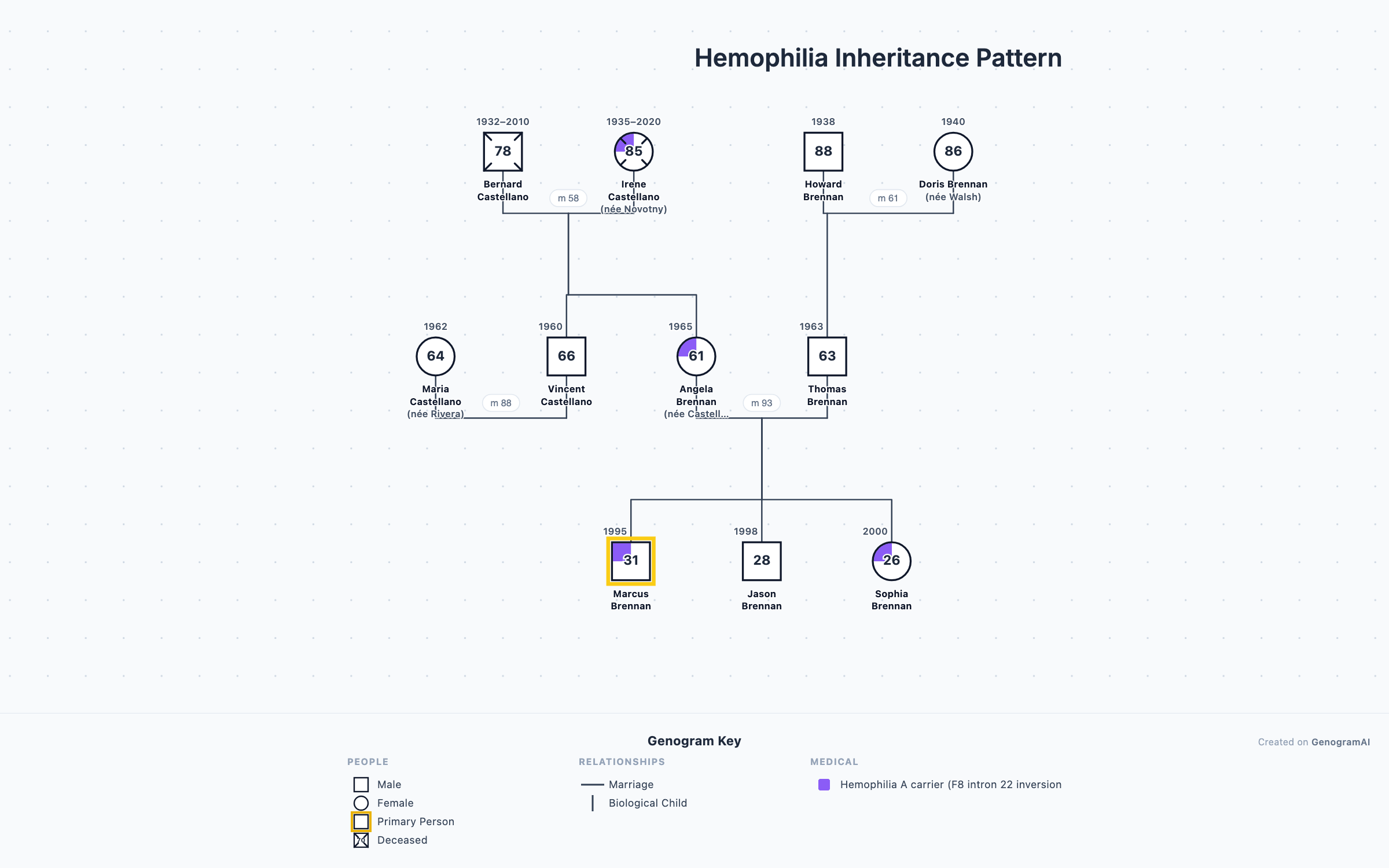
| Carrier (heterozygote) | Dot in the centre or half-shaded | Use a quadrant or a note; no dedicated carrier dot |
| Proband / consultand | Arrow (P marks the proband) | No arrow; mark the index person and add a note |
| Deceased | Diagonal line through the symbol | X through the symbol |
| Consanguinity | Double relationship line | Supported |
| Pregnancy loss | Small triangle | Miscarriage and pregnancy symbols |
| Emotional relationships | Not part of the standard | 39 emotional relationship types |
Conditions commonly tracked
- BRCA1/BRCA2 (Hereditary Breast & Ovarian Cancer)
- Huntington's Disease
- Lynch Syndrome (HNPCC)
- Cystic Fibrosis
- Sickle Cell Disease
- Thalassemia
- Familial Hypercholesterolemia
- Marfan Syndrome
- Neurofibromatosis
- Hemophilia A/B
- Duchenne Muscular Dystrophy
- Polycystic Kidney Disease
- Hereditary Hemochromatosis
- Fragile X Syndrome
How do inheritance patterns look on a pedigree?
Autosomal Dominant
Autosomal Recessive
X-Linked
Mitochondrial

Genetic counseling programs worldwide
| Institution | Program | Country |
|---|---|---|
| Cardiff University | MSc in Genetic & Genomic Counselling | UK |
| University of Melbourne | Master of Genetic Counselling | Australia |
| King's College London | MSc Genomic Medicine | UK |
| University of Coimbra | Master in Clinical Laboratorial Genetics | Portugal |
| US Accredited Programs | ACGC-accredited MS in Genetic Counseling | USA |
| McGill University | MSc Genetic Counselling | Canada |
How do you create a genetic pedigree in GenogramAI?
- 1
Add family members
Start with the proband and build out. Add parents, siblings, aunts, uncles, and grandparents. - 2
Mark affected status
Use the medical quadrant system to indicate who has specific conditions, who's a carrier, and who's been tested. - 3
Add genetic details
Include age of diagnosis, specific gene mutations (if known), and testing status for each family member. - 4
Assess risk
Use the finished pedigree for your inheritance calculations and risk models (GenogramAI documents the family; it does not calculate risk), then counsel patients. - 5
Export for documentation
Download a high-resolution PNG for case logs, board exams, and clinical documentation (PDF and SVG on paid plans).
For coursework, the free plan covers 2 genograms with PNG export. Professional ($12/month) adds PDF, SVG and GEDCOM export and file import; Clinical ($29/month) adds zero-knowledge encryption for identifiable patient data.
Genetic counseling pedigrees: questions
Can GenogramAI create proper genetic pedigrees?
Yes. GenogramAI supports the medical quadrant system for tracking specific conditions, deceased/affected status indicators, and carrier notation. GenogramAI uses McGoldrick-style genogram notation, not the NSGC (Bennett) pedigree standard, so some pedigree marks such as the proband arrow and carrier dots are shown with quadrants and notes rather than their NSGC symbols. Check your program's requirements before submitting.
Does it support consanguinity?
Yes. You can indicate consanguineous relationships, which is essential for calculating recessive disorder risk in populations with high rates of cousin marriage or in isolated communities.
Can I track specific genetic conditions?
Absolutely. Each person has 4 customizable medical quadrants where you can track specific conditions (e.g., breast cancer, colon cancer, cardiac disease, neurological conditions). You can also add notes for genetic test results.
Is it suitable for MSc genetic counseling programs?
Yes. Students at programs worldwide use GenogramAI for case documentation, competency assessments, and board preparation. The professional export (high-resolution PNG) meets academic and clinical documentation standards.
How does it handle multigenerational cancer histories?
GenogramAI supports unlimited generations. You can map cancer histories with specific ages of diagnosis, cancer types, and outcomes. That pedigree is what you then use for empiric risk assessment and for spotting hereditary cancer syndromes; GenogramAI documents the family, it does not calculate risk.
What's the difference between a pedigree and a genogram?
In genetics, 'pedigree' typically refers to a family tree focused on inheritance patterns of specific traits or conditions. 'Genogram' is a broader term that includes emotional relationships and psychosocial factors. For genetic counseling, GenogramAI provides the medical precision of a pedigree with the flexibility to add clinical notes.
Can I indicate carrier status vs. affected status?
Yes. You can use the medical quadrants and notes to distinguish between carriers (unaffected individuals who carry one copy of a recessive allele), affected individuals, and those with unknown status. This distinction is critical for accurate risk calculations.
How do I show unknown or uncertain information?
Add notes to indicate uncertainty. For unknown paternity, genetic status, or uncertain diagnoses, document what is known vs. reported vs. suspected. This transparency is essential for accurate genetic counseling.