School Counseling Genogram Template
Understand the family context behind a student's academic, social, and emotional challenges.
Template Preview
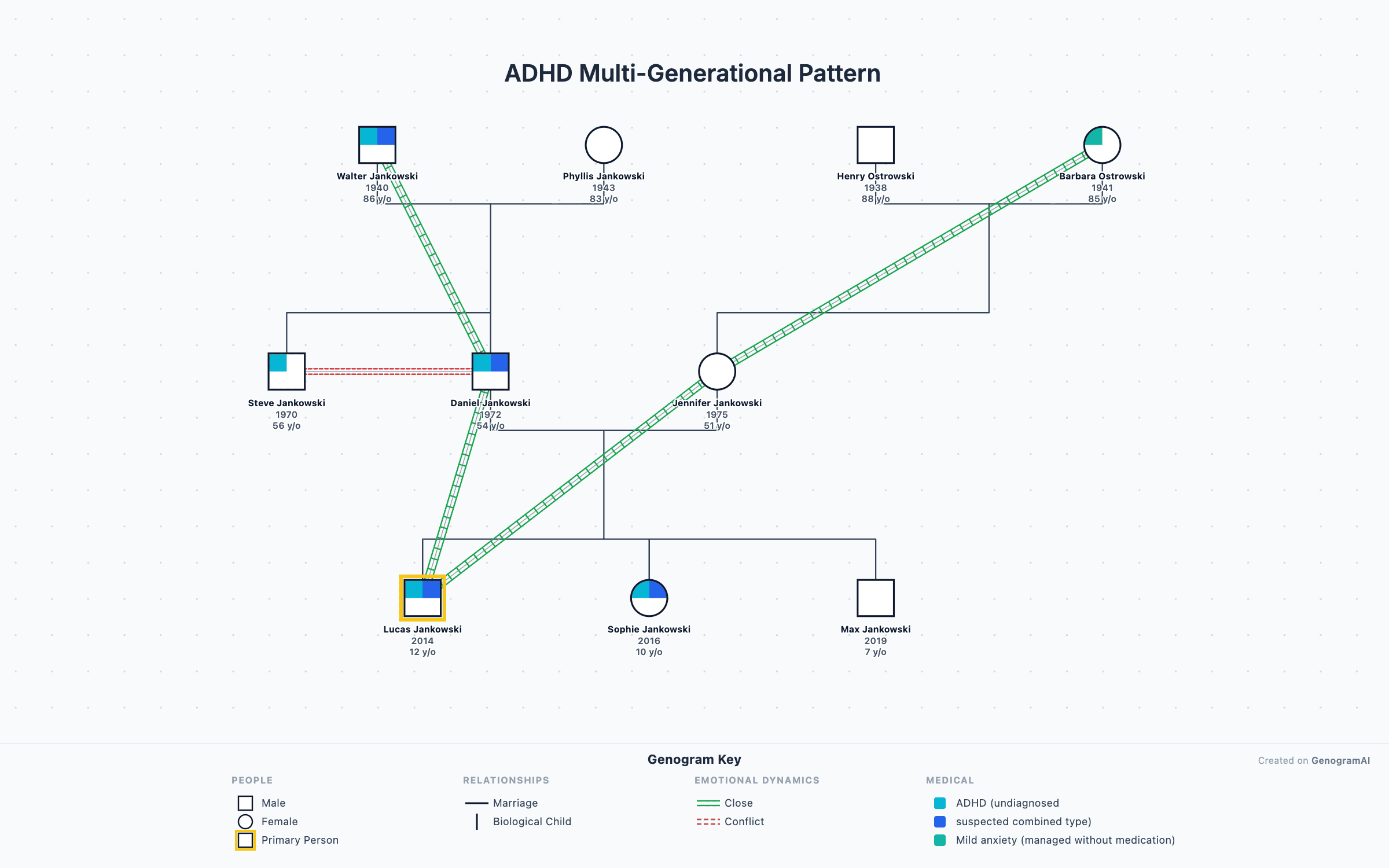
Example genogram created with GenogramAI — School Counseling Genogram
Who Uses This Template
School counselors, school social workers, special education coordinators, and school psychology students.
Common Use Cases
- Student mental health intake — understanding home and family context
- IEP and 504 plan family history documentation
- Truancy and attendance issue investigation — family system factors
- Academic underachievement pattern mapping across generations
- Crisis response — understanding family resilience and risk factors
How to Use This Template
Map the student's immediate household
Identify all household members and the student's relationship to each. Note custody arrangements, blended family configurations, and caregiving responsibilities.
Document educational history across generations
Note parents' and grandparents' educational attainment, learning differences, school experiences, and attitudes toward education. Academic patterns often transmit across generations.
Annotate relevant stressors and supports
Record recent family changes (divorce, job loss, move, death), protective factors (involved parent, stable housing), and community supports (extended family, faith community, mentors).
What's Included
Skip the blank template
Describe your family in plain English — GenogramAI builds it for you instantly.
Frequently Asked Questions
Do school counselors use genograms?
Yes — school counselors use genograms as part of comprehensive student assessments, particularly for students with academic, behavioral, or social-emotional challenges. A genogram helps the school counselor understand the family context behind a student's struggles: household composition, recent family transitions, parental involvement capacity, and multigenerational educational attitudes. The American School Counselor Association (ASCA) supports holistic, family-systems-informed approaches.
How is a school counseling genogram different from a clinical genogram?
School counseling genograms focus on educational history, family structure, household stability, and factors affecting school engagement — rather than clinical diagnoses or therapeutic relationship quality. They tend to be simpler (two generations rather than three) and focus on concrete, observable factors (custody, living situation, caregiver employment, recent moves) that directly affect the student's school experience. Confidentiality considerations are also different: school records may be shared among staff on a need-to-know basis.
Can genograms be used with elementary-age children?
Yes — genograms can be adapted for use with young children using child-friendly language and simpler structure. Many school counselors draw genograms as part of a family mapping activity where the child contributes by naming family members and identifying relationships. This engages the child's perspective on their family system and can be therapeutic in itself. For young children, focus on immediate household rather than extended family.
What are the confidentiality rules for school counseling genograms?
Genograms created in school counseling are part of the student's counseling records and are subject to FERPA protections. They should be stored separately from educational records and shared with teachers or administrators only with appropriate justification. Any information disclosed by parents during a genogram interview should be treated with the same confidentiality as other counseling communications, with standard exceptions for mandatory reporting of abuse or safety concerns.
Further Reading
- McGoldrick, M., Gerson, R., & Petry, S. — Genograms: Assessment and Treatment (4th ed.). W.W. Norton & Company, 2020
- American School Counselor Association — The ASCA National Model: A Framework for School Counseling Programs (4th ed.). ASCA, 2019
- Thompson, C.L., Rudolph, L.B., & Henderson, D. — Counseling Children (9th ed.). Cengage Learning, 2021