Community Support Network Genogram
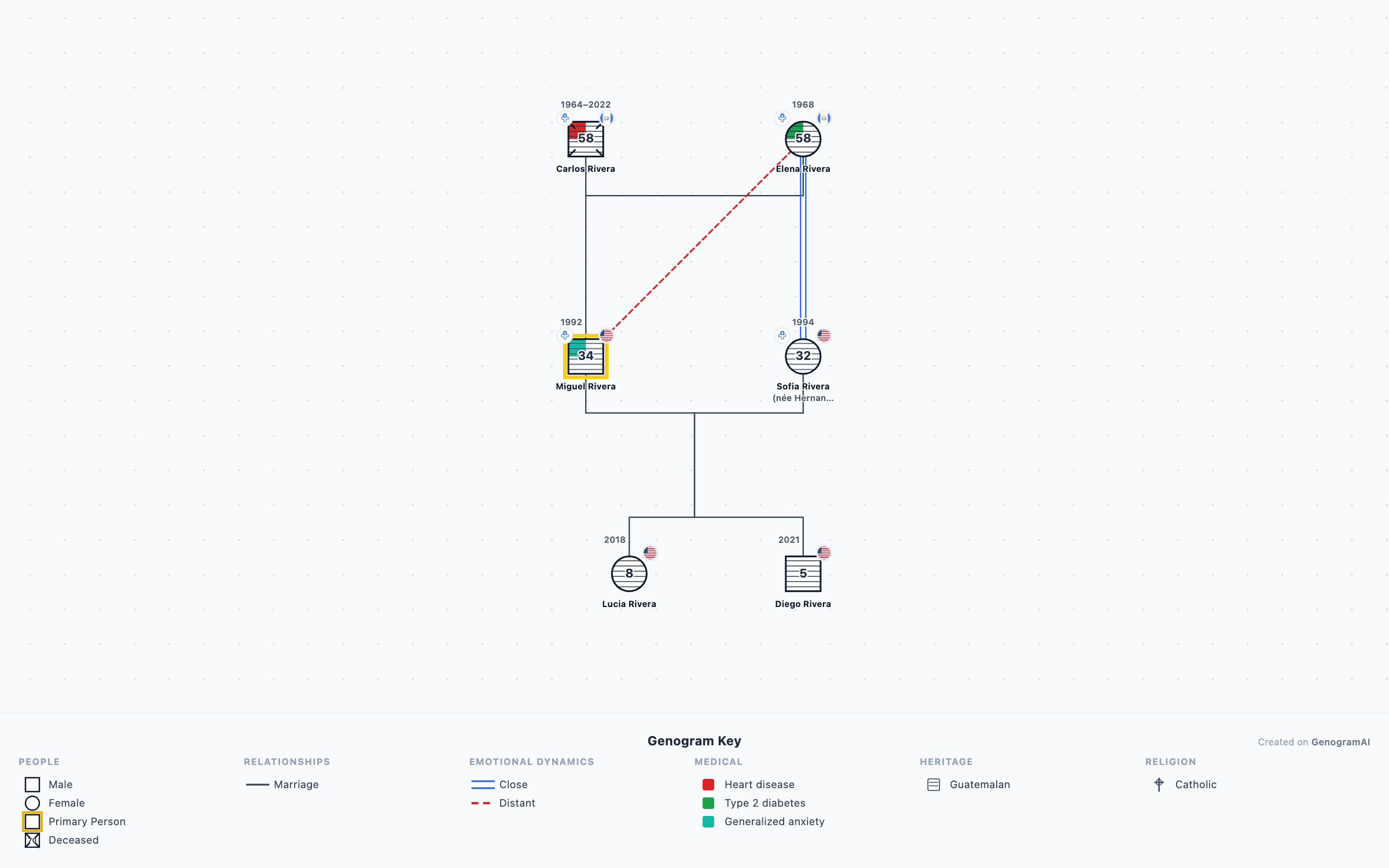
A community genogram mapping a Guatemalan immigrant family's connections to community resources including ESL programs, a local church, community health center.
Interactive Community Support Network Genogram
Click and drag to explore. Zoom with scroll.
Can't see the genogram? View in the GenogramAI Gallery
About This Genogram
A community genogram mapping a Guatemalan immigrant family's connections to community resources including ESL programs, a local church, community health center, public school system, and neighborhood support network. Demonstrates how institutional connections and barriers (language, transportation, documentation status) shape family functioning and resilience.
How to Read This Genogram
Standard genogram notation follows the conventions established by McGoldrick, Gerson, and Petry, which are widely adopted across social work, marriage and family therapy, psychology, and medicine. Squares represent male-identified individuals, circles represent female-identified individuals, and an X through either symbol indicates the person is deceased. Horizontal lines connect partners, with a single slash for separation and a double slash for divorce. Vertical and diagonal lines descend to children, who are arranged in birth order from left to right within a generation. A three-generation diagram is the minimum recommended for clinical use because it provides enough generational depth to identify repeating patterns.
Clinical applications range from intake assessment to treatment planning and outcome review. In a first session, a clinician sketching a genogram with a client gathers structural and historical data while simultaneously building rapport through collaborative storytelling. The resulting diagram then guides the clinician toward hypotheses about symptom function, family roles, and relational resources available to the client. In subsequent sessions the genogram can be updated as new information surfaces, and tracking those additions over time often reveals how the client's understanding of their own family history shifts in parallel with therapeutic progress.
Key Patterns in This Genogram
Family Structure
How this family structure is represented using standard genogram notation.
Relationship Patterns
Key relationship dynamics and emotional bonds within the family system.
Clinical Application
How professionals use this type of genogram in assessment and treatment.
Family Analysis
This community genogram maps the Rivera family — a 3-generation Guatemalan immigrant household comprising 8 family members — alongside 7 institutional connections and 4 identified community barriers. The index patient is María Rivera (b. 1980), a mother of three who presented at the community health center with somatic complaints later identified as anxiety related to her family's precarious documentation status. The genogram extends beyond the household to include the family's church (Iglesia Pentecostés), the county ESL program, the children's public school, a community health center, a neighborhood mutual aid network, and two employers. This ecological mapping reveals that the family's functioning cannot be understood apart from its institutional context.
The family's community resource utilization follows a gendered and generational pattern that carries significant clinical implications. Abuela Carmen (b. 1948), the family matriarch, maintains the strongest connection to the church community, which serves as her primary source of emotional support, social identity, and practical assistance. Her son-in-law Marco (b. 1977) interfaces primarily with his employer and a small network of male co-workers from the same region of Guatemala, creating an insular support system that provides economic stability but limited access to broader community resources. María occupies the critical middle position, serving as the family's primary interface with the health center, the children's school, and the ESL program. This concentration of institutional navigation labor in one family member creates a bottleneck effect — when María is overwhelmed or ill, the entire family's access to resources constricts.
The most clinically significant finding is the parentification of 14-year-old Isabella, who serves as the family's primary English-language cultural broker. Isabella translates at medical appointments, interprets school communications, negotiates with landlords, and explains legal documents. This role reversal — in which a child mediates between her parents and institutional authority — creates a power inversion that undermines parental hierarchy and places developmentally inappropriate burden on the adolescent. Isabella's recent decline in academic performance and emerging social withdrawal correlate with an increase in her brokering duties following the family's move to a new school district. The genogram makes visible what a purely intrafamilial assessment would miss: Isabella's symptoms are not simply a family dynamics issue but an ecological one rooted in the family's relationship to institutional systems.
Barrier mapping reveals four primary impediments to resource access: limited English proficiency (affecting Carmen, Marco, and María), lack of reliable transportation (the family shares one vehicle, which Marco uses for work), documentation-related fear (which prevents the family from accessing certain government services despite eligibility), and cultural mistrust of mental health services (rooted in both stigma and previous negative experiences with authority figures). These barriers interact synergistically — for example, the combination of limited English and documentation fear means María avoids the emergency room even when medically indicated, instead relying on the community health center's limited hours. The genogram reveals that the neighborhood mutual aid network partially compensates for institutional barriers, with neighbors providing childcare, transportation, and informal health advice, but this network is itself fragile and dependent on the undocumented status of its members.
Clinically, this community genogram reframes the presenting problem from an individual anxiety disorder to a systemic issue of ecological stress. Effective intervention requires not only individual or family therapy but also community-level advocacy: connecting the family with a bilingual patient navigator, reducing Isabella's brokering burden through professional interpretation services, strengthening María's direct institutional access through ESL advancement, and addressing documentation-related anxiety through legal consultation. The genogram serves as both a clinical assessment tool and an advocacy document, making visible the structural inequities that shape this family's daily functioning. For practitioners working with immigrant families, the community genogram is an essential complement to traditional family assessment.
Build a Similar Genogram
A practitioner documenting a family similar to this one would typically record three generations of household composition, significant life events such as births, deaths, marriages, and separations, any relevant medical or mental health history, and the quality of key relationships between members. That information comes from a combination of the client's verbal account, intake questionnaires, and, where available, collateral records. The completed diagram captures both the factual structure of the family and the practitioner's clinical observations about relational patterns, making it a reference that can be shared across disciplines or reviewed at future stages of treatment.
GenogramAI's AI genogram generator allows you to build a diagram like this one from a plain-language description of the family. You type or paste a narrative, such as the basic structure and any key relationships or health history you want to include, and the AI parses that text, places the correct symbols, draws the appropriate relationship lines, and arranges the layout automatically. The result is a fully editable diagram that you can refine, annotate, and export for clinical records or educational use. Try the AI genogram creator to generate your own genogram from a text description in seconds.
Genogram Symbols Used in This Example
The following standard genogram symbols appear in the Community Support Network Genogram. Each symbol follows McGoldrick and Gerson clinical notation conventions.
Person Symbols
- Male (Square)
- A square represents a male family member in standard genogram notation.
- Female (Circle)
- A circle represents a female family member in standard genogram notation.
Status Markers
- Index Patient (Arrow)
- An arrow pointing to a person identifies them as the index patient — the individual who is the focus of the clinical assessment.
- Institution (Hexagon)
- A hexagon represents an institutional or community resource connected to the family system.
Structural Relationships
- Marriage
- A solid horizontal line connecting two individuals represents a marriage or committed partnership.
- Parent-Child
- A vertical line descending from a couple line to a child symbol represents a parent-child relationship.
- Resource Connection
- A line connecting a family member to an institution represents active utilization of that community resource.
Emotional Relationships
- Close
- Two parallel lines between individuals represent an emotionally close relationship.
- Distant
- A dotted line represents an emotionally distant or disengaged relationship.
- Conflict
- A zigzag line between individuals represents an openly conflictual relationship.
- Barrier
- A line with a perpendicular bar indicates an institutional barrier impeding resource access.
Related Resources
- Learn how genograms in social work professionals use community-level genograms to map family ecosystems.
- Explore how cultural genograms capture the influence of heritage and identity on family patterns.
- This example uses the close relationship symbol to denote strong community bonds.
- The distant relationship symbol indicates limited or impeded access to resources.
Frequently Asked Questions
What is a community genogram and how does it differ from a traditional family genogram?
How does the Community Support Network genogram illustrate institutional barriers for immigrant families?
What clinical insights does mapping community resources on a genogram provide?
Can community genograms be used in non-clinical settings like schools or community organizations?
Related Genogram Examples
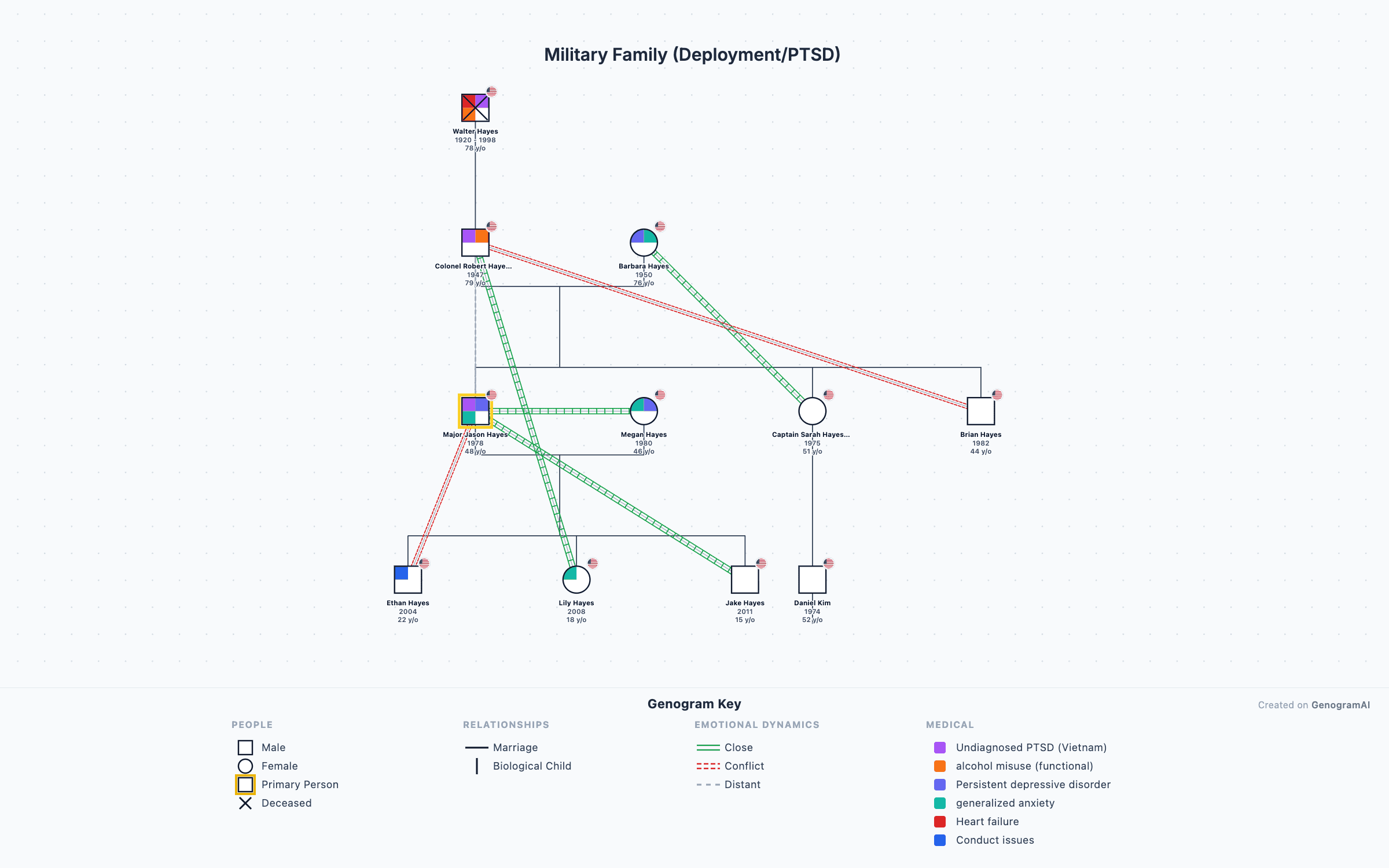
Military Family (Deployment/PTSD)
A multi-generational military family genogram illustrating the cumulative effects of combat deployment across three generations: Vietnam, Iraq, and Afghanistan.
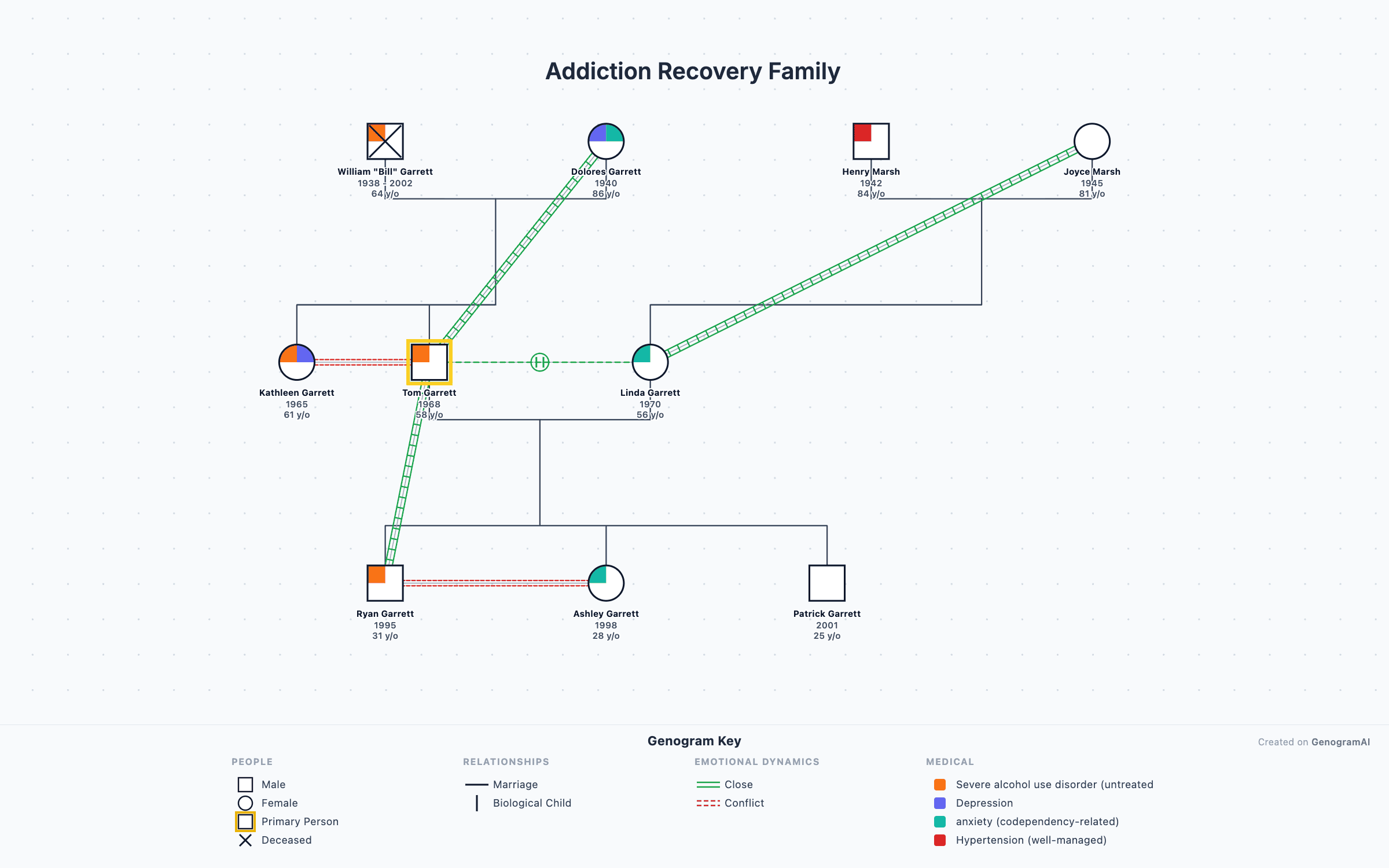
Addiction Recovery Family
A family genogram illustrating multiple generations of addiction and recovery, showing the full spectrum from active addiction to long-term sobriety.
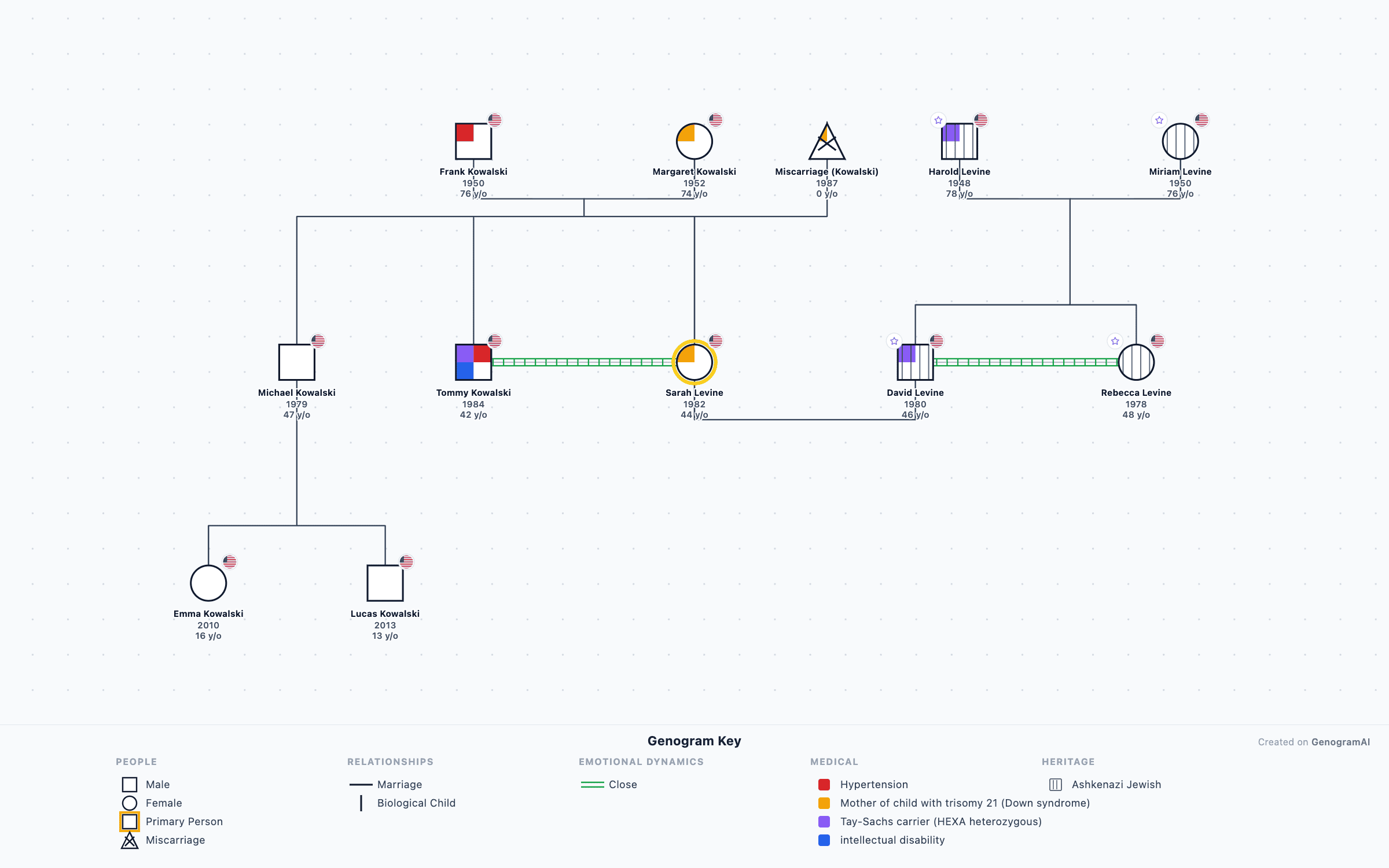
Genetic Counseling Genogram
A genetic counseling genogram for a couple seeking pre-conception genetic counseling.
Create Your Own Genogram
Use GenogramAI to build your own family genogram with AI assistance. Describe your family and let AI do the rest.
Educational disclaimer: This genogram example is an educational illustration of genogram notation and family systems concepts. Examples based on public figures use publicly available information. They are not clinical documents. All examples are intended for learning genogram symbols and patterns.