Pastoral Family Faith Patterns
A 3-generation genogram of a Korean-American pastoral family exploring how faith traditions, church leadership roles.
Interactive Pastoral Family Faith Patterns
Click and drag to explore. Zoom with scroll.
Can't see the genogram? View in the GenogramAI Gallery
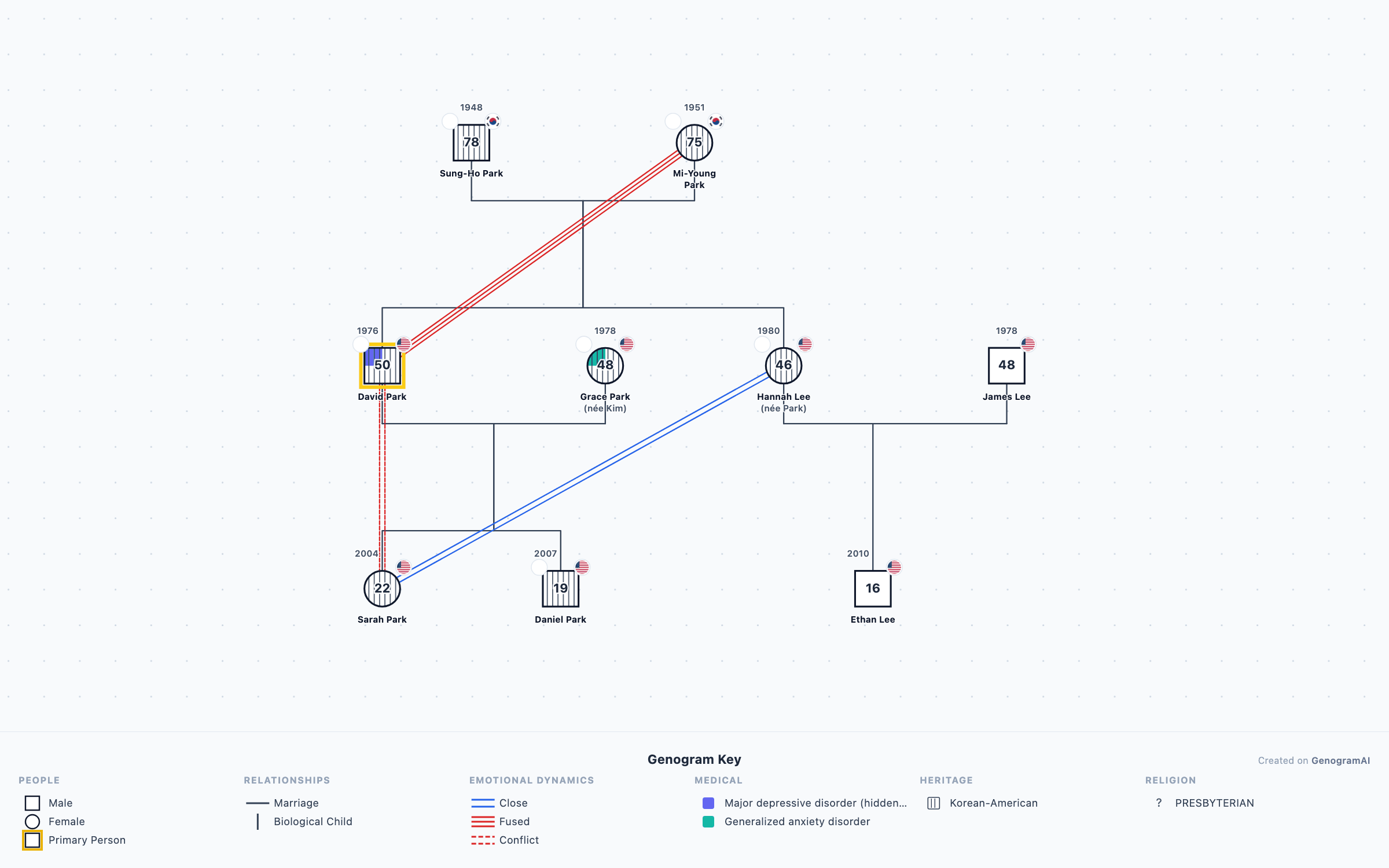
About This Genogram
A 3-generation genogram of a Korean-American pastoral family exploring how faith traditions, church leadership roles, and religious expectations shape family dynamics. Maps denominational shifts, interfaith tensions, faith deconstruction in the youngest generation, and the unique pressures of "PK" (pastor's kid) identity on family relationships.
How to Read This Genogram
Standard genogram notation follows the conventions established by McGoldrick, Gerson, and Petry, which are widely adopted across social work, marriage and family therapy, psychology, and medicine. Squares represent male-identified individuals, circles represent female-identified individuals, and an X through either symbol indicates the person is deceased. Horizontal lines connect partners, with a single slash for separation and a double slash for divorce. Vertical and diagonal lines descend to children, who are arranged in birth order from left to right within a generation. A three-generation diagram is the minimum recommended for clinical use because it provides enough generational depth to identify repeating patterns.
Clinical applications range from intake assessment to treatment planning and outcome review. In a first session, a clinician sketching a genogram with a client gathers structural and historical data while simultaneously building rapport through collaborative storytelling. The resulting diagram then guides the clinician toward hypotheses about symptom function, family roles, and relational resources available to the client. In subsequent sessions the genogram can be updated as new information surfaces, and tracking those additions over time often reveals how the client's understanding of their own family history shifts in parallel with therapeutic progress.
Key Patterns in This Genogram
Family Structure
How this family structure is represented using standard genogram notation.
Relationship Patterns
Key relationship dynamics and emotional bonds within the family system.
Clinical Application
How professionals use this type of genogram in assessment and treatment.
Family Analysis
This 3-generation genogram maps 12 members of the Park family, a Korean-American pastoral dynasty in which church leadership and family identity have been intertwined for over 50 years. The index patient is Pastor David Park (b. 1968), senior pastor of a 1,200-member Korean-American church, who presents with burnout, marital distance, and anxiety about his children's diverging faith trajectories. The genogram reveals that David is the third generation of church leaders: his grandfather founded a Korean Presbyterian church in Seoul, his father planted the first Korean immigrant church in their American city, and David transitioned that church from a traditional Korean-language ministry to a bilingual, nondenominational megachurch model. Each generational shift in ecclesiology created rifts that map directly onto family emotional patterns.
The family's relational structure is organized around what Murray Bowen would recognize as a profoundly fused family-institutional system. The Park family does not merely attend church — they are the church. David's wife Grace (b. 1971) serves as women's ministry director, his mother leads the Korean-language prayer group, and family meals regularly include church elders. This fusion means that congregational crises (a budget shortfall, a staff affair, a worship style controversy) land directly in the family's emotional field. The genogram maps multiple instances where church conflict triggered family conflict: when a faction opposed David's bilingual transition, his father sided with the opposition, creating a father-son cutoff that lasted 18 months and was experienced by the family as both a relational and a theological betrayal.
The three Park children illustrate three distinct adaptive strategies for managing the fishbowl pressure of clergy family life. Daniel (b. 1993), the eldest, adopted the compliant strategy: he attended a Christian university, married a pastor's daughter, and enrolled in seminary, essentially replicating his father's path. His compliance, however, masks significant resentment about his lack of vocational autonomy, which emerges in passive-aggressive conflict with his wife. Grace-Anna (b. 1996), the middle child, chose overt differentiation: she left the family church, began dating a Catholic man, and openly questioned evangelical theology, triggering a family crisis that the parents frame as spiritual rebellion rather than healthy individuation. Samuel (b. 2001), the youngest, occupies the most psychologically precarious position: he has privately deconstructed his faith but continues to perform belief for the congregation, creating a false-self adaptation that generates anxiety, depressive symptoms, and a growing sense of inauthenticity.
The genogram reveals a multigenerational pattern in which theological disagreement functions as the family's idiom for expressing relational conflict. When David's father opposed the bilingual transition, the family fought about ecclesiology rather than addressing the underlying issue of the elder Park's fear of cultural erasure. When Grace-Anna began dating a Catholic partner, the family debated interfaith theology rather than confronting their anxiety about losing control of their daughter's identity. This theologization of relational conflict is a defense mechanism specific to clergy families: it allows the family to avoid vulnerable emotional engagement by rerouting disagreements through doctrinal frameworks that carry inherent authority. The therapist working with this family must learn to hear the relational content beneath the theological language.
Clinical intervention with the Park family requires a dual-system approach that addresses both the family system and the church system simultaneously. David's burnout cannot be treated as an individual condition — it is a systemic symptom of a family-church fusion that has eliminated all boundaries between public ministry and private life. Therapy should focus on helping David and Grace establish a differentiated family identity that exists apart from their pastoral roles, supporting Samuel's faith exploration without pathologizing doubt, reframing Grace-Anna's departure as differentiation rather than apostasy, and addressing the unresolved cutoff with David's father before it calcifies into permanent estrangement. The genogram serves as a crucial tool for helping this family see the church system as an external force acting upon them, rather than an intrinsic part of their family identity — a distinction that is emotionally revolutionary for families that have never known any other way of being.
Build a Similar Genogram
A practitioner documenting a family similar to this one would typically record three generations of household composition, significant life events such as births, deaths, marriages, and separations, any relevant medical or mental health history, and the quality of key relationships between members. That information comes from a combination of the client's verbal account, intake questionnaires, and, where available, collateral records. The completed diagram captures both the factual structure of the family and the practitioner's clinical observations about relational patterns, making it a reference that can be shared across disciplines or reviewed at future stages of treatment.
GenogramAI's AI genogram generator allows you to build a diagram like this one from a plain-language description of the family. You type or paste a narrative, such as the basic structure and any key relationships or health history you want to include, and the AI parses that text, places the correct symbols, draws the appropriate relationship lines, and arranges the layout automatically. The result is a fully editable diagram that you can refine, annotate, and export for clinical records or educational use. Try the AI genogram creator to generate your own genogram from a text description in seconds.
Genogram Symbols Used in This Example
The following standard genogram symbols appear in the Pastoral Family Faith Patterns. Each symbol follows McGoldrick and Gerson clinical notation conventions.
Person Symbols
- Male (Square)
- A square represents a male family member in standard genogram notation.
- Female (Circle)
- A circle represents a female family member in standard genogram notation.
Status Markers
- Deceased (X)
- An X drawn through the symbol indicates the person is deceased.
- Index Patient (Arrow)
- An arrow pointing to a person identifies them as the index patient — the individual who is the focus of the clinical assessment.
Structural Relationships
- Marriage
- A solid horizontal line connecting two individuals represents a marriage or committed partnership.
- Parent-Child
- A vertical line descending from a couple line to a child symbol represents a parent-child relationship.
Emotional Relationships
- Close
- Two parallel lines between individuals represent an emotionally close relationship.
- Enmeshed
- Three parallel lines indicate a fused or enmeshed relationship with poor boundary differentiation.
- Distant
- A dotted line represents an emotionally distant or disengaged relationship.
- Conflict
- A zigzag line between individuals represents an openly conflictual relationship.
- Cutoff
- A line with a break or fence marks indicates a severed or estranged relationship.
Related Resources
- Explore how cultural genograms capture the influence of heritage and faith traditions on family dynamics.
- The cutoff relationship symbol in this genogram marks the estrangement between father and son over church direction.
- This example uses the enmeshed relationship symbol to indicate fused family-church boundaries.
- The conflict relationship symbol marks theological disagreements that function as relational conflict.
Frequently Asked Questions
What unique dynamics does a pastoral family genogram reveal that other genograms do not?
How does the 'PK' (pastor's kid) identity appear in this genogram?
What role do denominational and interfaith tensions play in this genogram?
How can therapists use this genogram in pastoral counseling contexts?
Related Genogram Examples
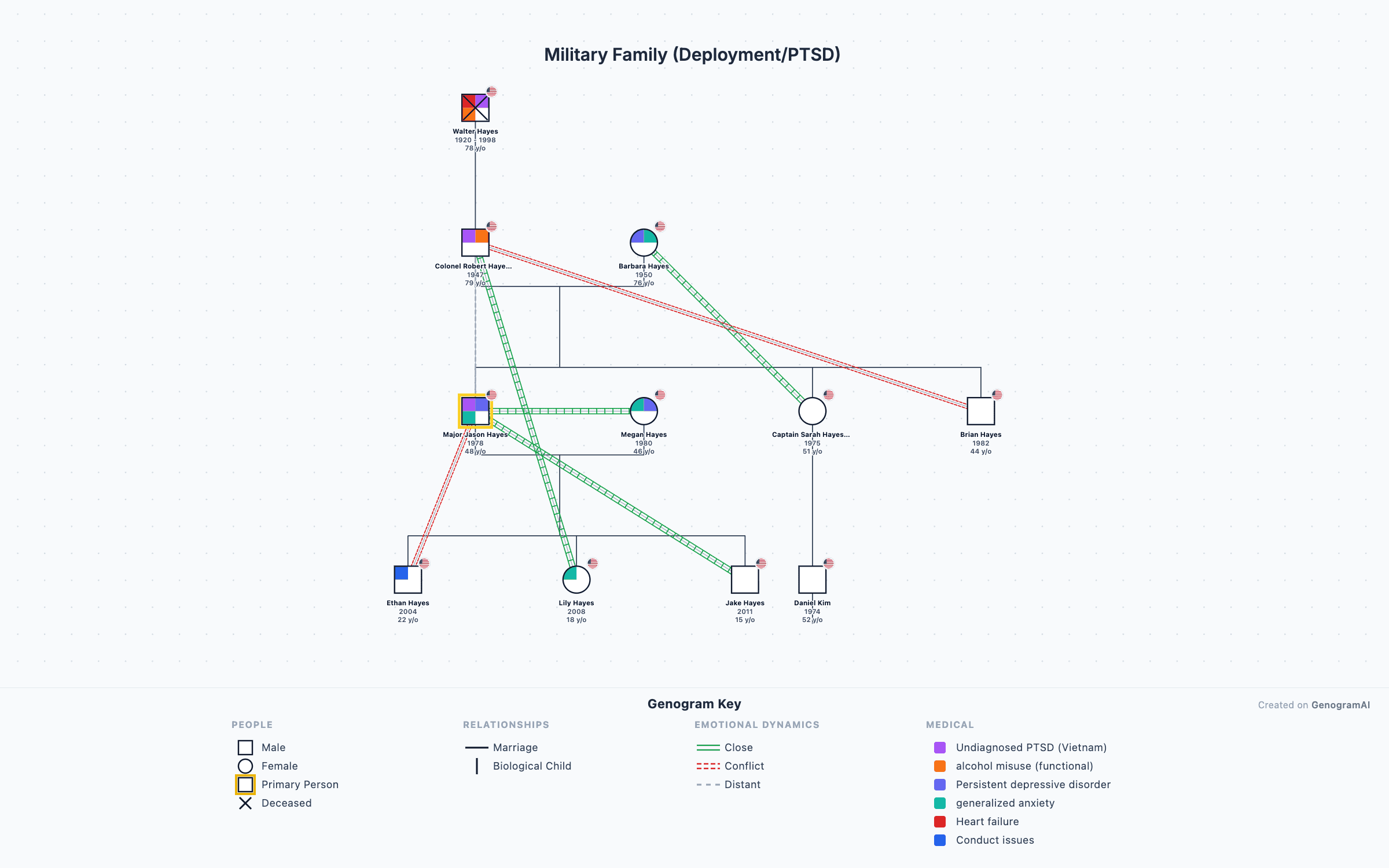
Military Family (Deployment/PTSD)
A multi-generational military family genogram illustrating the cumulative effects of combat deployment across three generations: Vietnam, Iraq, and Afghanistan.
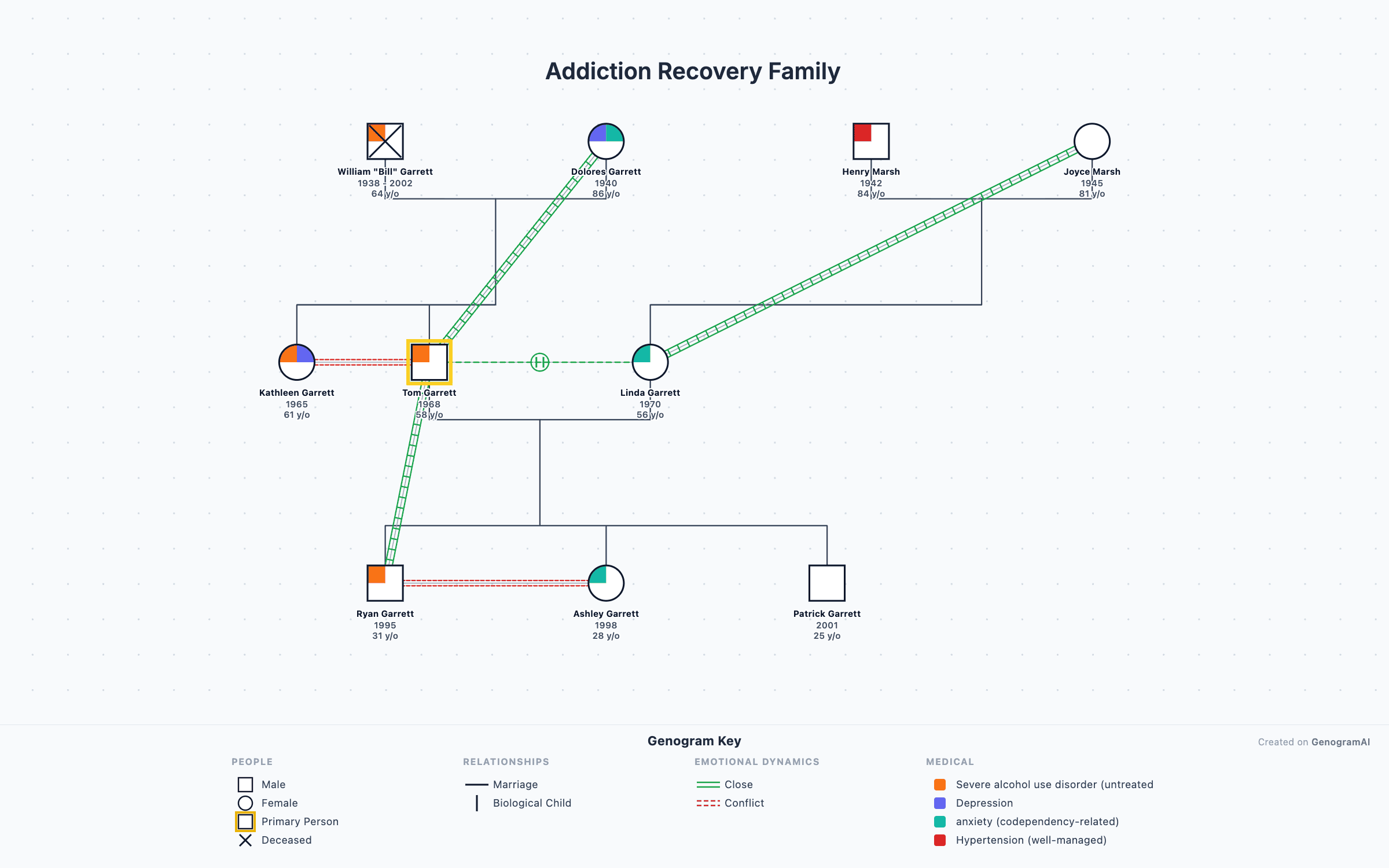
Addiction Recovery Family
A family genogram illustrating multiple generations of addiction and recovery, showing the full spectrum from active addiction to long-term sobriety.
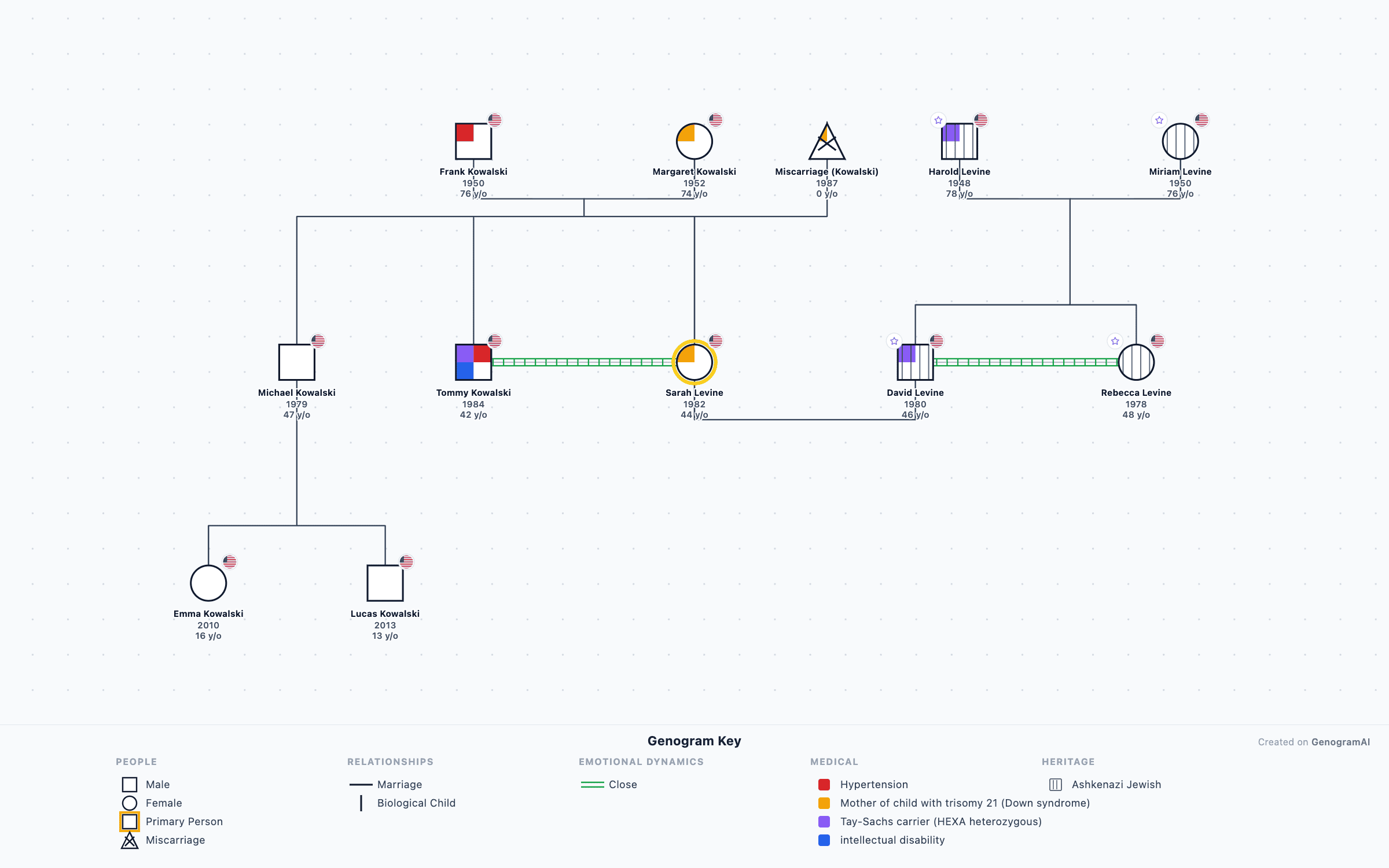
Genetic Counseling Genogram
A genetic counseling genogram for a couple seeking pre-conception genetic counseling.
Create Your Own Genogram
Use GenogramAI to build your own family genogram with AI assistance. Describe your family and let AI do the rest.
Educational disclaimer: This genogram example is an educational illustration of genogram notation and family systems concepts. Examples based on public figures use publicly available information. They are not clinical documents. All examples are intended for learning genogram symbols and patterns.