Refugee Resettlement Across Three Generations
Genogram of a Syrian refugee family across five countries: displacement, a missing brother, PTSD, language brokering and resettlement in Canada.
Interactive Refugee Resettlement Across Three Generations
Click and drag to explore. Zoom with scroll.
Can't see the genogram? View in the GenogramAI Gallery
About This Genogram
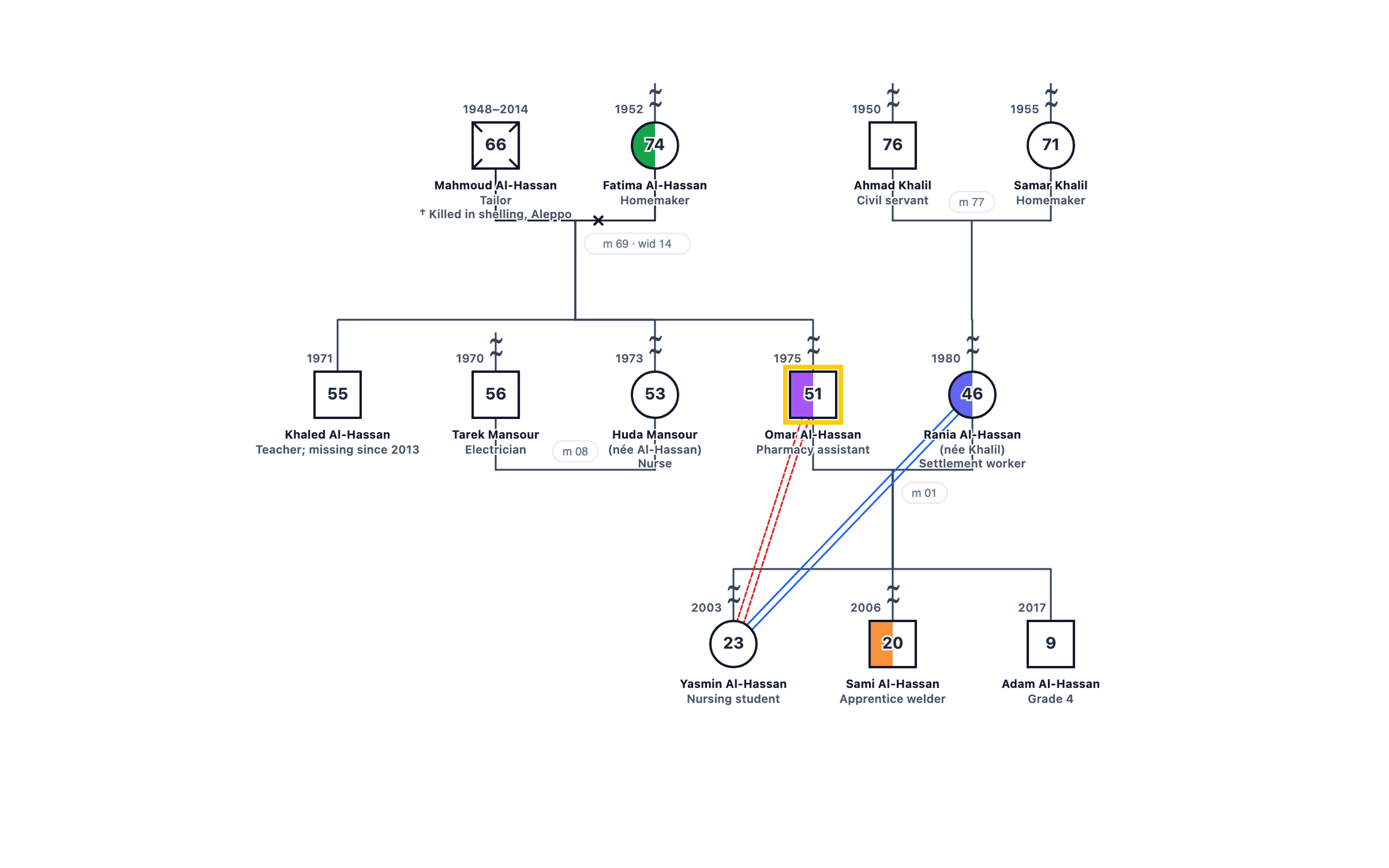
A three-generation genogram of a fictional Syrian family displaced by war and spread across Syria, Turkey, Jordan, Germany and Canada. It shows a father killed in the conflict, a brother missing since 2013, immigration markers and country flags, PTSD and depression, a daughter who became the family’s language broker and the first child born in Canada.
How to Read This Genogram
Cultural genograms extend the standard notation to capture heritage, immigration history, and the values or practices a family carried across geographic and generational transitions. Country of origin is often noted beside or below a generation's symbols, and arrows or migration lines track when and where family members relocated. Dates of immigration anchor those movements in historical context, which matters because the political or economic conditions that prompted a move frequently shape the story the family tells about itself and the coping strategies it transmitted to the next generation.
Reading a cultural genogram well requires attending to what changed at each generational boundary and what remained constant. Language retention, religious practice, occupational patterns, and naming conventions are all data points that appear in or alongside the diagram. When a cultural practice persists across three generations in a new country, it often carries psychological weight for the family and deserves attention in assessment. When it disappears in one generation and reappears in the next, that gap can mark a period of assimilation stress or intergenerational conflict worth exploring in a clinical or educational context.
Key Patterns in This Genogram
Cultural Context
How cultural values and traditions shape family structure and relationships.
Family Roles
Culturally defined family roles, expectations, and intergenerational dynamics.
Immigration & Adaptation
How families navigate cultural transitions while maintaining identity and bonds.
Family Analysis
Omar Al-Hassan (51) was a pharmacist in Aleppo. In 2012 he, his wife Rania and their two children fled to Jordan, where they spent two years in a refugee camp before government-sponsored resettlement to Toronto in 2016. His father Mahmoud was killed in shelling in 2014; his mother Fatima lives in Gaziantep, Turkey. His older brother Khaled was detained in 2013 and has not been heard from since. His sister Huda and her husband reached Germany in 2015.
The genogram shows a family that is intact in Canada but scattered across five countries, and two kinds of loss: a confirmed death and an ambiguous one. Omar’s PTSD and Rania’s depression are recorded with medical shading. Rania’s parents remain in Amman. Adam, born in 2017, is the first family member born in Canada and has no immigration marker, a small detail that often matters to families.
Yasmin (23), now a nursing student, became the family’s interpreter at 13. Her close line with her mother and conflict line with her father capture a common pattern in resettled families: the child who adapts fastest gains authority that unsettles the parent who lost the most status. Sami’s ADHD, diagnosed in Canada, adds school pressures. A culturally informed clinician can use the chart to talk about all of this without asking the family to retell the whole story.
Build a Similar Genogram
A practitioner documenting a family similar to this one would typically record three generations of household composition, significant life events such as births, deaths, marriages, and separations, any relevant medical or mental health history, and the quality of key relationships between members. That information comes from a combination of the client's verbal account, intake questionnaires, and, where available, collateral records. The completed diagram captures both the factual structure of the family and the practitioner's clinical observations about relational patterns, making it a reference that can be shared across disciplines or reviewed at future stages of treatment.
GenogramAI's AI genogram generator allows you to build a diagram like this one from a plain-language description of the family. You type or paste a narrative, such as the basic structure and any key relationships or health history you want to include, and the AI parses that text, places the correct symbols, draws the appropriate relationship lines, and arranges the layout automatically. The result is a fully editable diagram that you can refine, annotate, and export for clinical records or educational use. Try the AI genogram creator to generate your own genogram from a text description in seconds.
Genogram Symbols Used in This Example
The following standard genogram symbols appear in the Refugee Resettlement Across Three Generations. Each symbol follows McGoldrick and Gerson clinical notation conventions.
Person Symbols
- Male (Square)
- A square represents a male family member.
- Female (Circle)
- A circle represents a female family member.
- Index person (highlighted outline)
- The person at the centre of the assessment is drawn with a highlighted outline.
- Deceased (X)
- An X through the symbol marks a person who has died; birth and death years are written above it.
- Age inside the symbol
- The current age (or age at death) is written inside each symbol, with years above it.
Migration
- Immigration marker
- A double wavy mark on a person’s line records immigration; a single wavy mark records living across two cultures.
Couples
- Marriage
- A solid line between partners; the marriage year is written on the line (m 90 = married 1990).
- Widowed
- A small x on the couple line marks the end of a marriage through death (wid 15).
Emotional Relationships
- Close
- Two parallel blue lines mark an emotionally close relationship.
- Conflict
- Dashed red double lines mark open conflict.
Medical
- Medical shading
- The left half of a symbol is shaded for a physical or mental illness and the bottom half for alcohol or drug use; each condition has its own colour, listed in the key. Hatching means suspected, a partial fill means in recovery.
Related Resources
- Read about the immigration symbol.
- A cultural genogram adds heritage, language and migration history.
- Compare with our transnational family genogram.
- The conflict relationship symbol marks the tension between Yasmin and her father.
Frequently Asked Questions
How is immigration shown on a genogram?
How do you show a relative who is missing?
What is language brokering and why does it matter?
Can I build a migration genogram in other languages?
Related Genogram Examples
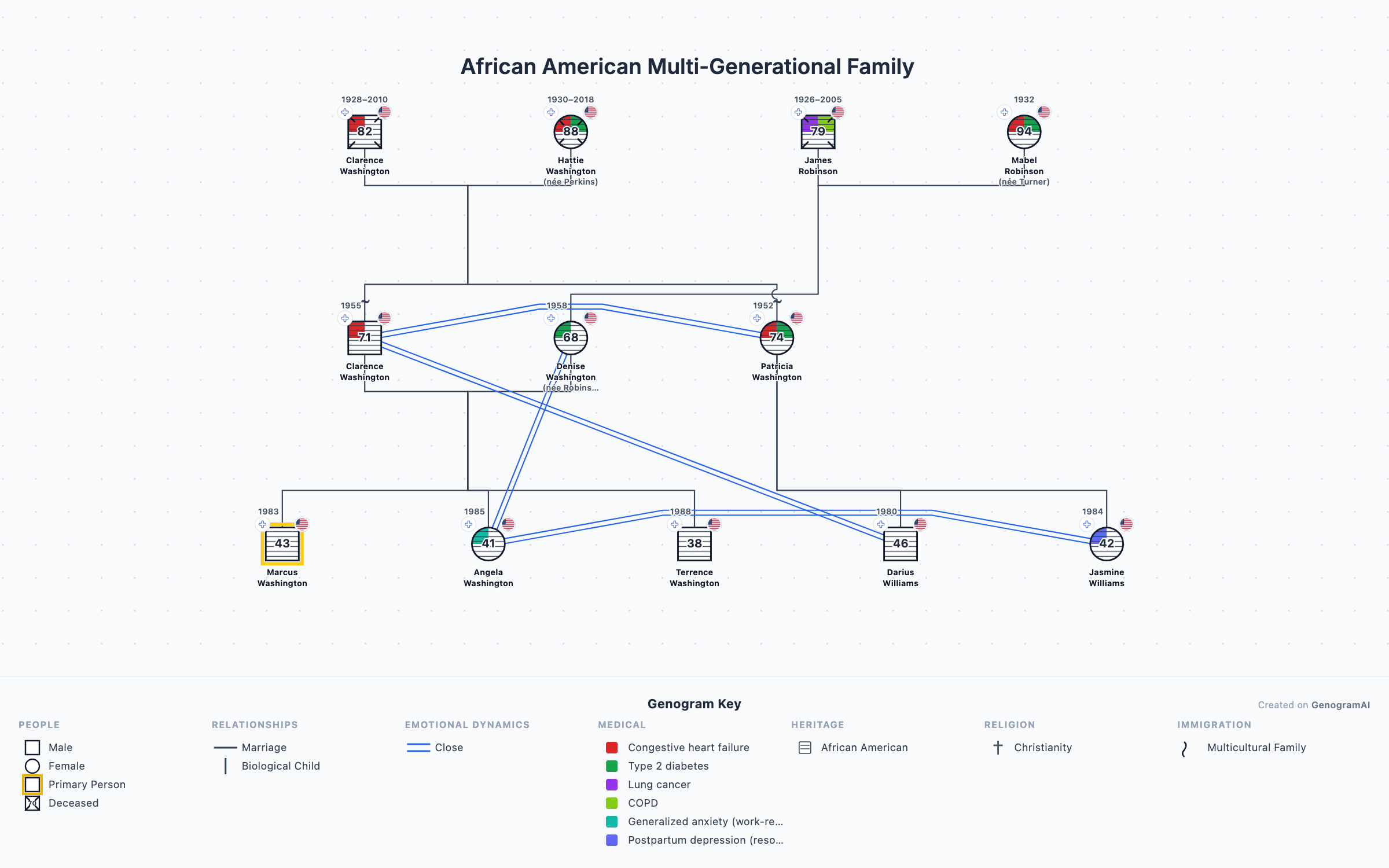
African American Multi-Generational Family
A three-generation African American family genogram tracing roots from the rural South through the Great Migration to Chicago.
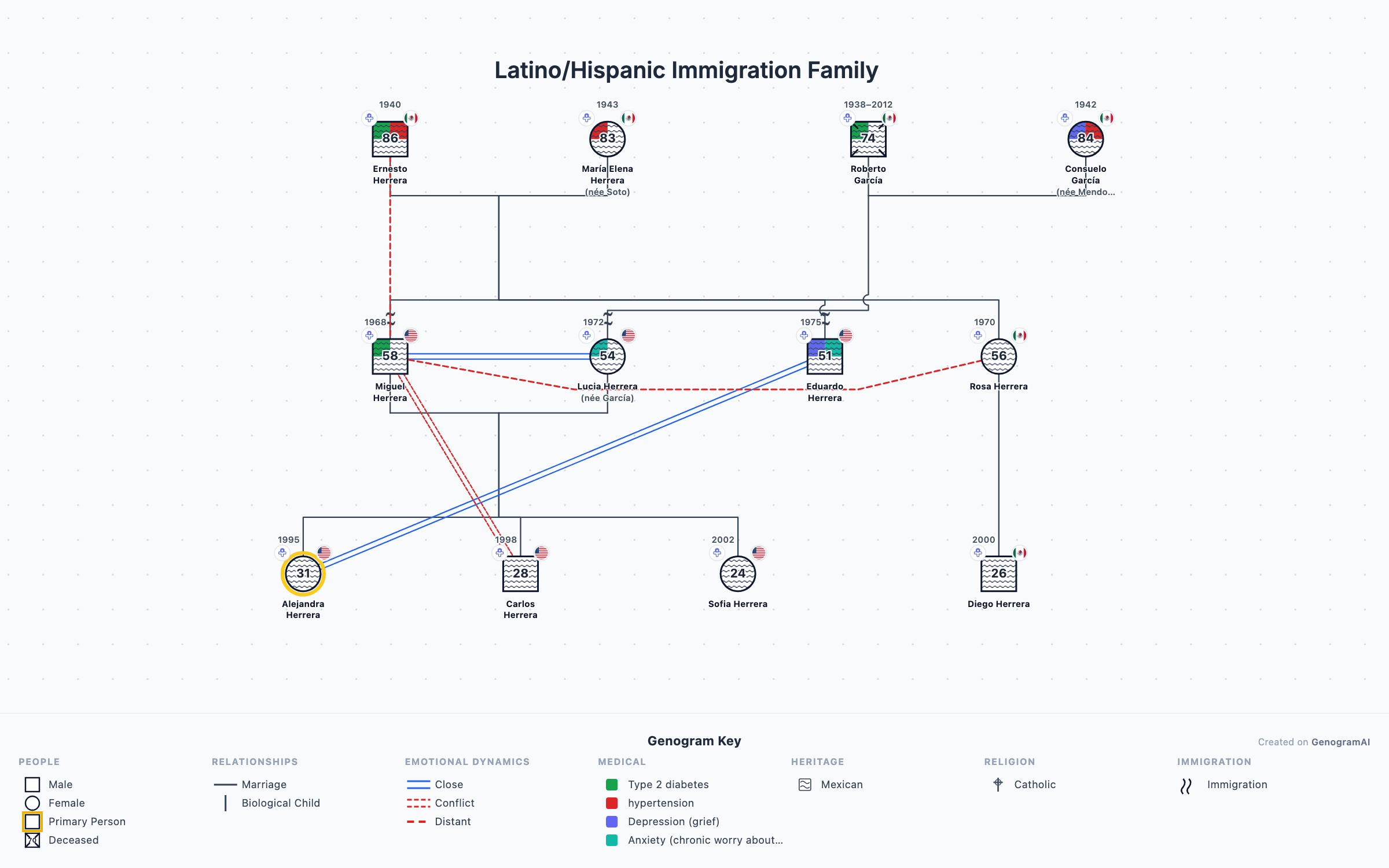
Latino/Hispanic Immigration Family
A three-generation Mexican-American family genogram illustrating the immigration experience across the U.S.-Mexico border.
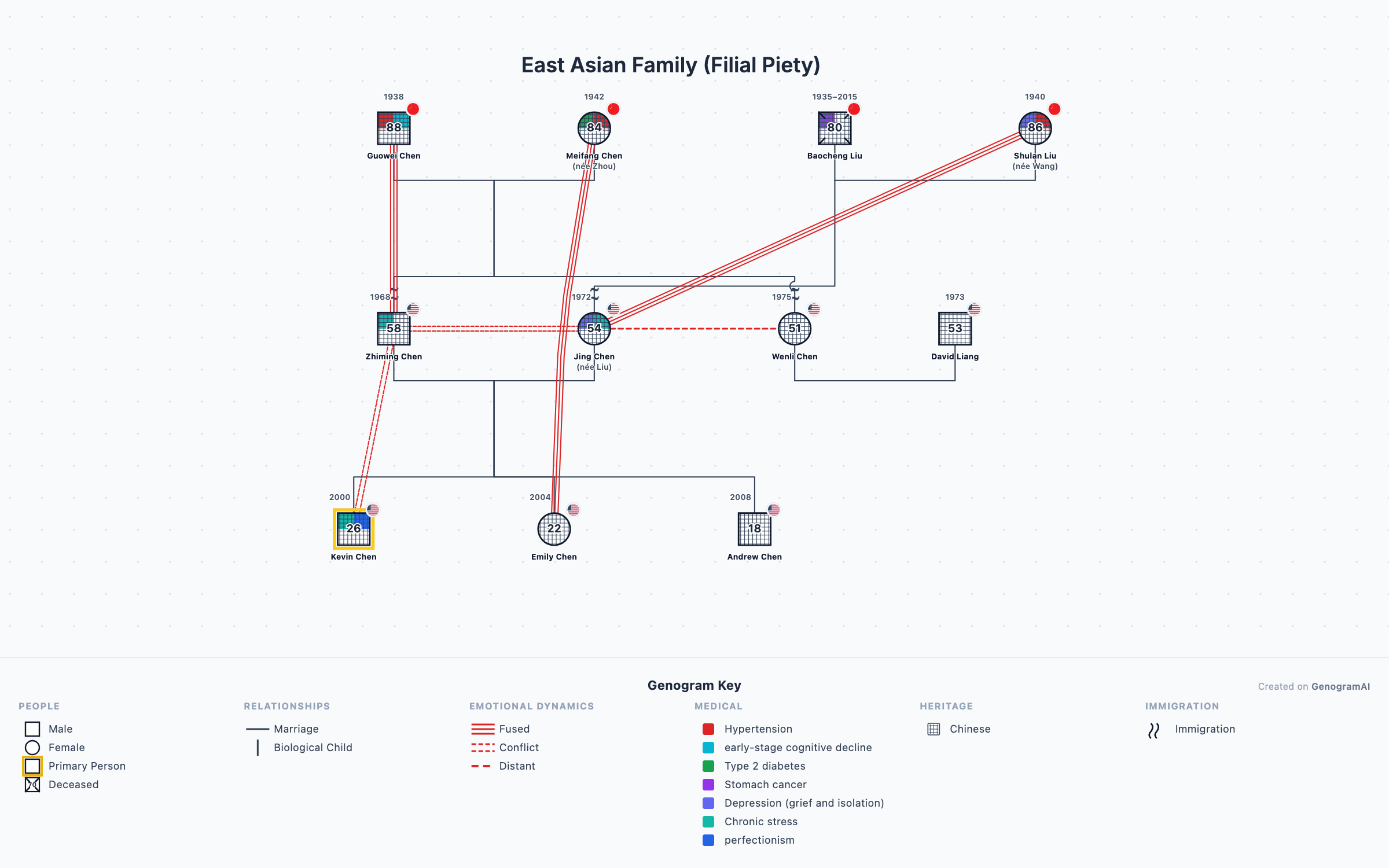
East Asian Family (Filial Piety)
A three-generation Chinese-American family genogram illustrating the dynamics of filial piety (xiào), Confucian family values.
Create Your Own Genogram
Use GenogramAI to build your own family genogram with AI assistance. Describe your family and let AI do the rest.
Educational disclaimer: This genogram example is an educational illustration of genogram notation and family systems concepts. Examples based on public figures use publicly available information. They are not clinical documents. All examples are intended for learning genogram symbols and patterns.