Free genogram template
Immigration and Cultural Genogram Template
Quick answer
Download the immigration and cultural genogram template
- Blank template (PDF)US Letter, print and fill in by hand
- Editable PowerPoint (.pptx)Every symbol and line is a shape; opens in Google Slides and Keynote
- Filled example + blank (PDF)Two pages: the example with its key, then the blank
- High-resolution example (PNG)2400 px wide, free to reuse with credit
- Vector blank (SVG)Edit in Illustrator, Inkscape, Figma or Canva
When to use a immigration and cultural genogram template
Use this template when migration is part of the family’s story: grandparents who stayed in the country of origin, parents who moved as adults, children born in the new country. Writing the country of birth and the year of each move under every person shows the shape of the migration at a glance: who moved first, who followed, who was left behind, and which generation grew up between two languages.
The notes section prompts for the things that most often explain intergenerational conflict in immigrant families: languages spoken at home, religion and practice, the migration story (including documentation status where safe to record), and the values each generation holds. Record these carefully and only with consent; immigration status can be sensitive in clinical records.
For a full cultural genogram covering ethnicity, class, gender and spirituality in depth, see the Cultural Genogram guide. If the family shares one home across three generations, combine this with the Multigenerational Household Genogram Template.
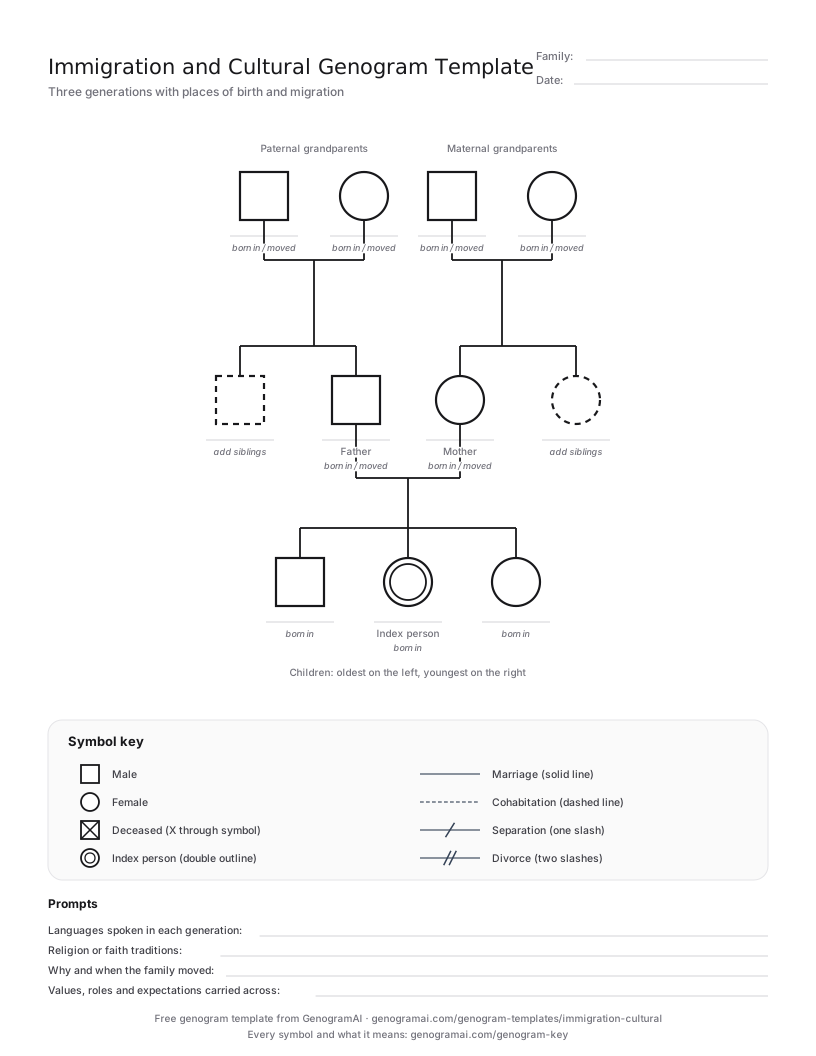
The blank template and a filled-in example
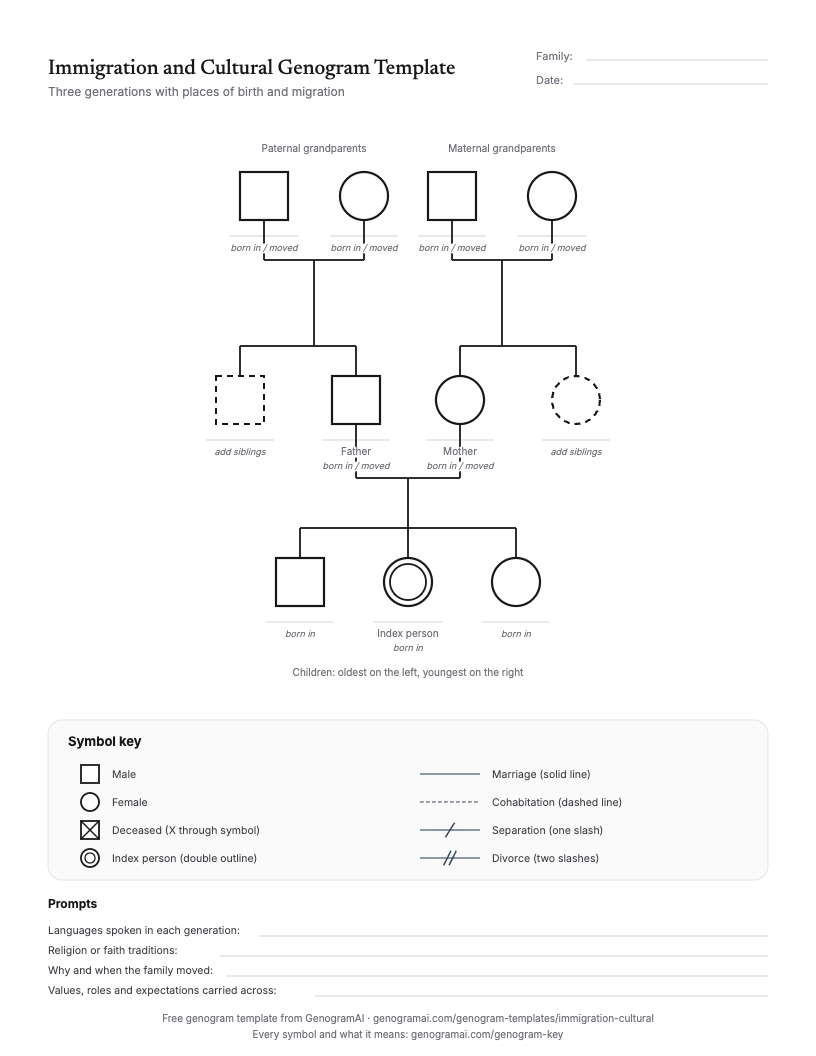
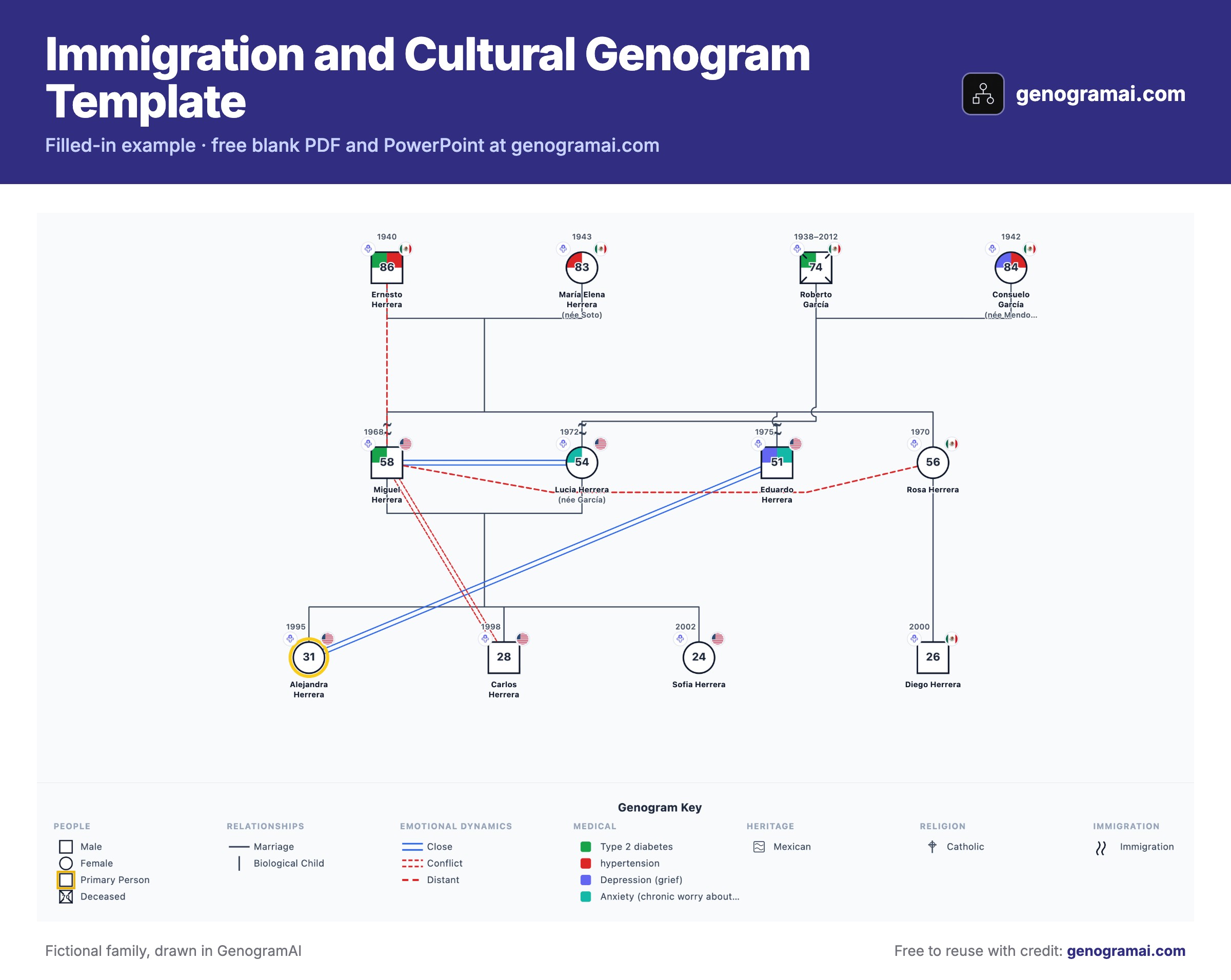
Open this example in GenogramAI to start from the finished layout: it copies into your account (the Free plan holds 2 genograms) and every person, line and condition stays editable.
How to fill in a immigration and cultural genogram template
- 1
Draw three generations
Grandparents, parents and the index person with siblings, with partner and child lines. - 2
Fill in the migration lines
Under each person write where they were born and the year they moved, if they did. - 3
Answer the prompts
Note languages, religion, the migration story and the values each generation holds. - 4
Add relationships
Show closeness, distance and conflict, especially across generations and borders.
Symbols this template uses
| Symbol | What it means |
|---|---|
| Country label or flag | Country of birth. GenogramAI can show a flag beside each person. |
| Migration marker | A person who migrated; GenogramAI has single and double immigration markers for one or more moves. |
| "Moved" year | The year each person migrated, written under the symbol. |
| Dashed red line | Distant: often between relatives separated by migration. |
| Two dashed red lines | Conflict, for example between generations with different values or languages. |
| Two blue lines | Close: bonds maintained across borders. |
Common mistakes to avoid
- Recording only the index person’s migration. The pattern is in who moved when across the whole family.
- Writing documentation status on a chart that will be shared without consent. Keep sensitive details in protected notes.
- Ignoring relatives who stayed behind. Separation from them is often the emotional centre of the story.
- Treating one generation’s culture as the family’s culture. Note how each generation differs.
Who uses this template?
Multicultural counselors, family therapists, social workers with immigrant and refugee families, school counselors, and students completing cultural genogram assignments.
Common uses
- Therapy with immigrant and second-generation families
- Acculturation and intergenerational conflict
- Refugee and resettlement casework
- Cultural genogram assignments in counseling programs
- Family separation and reunification across borders
What the template covers
- Three-generation layout with "born in / moved" lines
- Header for family name and date
- Prompts for language, religion, migration story and values
- Key with basic symbols and partner lines
- Editable PowerPoint and SVG versions
What is free?
Free and paid, plainly
Frequently asked questions
How do you show immigration on a genogram?
Write each person’s country of birth and the year they moved under their symbol. GenogramAI can also show a flag and an immigration marker, which makes the pattern of migration visible at a glance.
What is the difference between this and a cultural genogram?
This template focuses on migration and the generational differences it creates. A cultural genogram goes further into ethnicity, class, religion, gender roles and identity; see the Cultural Genogram guide for that approach.
Should I record documentation status?
Only when it is relevant, the family consents, and the record is protected. In shared documents, a general note such as "mixed status household" is often enough.
How do I show relatives who stayed in the home country?
Draw them in their usual place with their country under the symbol, and use emotional lines to show how contact has changed since the family moved.
Further Reading
- Hardy, K.V., & Laszloffy, T.A. — The Cultural Genogram: Key to Training Culturally Competent Family Therapists. Journal of Marital and Family Therapy, 21(3), 227-237, 1995
- McGoldrick, M., Giordano, J., & Garcia-Preto, N. (Eds.) — Ethnicity and Family Therapy (3rd ed.). Guilford Press, 2005
- McGoldrick, M., Gerson, R., & Petry, S. — Genograms: Assessment and Treatment (4th ed.). W.W. Norton & Company, 2020