Free genogram template
Multigenerational Household Genogram Template
Quick answer
Download the multigenerational household genogram template
- Blank template (PDF)US Letter, print and fill in by hand
- Editable PowerPoint (.pptx)Every symbol and line is a shape; opens in Google Slides and Keynote
- Filled example + blank (PDF)Two pages: the example with its key, then the blank
- High-resolution example (PNG)2400 px wide, free to reuse with credit
- Vector blank (SVG)Edit in Illustrator, Inkscape, Figma or Canva
When to use a multigenerational household genogram template
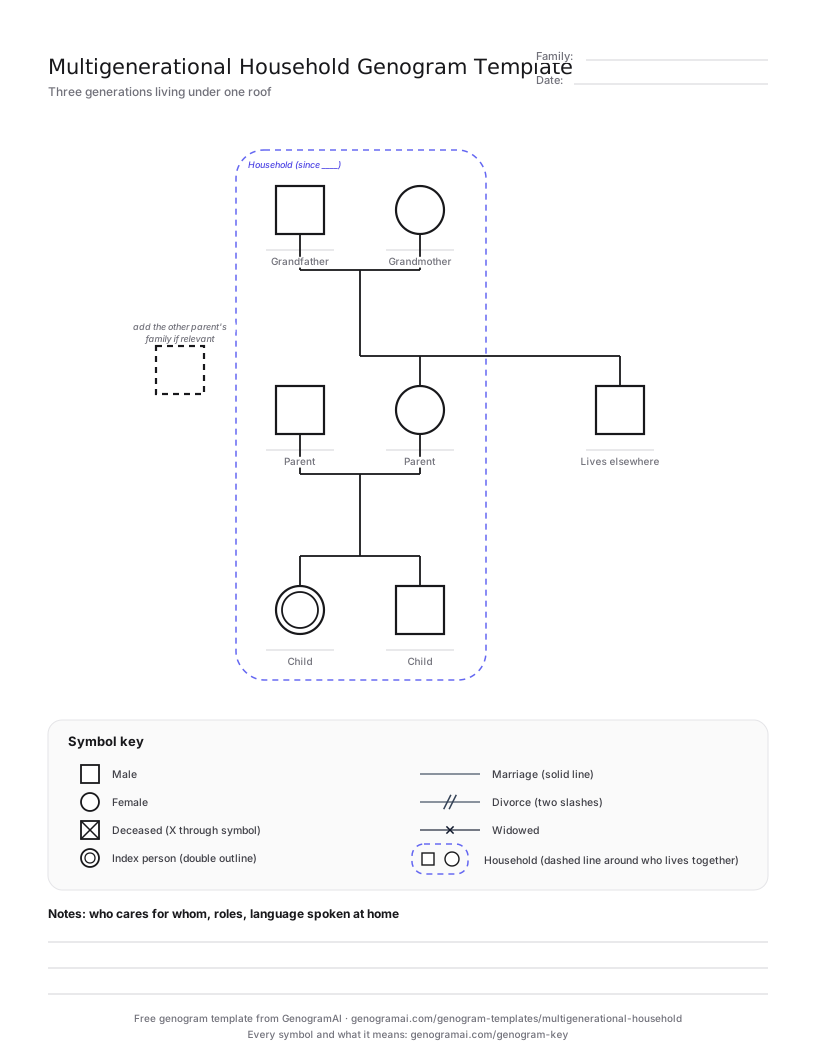
Use this template when grandparents, parents and children share a home, whether by culture, finances, caregiving or recent migration. The household boundary runs across three rows, which ordinary three-generation templates do not allow for, and it leaves an aunt or uncle outside so the difference between the family and the household is visible.
Shared homes bring their own questions: who has authority over the children, who looks after an ageing grandparent, how values differ between generations, and where privacy and conflict sit. Emotional lines between grandparents and grandchildren are often as important as those between parents and children, so leave room for them.
If grandparents are raising grandchildren without the parents in the home, the Child Welfare Genogram Template or Single Parent Family Genogram Template may be closer. For families where migration is the main story, the Immigration and Cultural Genogram Template adds country and migration labels.
The blank template and a filled-in example
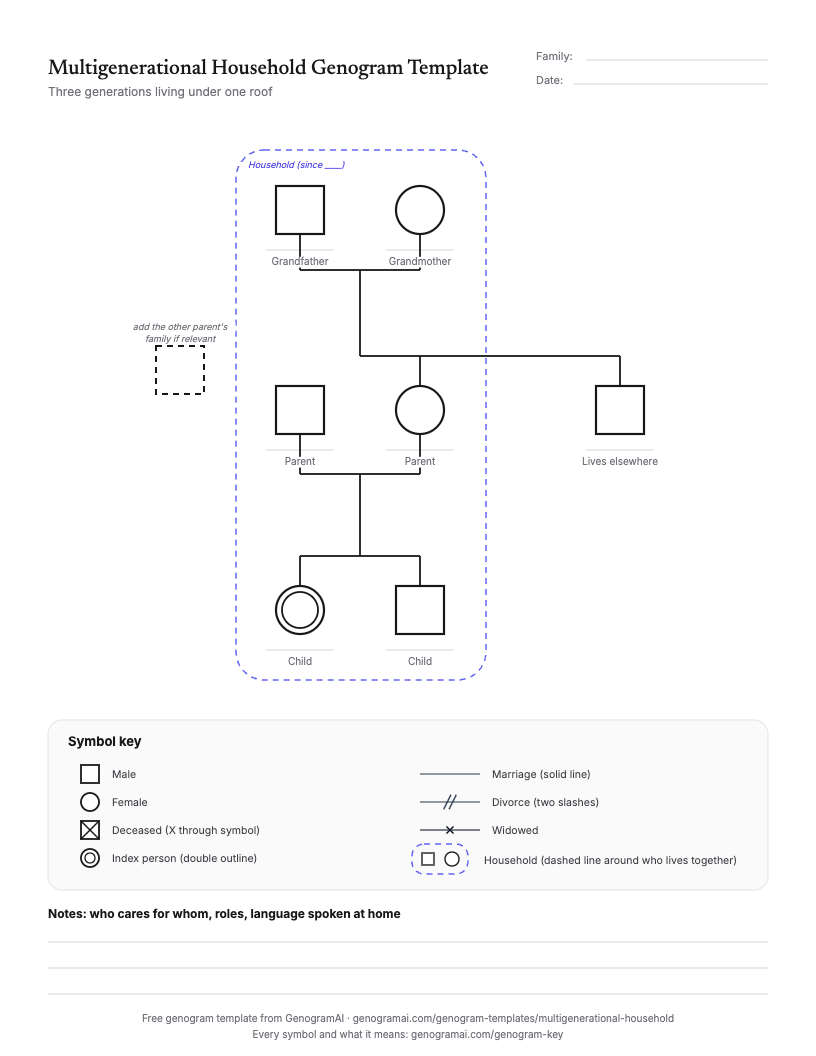
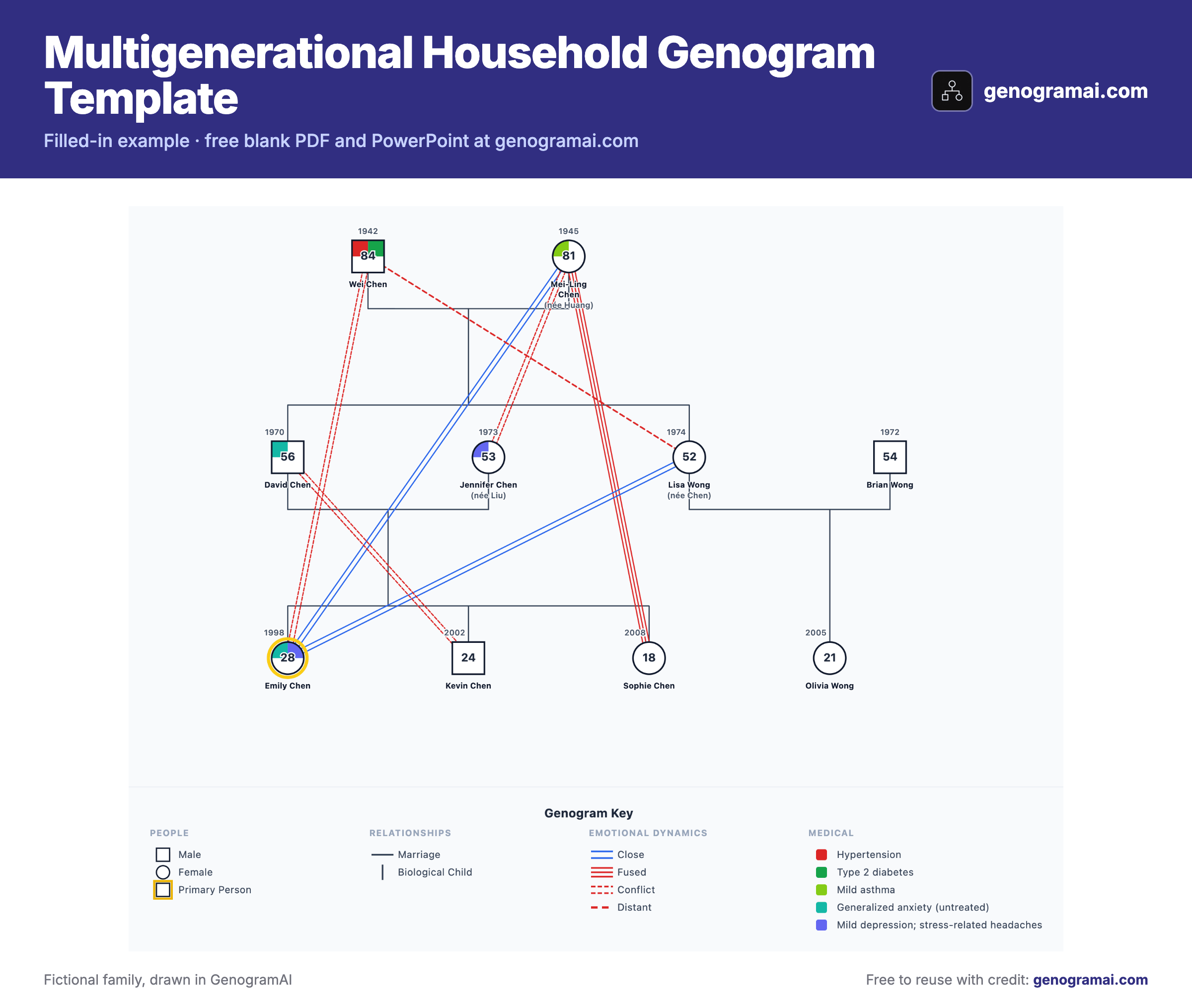
Open this example in GenogramAI to start from the finished layout: it copies into your account (the Free plan holds 2 genograms) and every person, line and condition stays editable.
How to fill in a multigenerational household genogram template
- 1
Draw three generations
Grandparents on top, parents in the middle, children below, with partner and child lines. - 2
Enclose the household
Draw one dashed boundary around everyone who lives in the home, across all rows, and note when it formed. - 3
Add relatives who live elsewhere
Keep aunts, uncles and adult children outside the boundary, with where they live. - 4
Add care and emotional lines
Show who cares for whom, and the closeness or conflict between generations.
Symbols this template uses
| Symbol | What it means |
|---|---|
| Dashed enclosure across rows | Household boundary: everyone under one roof, across all three generations. |
| Person outside the enclosure | A relative who lives elsewhere, such as an aunt or uncle. |
| Three red lines | Fused: an enmeshed relationship, for example between a grandparent and a grandchild. |
| Two dashed red lines | Conflict, often between generations with different values. |
| Red line with an open arrowhead | Caretaker: one person looks after another, such as an adult child caring for a parent. |
| Flag or country label | Country of birth, useful when generations were born in different countries. |
Common mistakes to avoid
- Drawing a separate box per generation. One household is one boundary, even across three rows.
- Putting relatives who live elsewhere inside the boundary because they visit often.
- Leaving out the grandparents’ emotional lines to the grandchildren, which are often the strongest in the home.
- Forgetting the date the household formed. Note when each generation moved in.
Who uses this template?
Family therapists, home health and community nurses, social workers, multicultural counselors and students studying family structure.
Common uses
- Families where grandparents and grandchildren share a home
- Elder care and caregiver strain assessments
- Culturally informed family therapy
- Home visits by nurses and health visitors
- Teaching household boundary notation
What the template covers
- Three-row layout with one cross-generation household boundary
- A relative outside the household
- Key with household boundary and partner lines
- Notes lines for roles, care and when the household formed
- Editable PowerPoint and SVG versions
What is free?
Free and paid, plainly
Frequently asked questions
How do you show a multigenerational household on a genogram?
Draw the generations in their usual rows and put one dashed boundary around everyone who lives in the home. It can bend around people who live elsewhere.
Is a multigenerational household the same as an extended family genogram?
No. An extended family genogram shows relatives; a household genogram also shows who lives together. Many people on the chart can be family without sharing the home.
How do you show who cares for an elderly parent?
Use a caretaker emotional line from the carer to the person cared for, and note the care tasks and any carer strain.
Can I show where each generation was born?
Yes. Write the country under each person or, in GenogramAI, add a country flag. It helps when the generations grew up in different cultures.
Further Reading
- McGoldrick, M., Gerson, R., & Petry, S. — Genograms: Assessment and Treatment (4th ed.). W.W. Norton & Company, 2020
- McGoldrick, M., Giordano, J., & Garcia-Preto, N. (Eds.) — Ethnicity and Family Therapy (3rd ed.). Guilford Press, 2005