Free genogram template
Single Parent Family Genogram Template
Quick answer
Download the single parent family genogram template
- Blank template (PDF)US Letter, print and fill in by hand
- Editable PowerPoint (.pptx)Every symbol and line is a shape; opens in Google Slides and Keynote
- Filled example + blank (PDF)Two pages: the example with its key, then the blank
- High-resolution example (PNG)2400 px wide, free to reuse with credit
- Vector blank (SVG)Edit in Illustrator, Inkscape, Figma or Canva
When to use a single parent family genogram template
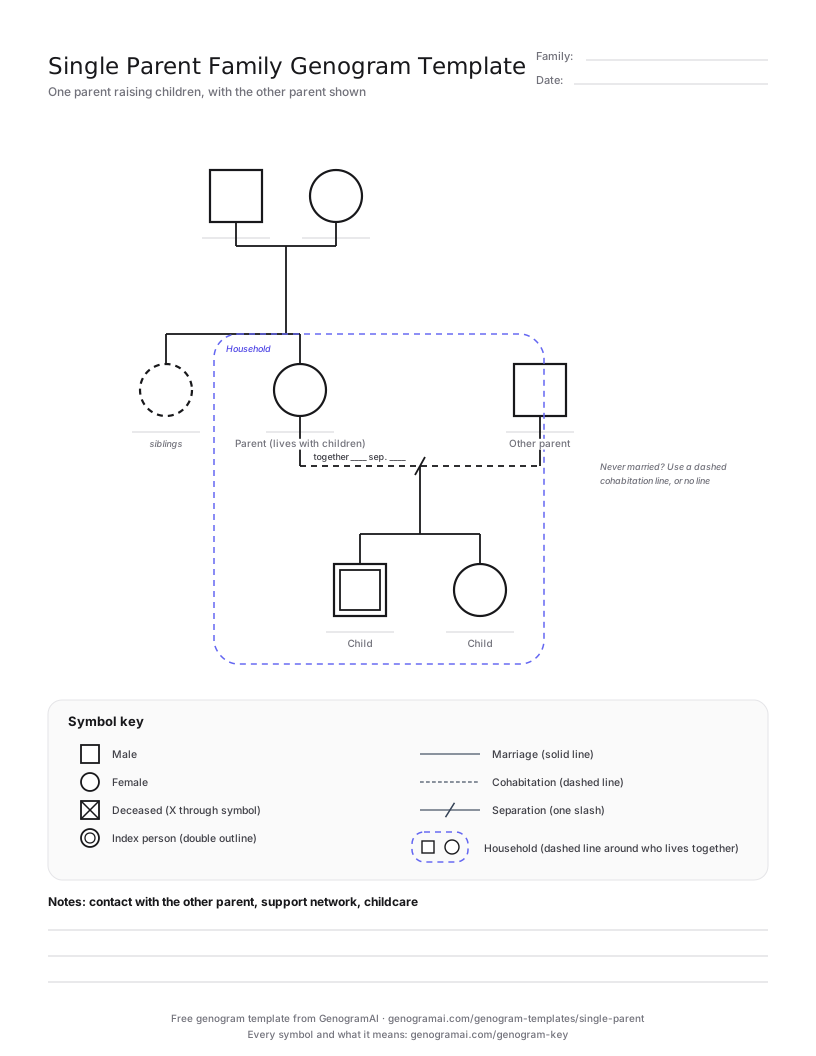
Use this template when children live with one parent: after separation or divorce, after a parent’s death, or where the parents never lived together. The household boundary goes around the parent and children, while the other parent stays on the page with an ended partner line. That keeps the absent parent’s family history, and the children’s contact with that side, in view.
Single-parent families often depend on a grandparent, a sibling or a neighbour for daily care, and older children sometimes take on adult roles. Use emotional lines for those supports and for parentification, and note work hours, money pressure and childcare arrangements, which are usually more important here than in a two-parent household.
If the parent has a new partner living in the home, the family is blended and the Blended Family Genogram Template fits better. If a grandparent is the main carer, try the Multigenerational Household Genogram Template or, if the case is open to services, the Child Welfare Genogram Template.
The blank template and a filled-in example
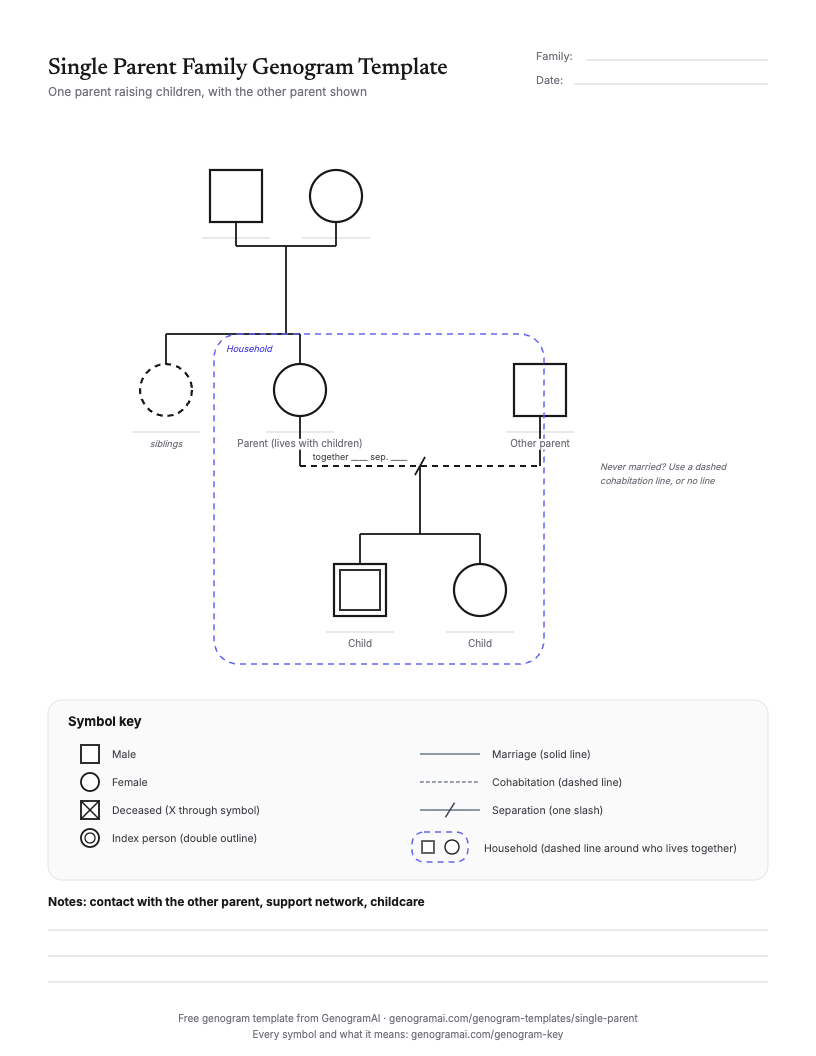
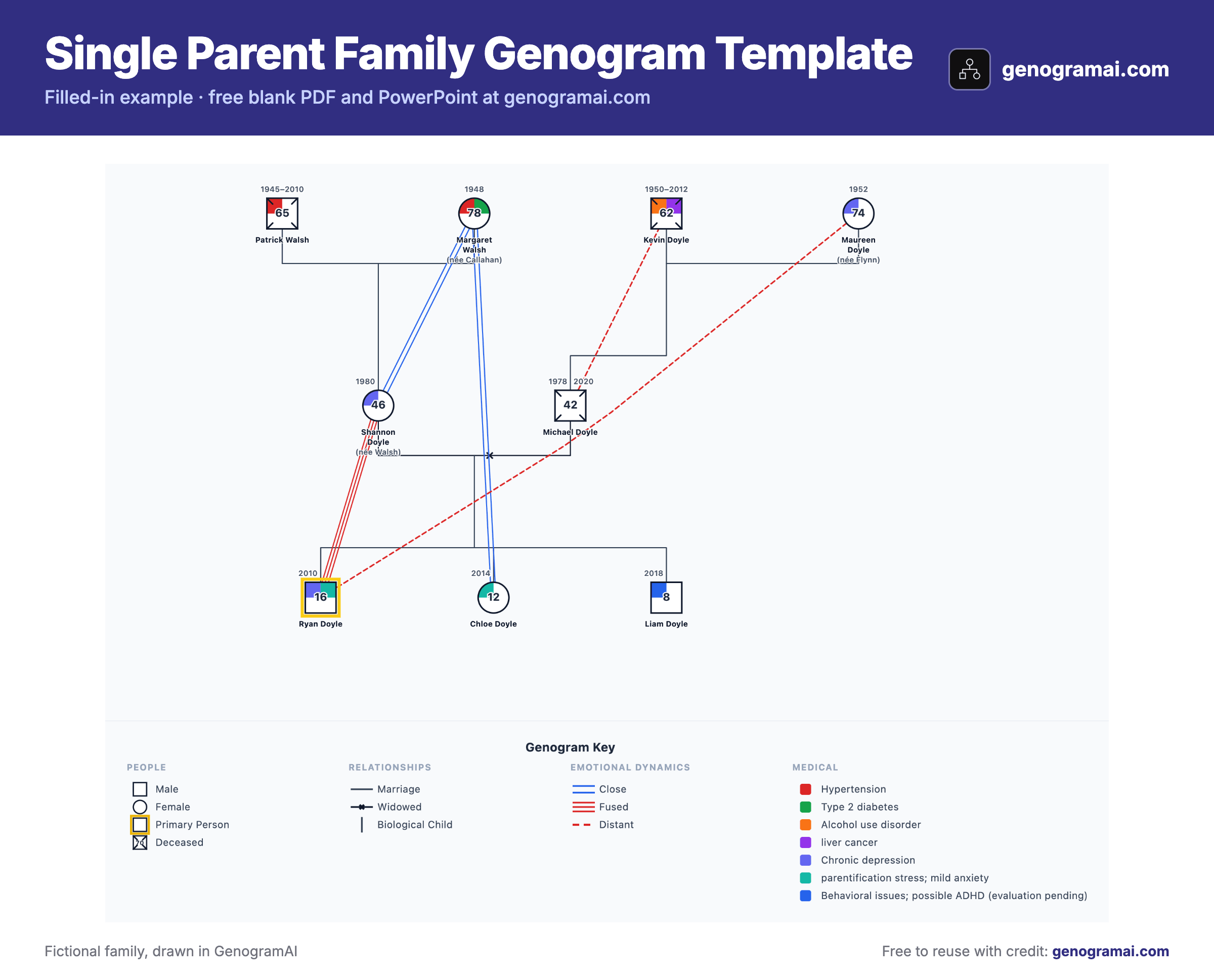
Open this example in GenogramAI to start from the finished layout: it copies into your account (the Free plan holds 2 genograms) and every person, line and condition stays editable.
How to fill in a single parent family genogram template
- 1
Draw the parent and children
Place the resident parent and hang the children from the couple line, oldest on the left. - 2
Add the other parent
Draw them on the partner line and end it with the right symbol: separation, divorce or widowed, with the year. - 3
Add grandparents and helpers
Add the resident parent’s parents above and anyone who helps with care. - 4
Enclose the household and add feelings
Draw the household boundary and add emotional lines, especially support and any parentified child.
Symbols this template uses
| Symbol | What it means |
|---|---|
| Dashed household enclosure | Who lives together: the parent and the children. |
| Dashed partner line with one slash | Physical separation of a couple who lived together without marrying. |
| Two slashes on a solid line | Divorce. |
| X across the partner line | Widowed: the partnership ended with a death. The deceased partner also has an X through their symbol. |
| Three red lines | Fused: an enmeshed relationship, for example a parent leaning on the eldest child. |
| Two blue lines | Close: a supportive bond, such as with a grandparent who helps with care. |
Common mistakes to avoid
- Leaving the other parent off because they are absent. Their side of the family is still the children’s history.
- Drawing the children under one parent with no line to the other. Hang them from the couple line, then end the couple line.
- Missing the helpers. A grandparent who does school runs belongs on the chart with a close line.
- Not recording why the partnership ended. Separation, divorce and death carry different meanings for the children.
Who uses this template?
Family therapists, school counselors, child and family social workers, health visitors and community nurses.
Common uses
- Assessing support around a single parent
- Grief work after a parent’s death
- Parentification and role reversal in older children
- School referrals and attendance concerns
- Contact planning with the non-resident parent’s family
What the template covers
- Parent with two children inside a household boundary
- Other parent on an ended partner line
- Maternal grandparents
- Key with separation, divorce, widowed and household symbols
- Editable PowerPoint and SVG versions
What is free?
Free and paid, plainly
Frequently asked questions
How do you draw a single parent family on a genogram?
Draw both parents with the children hanging from their partner line, end that line with the right symbol (separation, divorce or widowed), and enclose the parent and children who live together with a dashed household line.
Should the absent parent be on the genogram?
Yes. Even with no contact, the other parent is half of the children’s family history. If their identity is unknown, draw an unknown symbol so the gap is recorded.
How do you show a parent who never married?
Use a dashed partner line (cohabitation) or a dating line, ended with a slash if they lived together and separated. Write the years.
How do you show a child taking on a parent role?
Use an emotional line between the parent and child, often fused or caretaker, and note the responsibilities the child carries.
Further Reading
- McGoldrick, M., Gerson, R., & Petry, S. — Genograms: Assessment and Treatment (4th ed.). W.W. Norton & Company, 2020
- McGoldrick, M., Garcia Preto, N., & Carter, B. — The Expanding Family Life Cycle: Individual, Family, and Social Perspectives (5th ed.). Pearson, 2016