Free genogram template
Child Welfare Genogram Template
Quick answer
Download the child welfare genogram template
- Blank template (PDF)US Letter, print and fill in by hand
- Editable PowerPoint (.pptx)Every symbol and line is a shape; opens in Google Slides and Keynote
- Filled example + blank (PDF)Two pages: the example with its key, then the blank
- High-resolution example (PNG)2400 px wide, free to reuse with credit
- Vector blank (SVG)Edit in Illustrator, Inkscape, Figma or Canva
When to use a child welfare genogram template
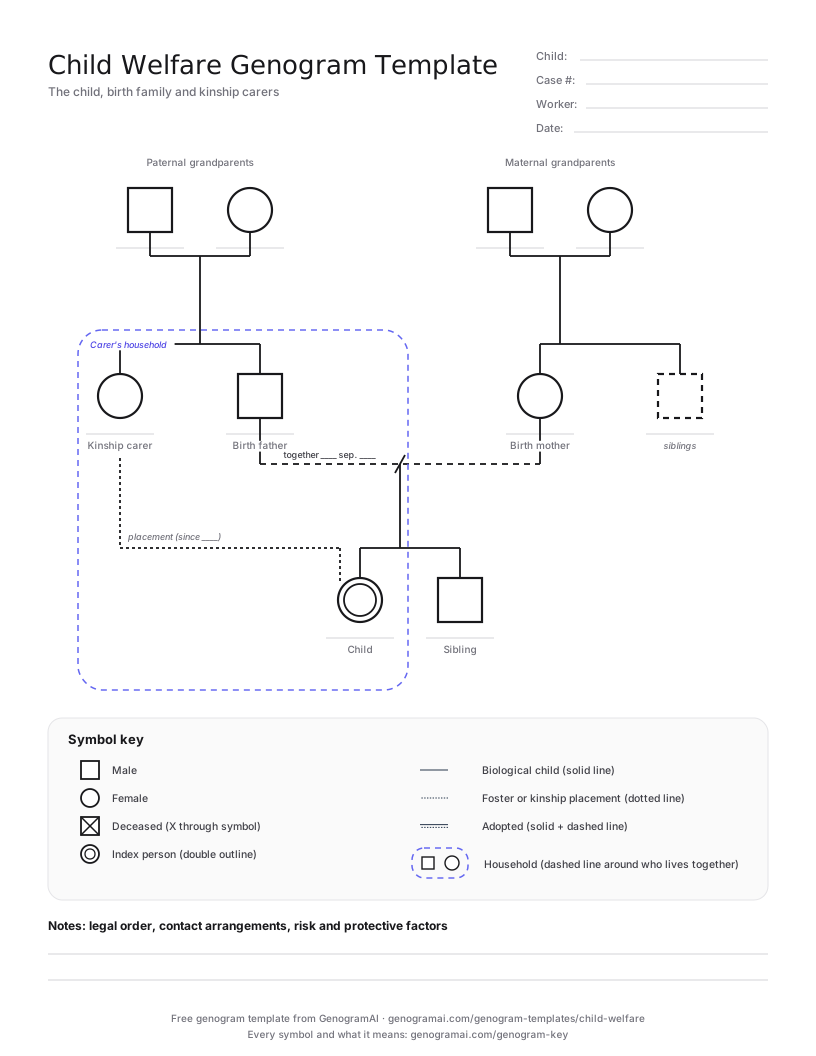
Use this template in child protection, foster care and kinship assessments, where the first question is who is in this child’s family and who could help. The child sits at the centre with both birth parents and both sets of grandparents, so relatives on each side are visible when you search for a kinship placement. The kinship carer’s household is drawn with its own boundary and a placement line to the child.
The case header (child, case number, worker, date) makes the sheet fit straight into a file, and the child-line key covers biological, adopted and foster connections. Write placement dates on the lines and keep notes on contact arrangements. For practice guidance, see Genograms for Child Welfare.
If the case is a wider family assessment rather than one child’s placement, the Social Work Genogram Template has a family-centred layout. If outside services (school, court, treatment, health) need to be shown around the family, use the Genogram and Eco-Map Template.
The blank template and a filled-in example
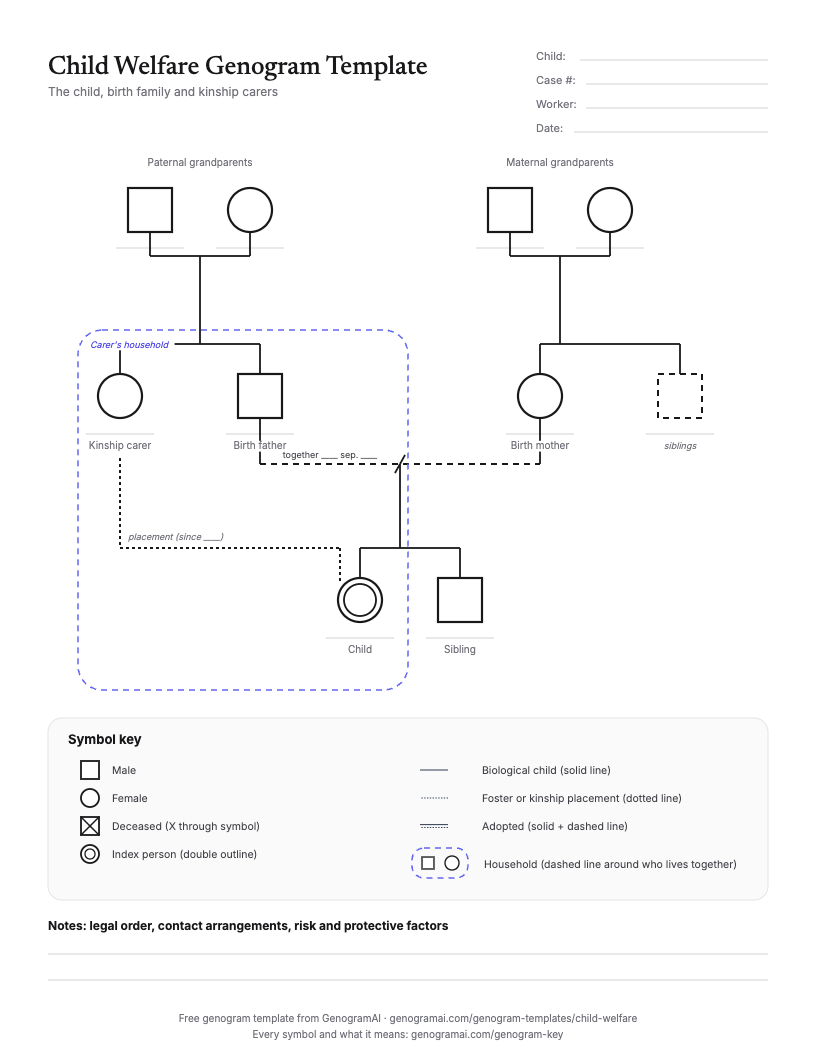
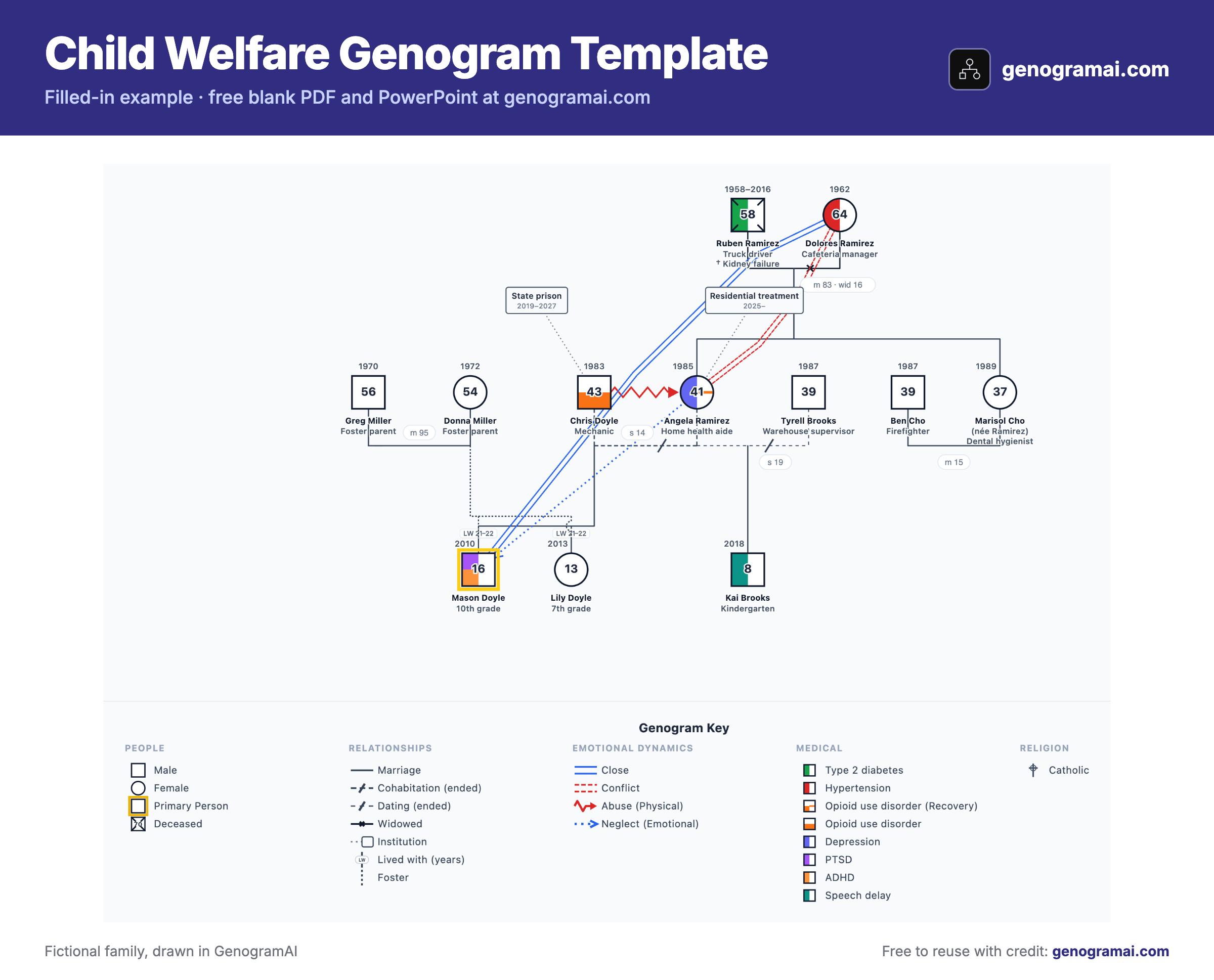
Open this example in GenogramAI to start from the finished layout: it copies into your account (the Free plan holds 2 genograms) and every person, line and condition stays editable.
How to fill in a child welfare genogram template
- 1
Place the child
Put the child in the centre with a double outline and their siblings beside them. - 2
Add both sides
Draw the birth parents with their partner line, then both sets of grandparents and the parents’ siblings. - 3
Show the placement
Draw a household boundary around the carer’s home and a placement line to the child, with dates. - 4
Add services and safety
Note institutions, contact arrangements and any abuse or neglect lines, then complete the case header.
Symbols this template uses
| Symbol | What it means |
|---|---|
| Double outline | The child the assessment is about. |
| Dotted child line | Foster or kinship placement: the child lives with this carer without a legal parent relationship. |
| Dashed enclosure | Household boundary: where the child lives now. |
| One slash on the partner line | The birth parents have separated. |
| Institution box | In GenogramAI, a prison, treatment centre or hospital linked to a person, with dates. |
| Red zigzag lines | Abuse or neglect lines, drawn from the person responsible to the child. |
Common mistakes to avoid
- Drawing only the side of the family the child lives with. The other parent’s relatives are potential carers.
- Using a biological line from a kinship carer. The carer is related to the child through a parent; the placement is a separate line.
- Leaving dates off placements and moves. The sequence of placements matters for court and for the child.
- Not checking names with the family. Errors in a court document undermine its value.
Who uses this template?
Child protective services caseworkers, foster care and kinship workers, children’s guardians, family court social workers and MSW students in child welfare placements.
Common uses
- Kinship placement searches
- Child protection assessments and case conferences
- Family group decision-making and family meetings
- Court reports on placement and contact
- Permanency planning
What the template covers
- Child-centred layout with both sides of the family
- Kinship carer household and placement line
- Case header (child, case #, worker, date)
- Key with child lines and household boundary
- Editable PowerPoint and SVG versions
What is free?
Free and paid, plainly
Frequently asked questions
What is a genogram used for in child welfare?
To map a child’s family on both sides, find relatives who could provide care, document placements and contact, and give courts and teams a shared picture of the family.
How do you show kinship care on a genogram?
Draw the relative in their usual family position, enclose their household with the child inside it, and join them to the child with a placement line and the start date.
How do you show a parent in prison or treatment?
Keep the parent in their usual place and add a note or, in GenogramAI, an institution box linked to them with the dates.
Can I use this template in court?
Many caseworkers attach genograms to court reports. Check names and dates with the family, include the key, and follow your agency’s rules on what may be shared.
Further Reading
- McGoldrick, M., Gerson, R., & Petry, S. — Genograms: Assessment and Treatment (4th ed.). W.W. Norton & Company, 2020
- Hartman, A. — Diagrammatic assessment of family relationships. Social Casework, 59(8), 465-476, 1978