Free genogram template
Divorce and Remarriage Genogram Template
Quick answer
Download the divorce and remarriage genogram template
- Blank template (PDF)US Letter, print and fill in by hand
- Editable PowerPoint (.pptx)Every symbol and line is a shape; opens in Google Slides and Keynote
- Filled example + blank (PDF)Two pages: the example with its key, then the blank
- High-resolution example (PNG)2400 px wide, free to reuse with credit
- Vector blank (SVG)Edit in Illustrator, Inkscape, Figma or Canva
When to use a divorce and remarriage genogram template
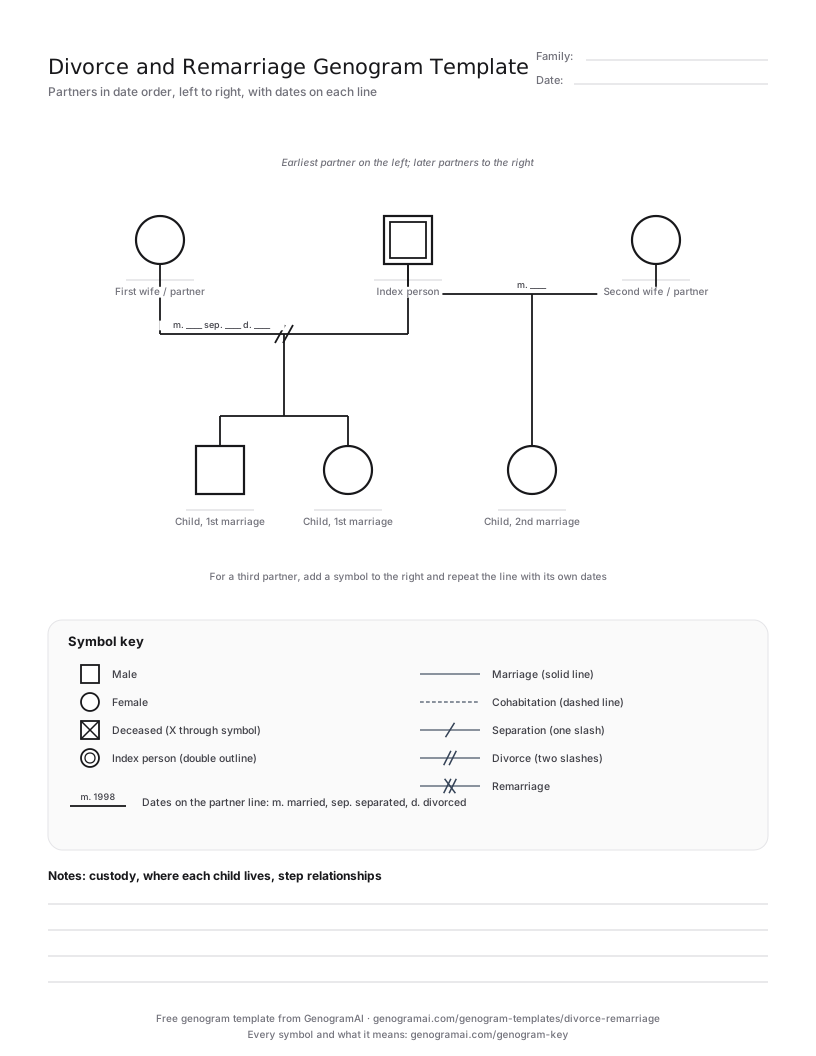
Use this template when the timeline of relationships is the story: a parent married more than once, children from each marriage, a separation that came before a divorce, or a cohabiting partner between marriages. The layout puts the man with his first wife on one side and his second wife on the other, with a date label on each partner line, so a reader can see at once which children came from which relationship and how old they were at each change.
Court reports, custody evaluations and therapy with children who have lived through several family transitions all depend on getting the sequence right. The key on this template covers every partner line you are likely to need: marriage, cohabitation, legal separation, divorce and remarriage.
If the main question is how a step-family lives together now, the Blended Family Genogram Template puts more weight on the current household. For an adult client reviewing their own relationship history, the Couples Therapy Genogram Template may fit better.
The blank template and a filled-in example
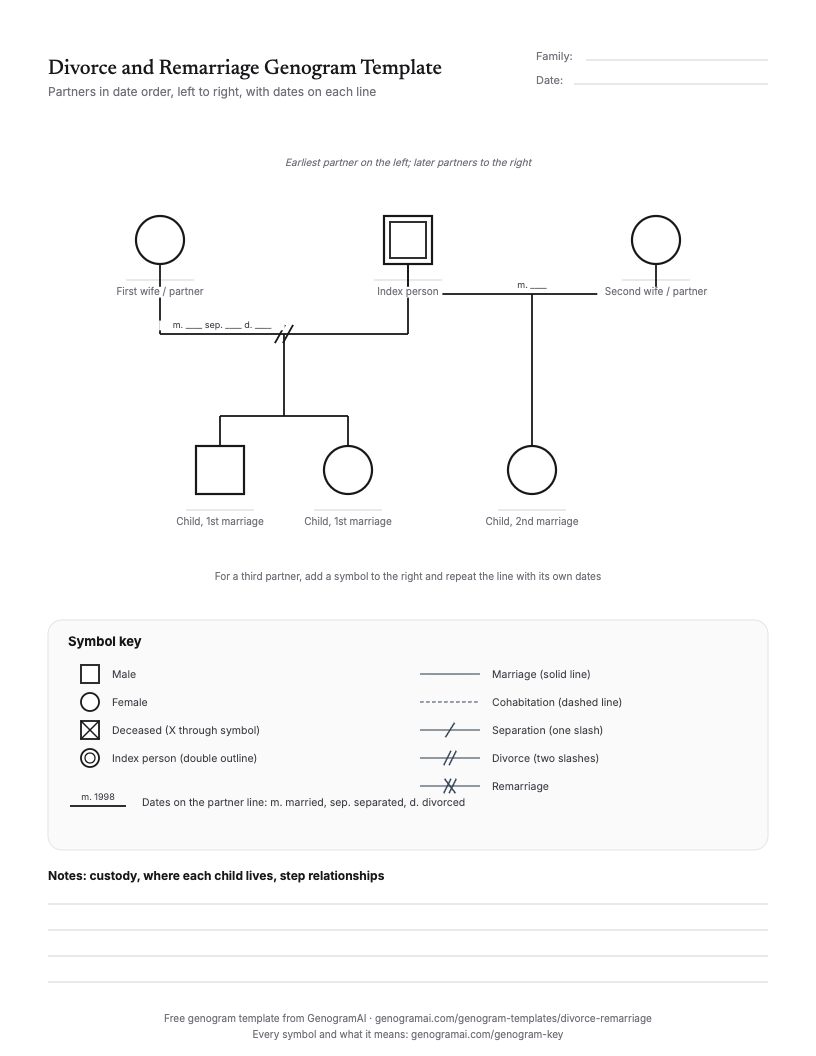
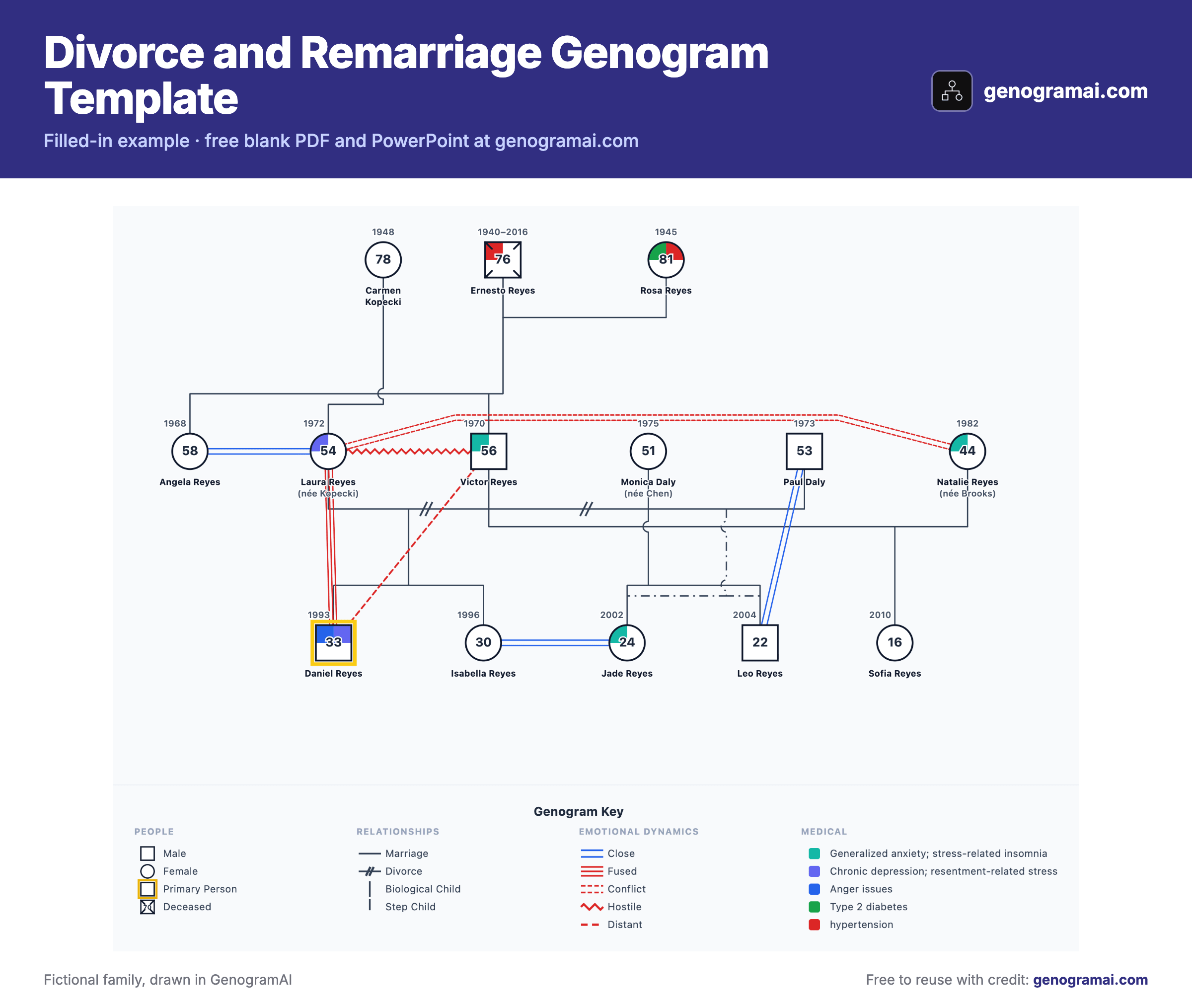
Open this example in GenogramAI to start from the finished layout: it copies into your account (the Free plan holds 2 genograms) and every person, line and condition stays editable.
How to fill in a divorce and remarriage genogram template
- 1
Place the person with several partners
Put them in the centre of the row. - 2
Order partners by date
Draw each partner with the right line type and label it with marriage, separation and divorce years. - 3
Add children to the right relationship
Drop each child from the partner line they were born into, oldest on the left within each set. - 4
Add households and feelings
Enclose current households and add emotional lines between ex-partners and between children and each parent.
Symbols this template uses
| Symbol | What it means |
|---|---|
| Solid horizontal line | Marriage, labelled with the year (m. 1990). |
| One slash on a solid line | Legal separation (s. 1999). On a dashed line, one slash is a physical separation. |
| Two slashes | Divorce (d. 2001). |
| Two slashes crossed by a third | Remarried: a couple who divorced and later married each other again. |
| Dashed horizontal line | Cohabitation (living together without marriage). |
| X across the partner line | Widowed: the marriage ended with a partner’s death. |
| Partner order | Earlier partners further from the centre, later partners nearer, or first to last reading left to right. |
Common mistakes to avoid
- Leaving the dates off the partner lines. Without them the order of marriages is guesswork.
- Using one slash for divorce. One slash is separation; divorce is two.
- Drawing all the children under the current marriage. Each child belongs under the relationship they were born into.
- Putting partners in order of importance rather than chronology.
Who uses this template?
Family therapists, custody evaluators, family court social workers, mediators, and students learning partner-line notation.
Common uses
- Custody evaluations and family court reports
- Children adjusting after more than one family transition
- Adult clients reviewing a pattern of relationships
- Teaching separation, divorce and remarriage notation
What the template covers
- Two-marriage layout with date labels on each line
- Child slots for each marriage
- Key covering marriage, cohabitation, separation, divorce and remarriage
- Notes lines for custody and contact arrangements
- Editable PowerPoint and SVG versions
What is free?
Free and paid, plainly
Frequently asked questions
How is divorce shown on a genogram?
With two short slashes across the line between the partners, plus the year (d. 2001). One slash on a solid line is a legal separation. GenogramAI draws both and keeps the year on the line.
How do you show multiple marriages?
Put the person in the centre and their partners on either side or in a row, ordered by date. Label every line with marriage and divorce years so the sequence is clear without reading notes.
How do you show a couple who divorced and remarried each other?
Use the remarriage line: the divorce slashes crossed by a third line, with both the divorce year and the new marriage year written on it.
What does m. and d. mean on a genogram?
They are the standard abbreviations for married and divorced, written above the partner line with the year. Separated is often written s. and widowed w.
Further Reading
- McGoldrick, M., Gerson, R., & Petry, S. — Genograms: Assessment and Treatment (4th ed.). W.W. Norton & Company, 2020
- McGoldrick, M., Garcia Preto, N., & Carter, B. — The Expanding Family Life Cycle: Individual, Family, and Social Perspectives (5th ed.). Pearson, 2016