Free genogram template
Mental Health Genogram Template
Quick answer
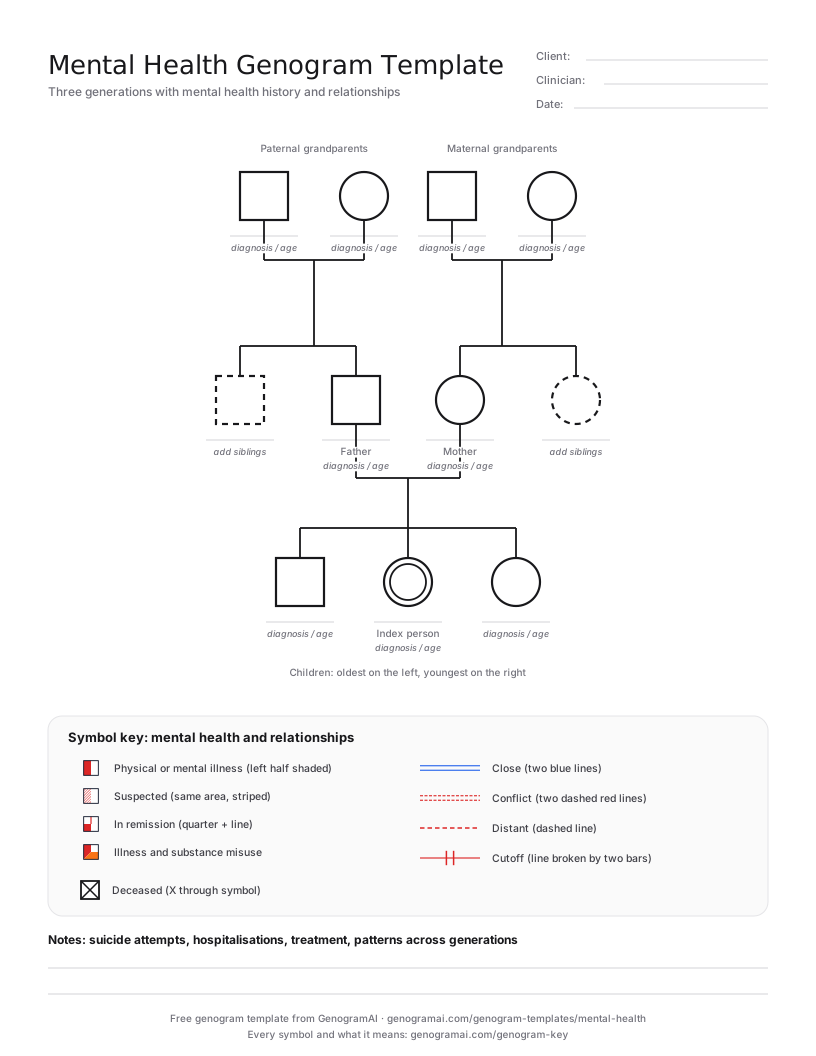
Download the mental health genogram template
- Blank template (PDF)US Letter, print and fill in by hand
- Editable PowerPoint (.pptx)Every symbol and line is a shape; opens in Google Slides and Keynote
- Filled example + blank (PDF)Two pages: the example with its key, then the blank
- High-resolution example (PNG)2400 px wide, free to reuse with credit
- Vector blank (SVG)Edit in Illustrator, Inkscape, Figma or Canva
When to use a mental health genogram template
Use this template when a mental health condition is part of the referral and you want to know whether, and how, it runs in the family. Depression, anxiety, bipolar disorder, psychosis, suicide and self-harm often appear in more than one generation, and seeing them on one page changes the conversation: a client may realise for the first time that a grandparent’s "nerves" or an uncle’s early death fit a pattern.
The key separates confirmed diagnoses from suspected ones and from conditions in remission, which keeps the chart honest about what is known. Emotional lines sit alongside the shading because relational patterns (cutoffs, conflict, over-closeness) are often part of how distress travels between generations. For more on reading these patterns, see the Mental Health Genogram guide.
If alcohol or drug use is the main concern, the Substance Use and Addiction Genogram Template has the substance shading and recovery markers. If you are working in Bowen family systems therapy, the Family Therapy Genogram Template has the full emotional key.
The blank template and a filled-in example
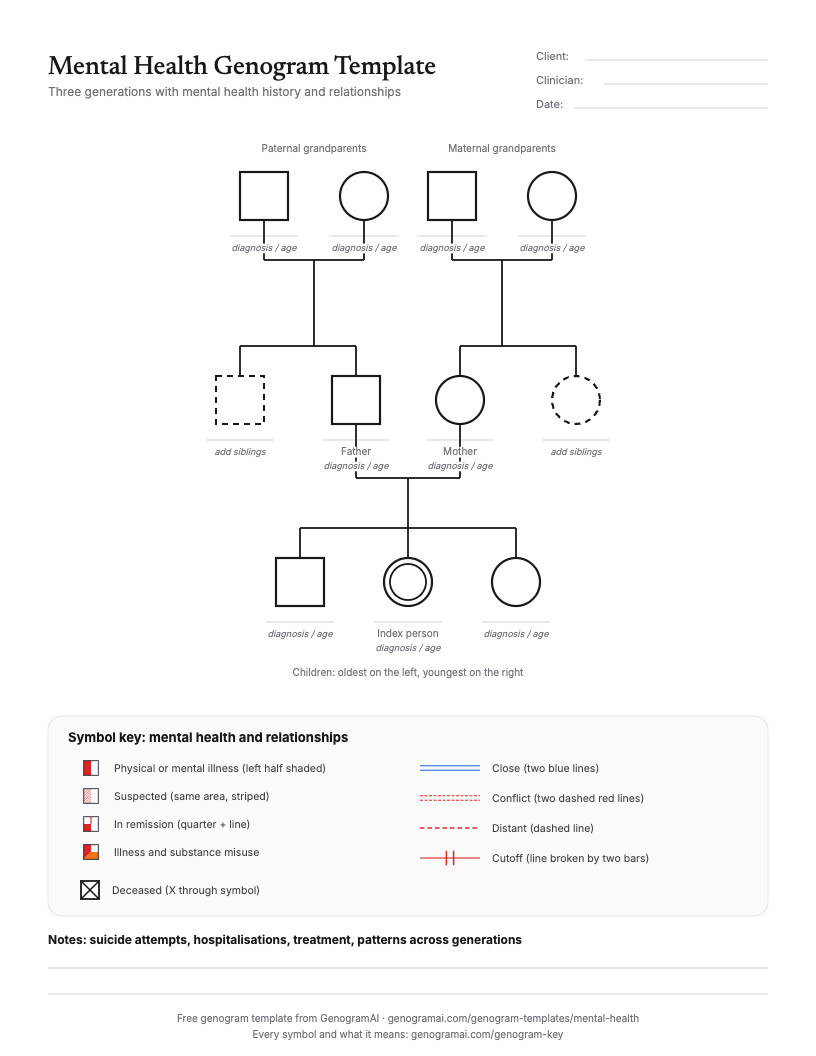
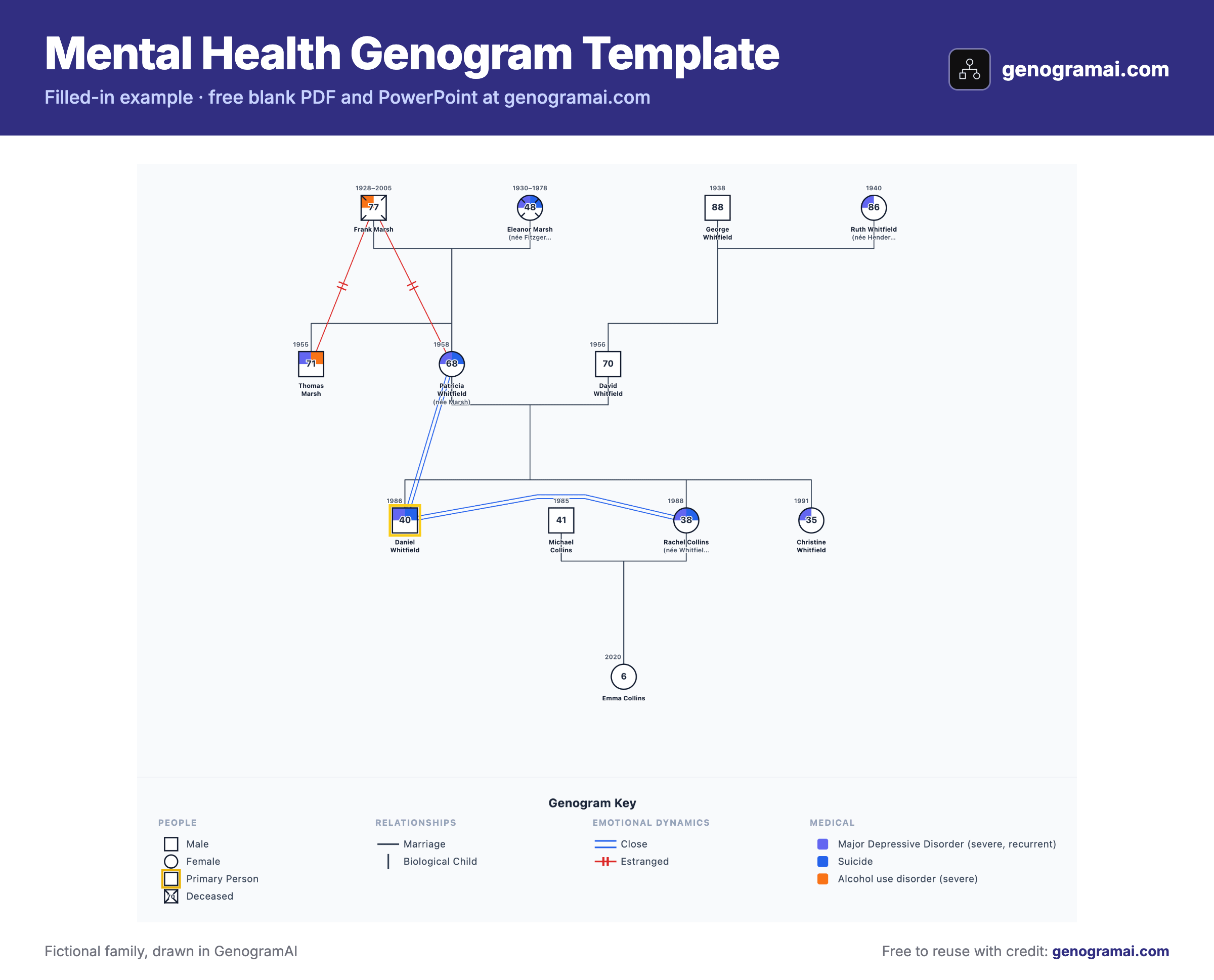
Open this example in GenogramAI to start from the finished layout: it copies into your account (the Free plan holds 2 genograms) and every person, line and condition stays editable.
How to fill in a mental health genogram template
- 1
Draw three generations
Grandparents, parents and the client’s generation, with the client in a double outline. - 2
Shade conditions
Fill the left half for each diagnosed condition, stripe suspected ones, and use the remission marker where relevant. Write the condition and age at onset. - 3
Record deaths and attempts
Mark deaths with an X and the cause, including suicide, and note attempts carefully. - 4
Add emotional lines
Show close, conflict, distant and cutoff relationships, then note the patterns you see.
Symbols this template uses
| Symbol | What it means |
|---|---|
| Left half filled | Physical or mental illness, as GenogramAI shades it (one colour per condition). |
| Left half striped | Suspected condition: not diagnosed, but reported or likely. |
| Quarter filled with a line | Illness in remission. |
| Two blue lines | Close relationship. |
| Two dashed red lines | Conflict. |
| Dashed red line | Distant relationship. |
| Red line broken by two bars | Cutoff: contact has ended. |
Common mistakes to avoid
- Shading a condition no one has diagnosed as if it were confirmed. Use the striped (suspected) marker.
- Recording the diagnosis without age of onset. Onset age is what shows anticipation or a repeating life-stage pattern.
- Leaving suicide or attempts off the chart because they are painful to ask about. They are among the most important facts, recorded with care.
- Drawing shading without a key that says what each colour means.
Who uses this template?
Psychotherapists, psychiatrists, clinical psychologists, mental health counselors, psychiatric nurses and trainees in each of these disciplines.
Common uses
- Assessment of depression, anxiety, bipolar disorder and psychosis
- Suicide risk assessment and family history of suicide
- Perinatal mental health
- Psychoeducation about family patterns
- Case formulation in training and supervision
What the template covers
- Three-generation layout with a clinical header
- Mental illness, suspected and remission shading key
- Close, conflict, distant and cutoff emotional lines
- Notes lines for onset ages and patterns
- Editable PowerPoint and SVG versions
What is free?
Free and paid, plainly
Frequently asked questions
How do you show mental illness on a genogram?
Shade part of the person’s symbol. In GenogramAI’s default notation the left half is filled for physical or mental illness, striped when suspected, and a quarter with a line marks remission. Add the diagnosis and age at onset beside the symbol.
How do you show suicide on a genogram?
Mark the person as deceased with an X and record the cause and year of death. Some clinicians add a note or symbol for attempts. Record it plainly; it is central to risk assessment.
Is a mental health genogram a diagnosis?
No. It is a record of what the family reports and what is known. It helps form questions and spot patterns; it does not establish genetic risk or a diagnosis on its own.
Can I keep this genogram confidential online?
GenogramAI’s Clinical plan adds zero-knowledge encryption for clinical genograms. The free PDF on this page can also be filled in by hand and kept with your paper records.
Further Reading
- McGoldrick, M., Gerson, R., & Petry, S. — Genograms: Assessment and Treatment (4th ed.). W.W. Norton & Company, 2020
- Kerr, M.E., & Bowen, M. — Family Evaluation: An Approach Based on Bowen Theory. W.W. Norton & Company, 1988