Free genogram template
Same-Sex Parents Genogram Template
Quick answer
Download the same-sex parents genogram template
- Blank template (PDF)US Letter, print and fill in by hand
- Editable PowerPoint (.pptx)Every symbol and line is a shape; opens in Google Slides and Keynote
- Filled example + blank (PDF)Two pages: the example with its key, then the blank
- High-resolution example (PNG)2400 px wide, free to reuse with credit
- Vector blank (SVG)Edit in Illustrator, Inkscape, Figma or Canva
When to use a same-sex parents genogram template
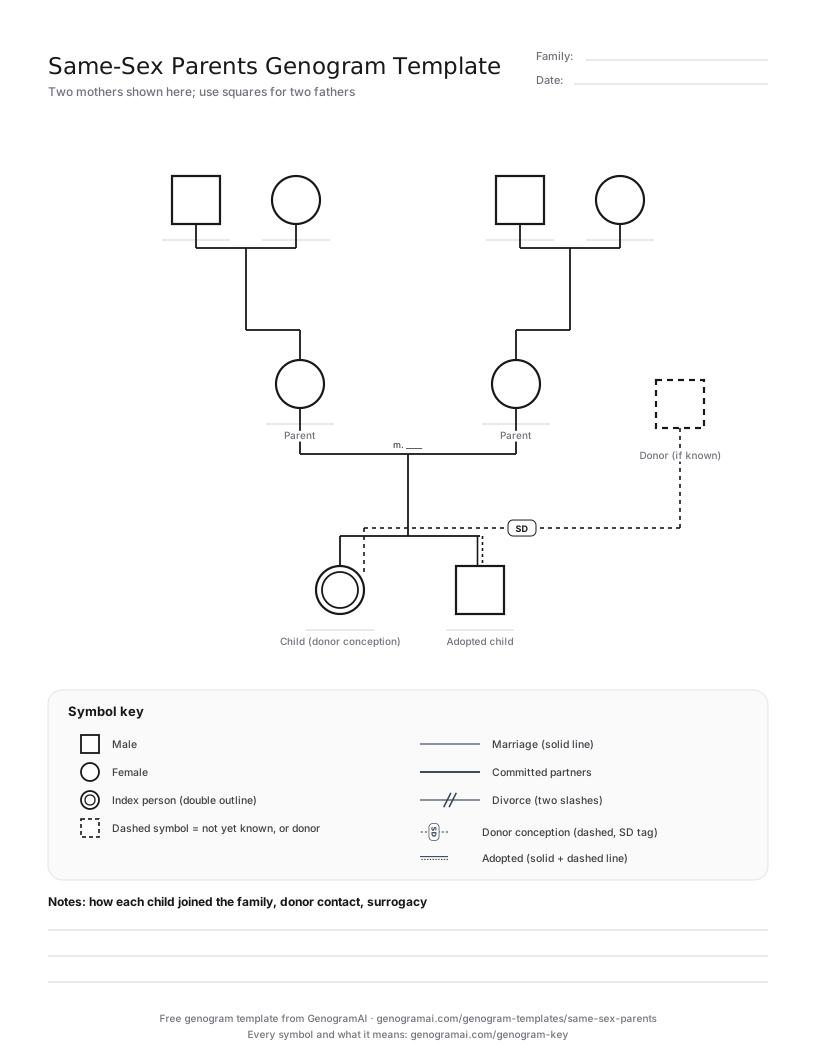
Use this template for families headed by two mothers or two fathers. Standard genogram conventions were written around a man on the left and a woman on the right, so many printable templates leave no clean way to show two parents of the same gender or the donor and adoption routes many of these families use. This one draws two circles joined by a marriage line, both families of origin above, a child conceived with a sperm donor, and an adopted child.
For two fathers, replace the circles with squares; a surrogate can be added the same way as the donor, as a dashed symbol with a surrogate line. Write the year of marriage or civil partnership on the partner line, and record acceptance or distance from each family of origin with emotional lines, since that is often clinically relevant.
If one partner has children from an earlier heterosexual relationship, combine this with the Blended Family Genogram Template. For a child adopted from care, the Adoption and Foster Care Genogram Template has more room for the birth family.
The blank template and a filled-in example
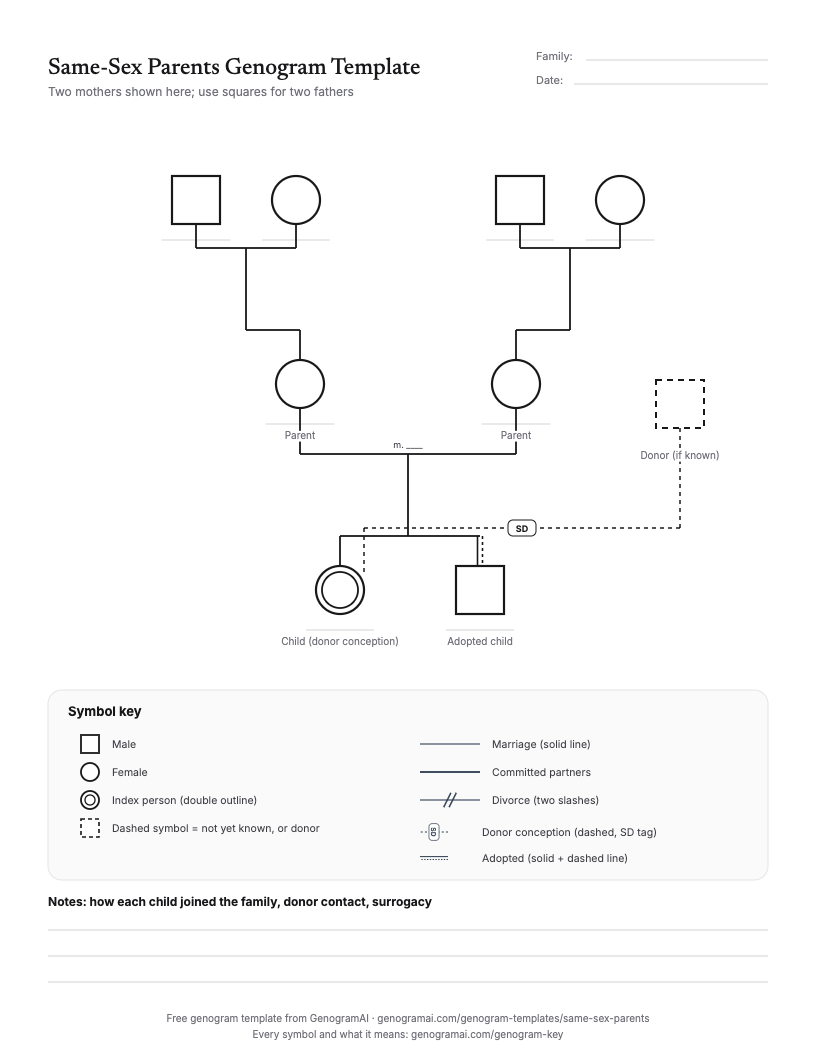
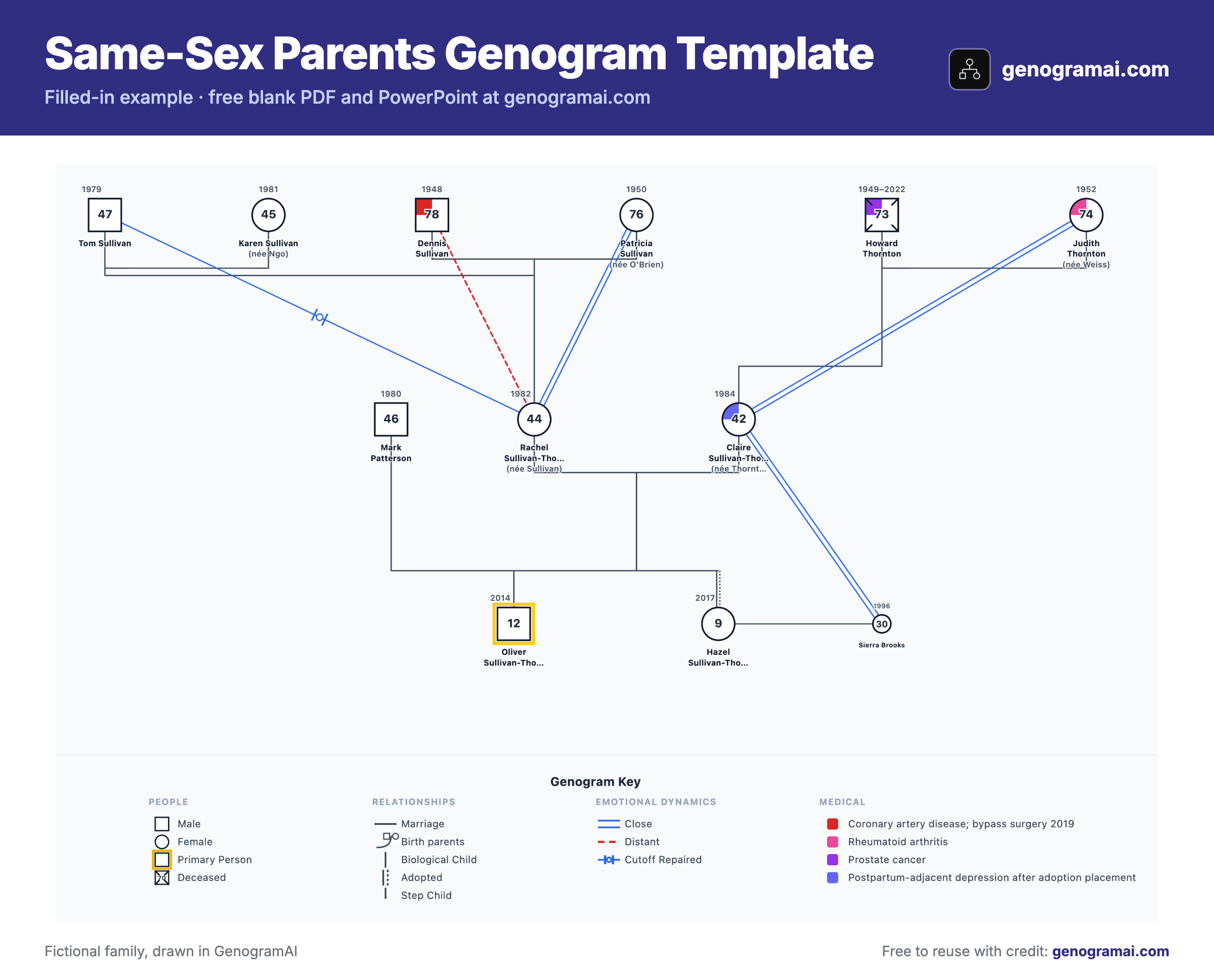
Open this example in GenogramAI to start from the finished layout: it copies into your account (the Free plan holds 2 genograms) and every person, line and condition stays editable.
How to fill in a same-sex parents genogram template
- 1
Draw the couple
Two circles for two mothers or two squares for two fathers, joined by a marriage or partnership line with the year. - 2
Add both families of origin
Each partner’s parents above them, with siblings if relevant. - 3
Add the children with the right connection
A donor-conceived child is linked to the parents and to a dashed donor symbol; an adopted child gets the adopted line and year. - 4
Show acceptance and support
Add emotional lines between the couple and each family, and note how each family responded to the relationship.
Symbols this template uses
| Symbol | What it means |
|---|---|
| Two circles (or two squares) joined by a solid line | A married same-sex couple, with the year. A thicker line in GenogramAI marks a life partnership. |
| Dashed symbol for the donor | A sperm or egg donor who is not a parent in the family. Known donors can carry a name. |
| Dashed child line with a donor label | Sperm donor or egg donor connection, as GenogramAI draws it; a surrogate line looks the same with its own label. |
| Solid and dashed line side by side | Adopted child, with the adoption year. |
| Two blue lines / dashed red line | Close / distant emotional lines, for example between each partner and their own parents. |
| Blue line broken by two bars | A cutoff that has been repaired. |
Common mistakes to avoid
- Forcing one partner into a square to fit a man-left, woman-right template. Draw each partner as they are.
- Drawing the donor as a parent with a marriage line. A donor connects to the child, not to the couple.
- Leaving out the non-biological parent’s family. Both families of origin are the child’s grandparents.
- Assuming the gender of a donor-conceived child’s genetic parent is irrelevant. Record what is known, because it matters for medical history.
Who uses this template?
LGBTQ+ affirming therapists, family therapists, fertility and genetic counselors, adoption workers and same-sex parent families drawing their own family tree.
Common uses
- Family therapy with two-mother or two-father families
- Fertility counseling and donor-conception planning
- Medical family history where a donor’s history matters
- Adoption assessments for same-sex couples
- Schoolwork where a child draws their own family
What the template covers
- Same-sex couple with both families of origin
- Donor symbol and donor line
- Adopted child slot
- Note on adapting the layout for two fathers or a surrogate
- Editable PowerPoint and SVG versions
What is free?
Free and paid, plainly
Frequently asked questions
How do you draw a same-sex couple on a genogram?
Draw two circles for two women or two squares for two men, joined by the usual partner line (marriage, life partner or cohabitation) with the year. The partner on the left is usually the older, or the one whose family you are focusing on.
How is a sperm donor shown?
As a separate symbol, often dashed, linked to the child by a donor line rather than to either mother by a partner line. GenogramAI has dedicated sperm donor, egg donor and surrogate connections.
Can I use this template for two fathers?
Yes. Swap the two circles for squares. If a surrogate carried the child, add her as a dashed symbol with a surrogate line, and an egg donor the same way if different.
How do I show family acceptance on the genogram?
Use emotional lines between each partner and their parents: close, distant, conflict or cutoff, including a repaired cutoff where a family has reconciled.
Further Reading
- McGoldrick, M., Gerson, R., & Petry, S. — Genograms: Assessment and Treatment (4th ed.). W.W. Norton & Company, 2020
- Goldberg, A.E. — Lesbian and Gay Parents and Their Children: Research on the Family Life Cycle. American Psychological Association, 2010