Genogram notation
How to Show an Affair in a Genogram
Quick answer
The notation
The affair line
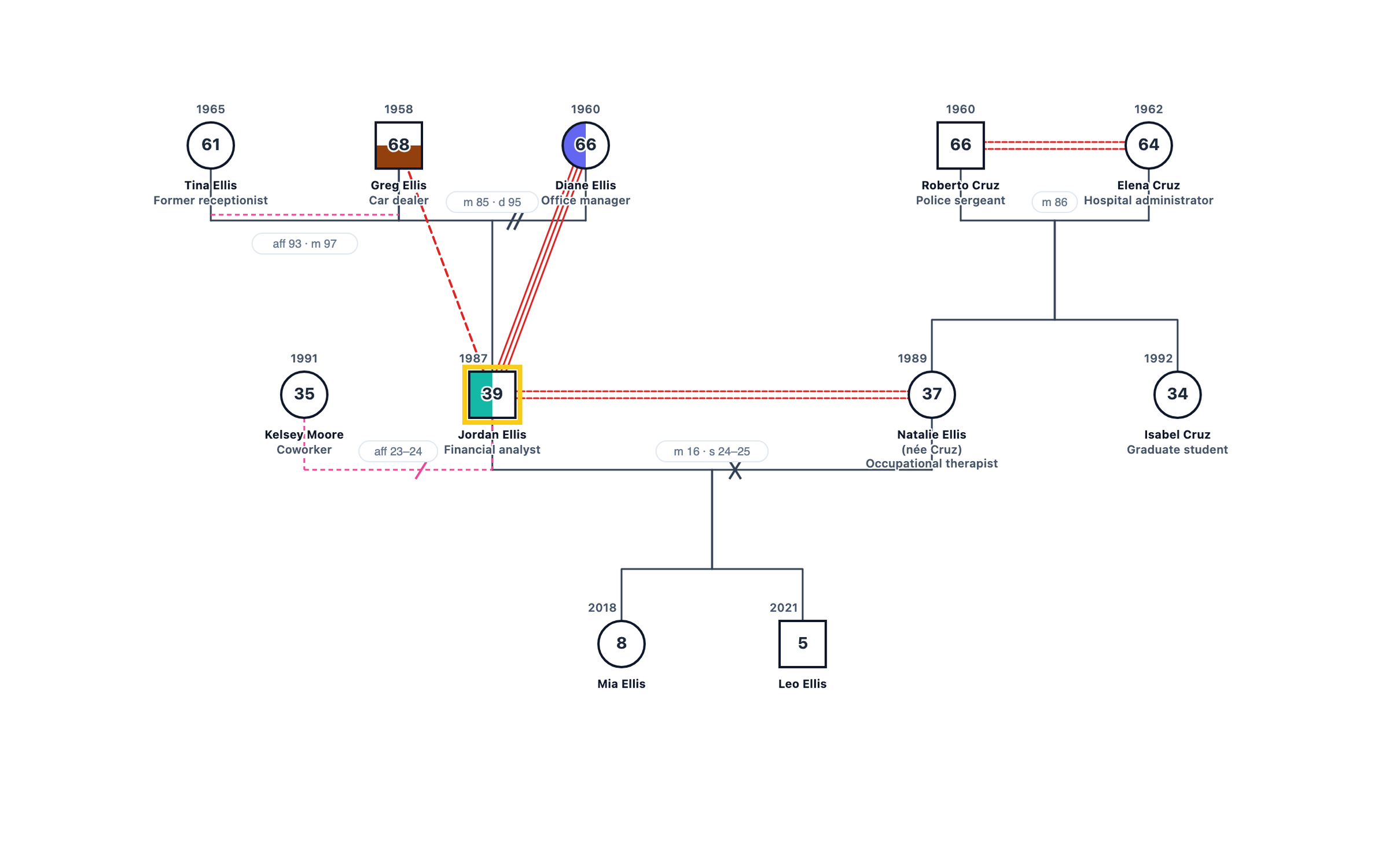
A dashed or otherwise distinct partnership line connecting the two people involved, drawn in addition to any existing marriage lines. Dates or duration can be annotated.
Children from an affair
A child of the affair hangs from the affair line exactly as children hang from marriage lines — this is how genograms keep complex families honest and readable.
When it ends a marriage
Combined notations exist: an affair line alongside a marriage line carrying separation or divorce slashes tells the sequence at a glance.
Affair: symbol and meaning
| Drawing | What you see | What it means |
|---|---|---|
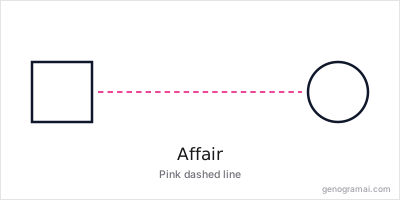 | Dashed or distinct partnership line between the two people | Affair |
| — | A child hanging from the affair line | Child born from the affair |
| — | Marriage line with slashes, plus an affair line | Affair alongside separation or divorce |
| — | Dates or duration on the affair line | When the affair happened |
What does it look like on a real genogram?
How to draw it in GenogramAI
- 1
Connect the two people with a relationship line and choose Affair as the type
- 2
GenogramAI also has combined Affair/Separation and Affair/Divorce types for when the affair and the marriage outcome belong together
- 3
Children can be added to the affair relationship like any other partnership
Frequently asked questions
Is there a standard genogram symbol for an affair?
Common practice draws a dashed or visually distinct partnership line between the two people, separate from marriage lines. What matters is that it’s distinguishable and, ideally, dated.
How do I show a child born from an affair?
Hang the child from the affair line, exactly as children hang from a marriage line. Each child connects to their actual biological parents.
How do I show an affair that led to divorce?
Keep the marriage line with divorce slashes and dates, and draw the affair line with its own dates. Tools like GenogramAI also offer combined Affair/Divorce relationship types.