Children's social care (UK)
Genograms in children's social care
Quick answer
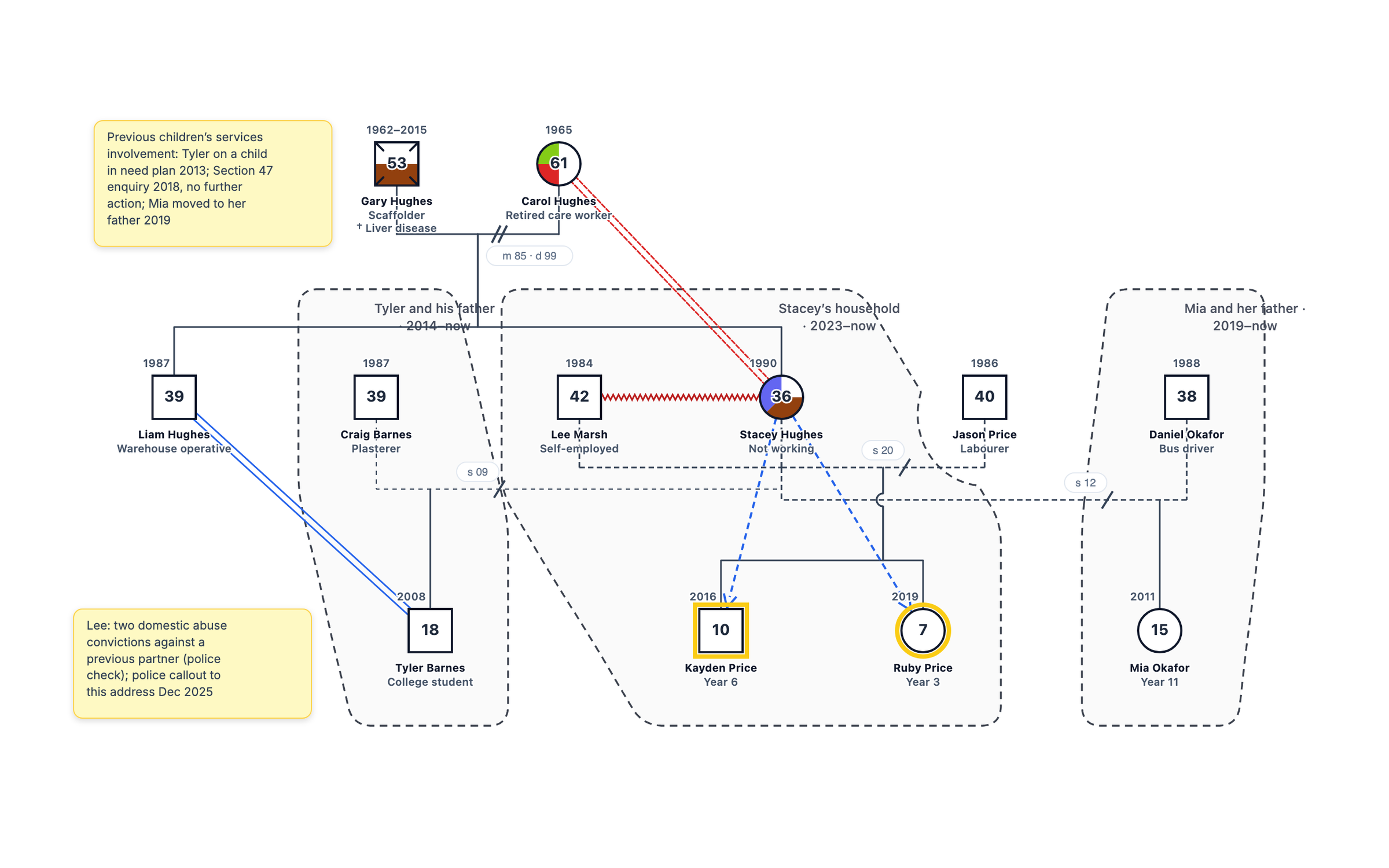
Why genograms matter in local authority practice
Case notes are written in date order; families are not. By the time a case reaches a strategy discussion or a legal planning meeting, the information about who is who is spread across contact records, referrals and partner agency reports. A genogram puts it in one place: mother and father, new partners, half-siblings living in other households, grandparents on both sides, and the aunt who has been looking after the children at weekends.
Working Together to Safeguard Children (2023) asks practitioners to work with the whole family network, and recent reforms push family group decision-making earlier, before proceedings. That makes the family network the centre of the work, and the genogram is the simplest way to show it. It also shows the court and partner agencies that every relative has been considered, which matters when the plan is to place a child outside the family.
Practice note
Where the genogram fits in a case
Child and Family Assessment
Section 47 enquiries and conferences
Family network meetings
PLO and care proceedings
Connected person and SGO assessments
Life story work
What to record on a children's social care genogram
| Record | How to show it | Why it matters |
|---|---|---|
| Household | Draw a dashed boundary around everyone who lives with the child | The starting point of any safety assessment |
| Adults with access | Include partners, ex-partners and regular visitors, even if they live elsewhere | Risk often comes from outside the household |
| Siblings and half-siblings | Show each child under the right parents, with where they live | Sibling contact and placing siblings together |
| Both sides of the family | Map paternal relatives even when the father is absent | Fathers’ families are the most often missed kinship carers |
| Relationship quality | Close, conflictual, cut off, violent or abusive lines | Shows where support is real and where it is not |
| Previous involvement | Text note: previous plans, proceedings or children removed | Patterns across children and generations |
| Offers of support | Text note against each relative after a family network meeting | Feeds the family plan and kinship assessments |
| Source and date | Legend plus a note with the date and who gave the information | Lets the diagram be relied on later |
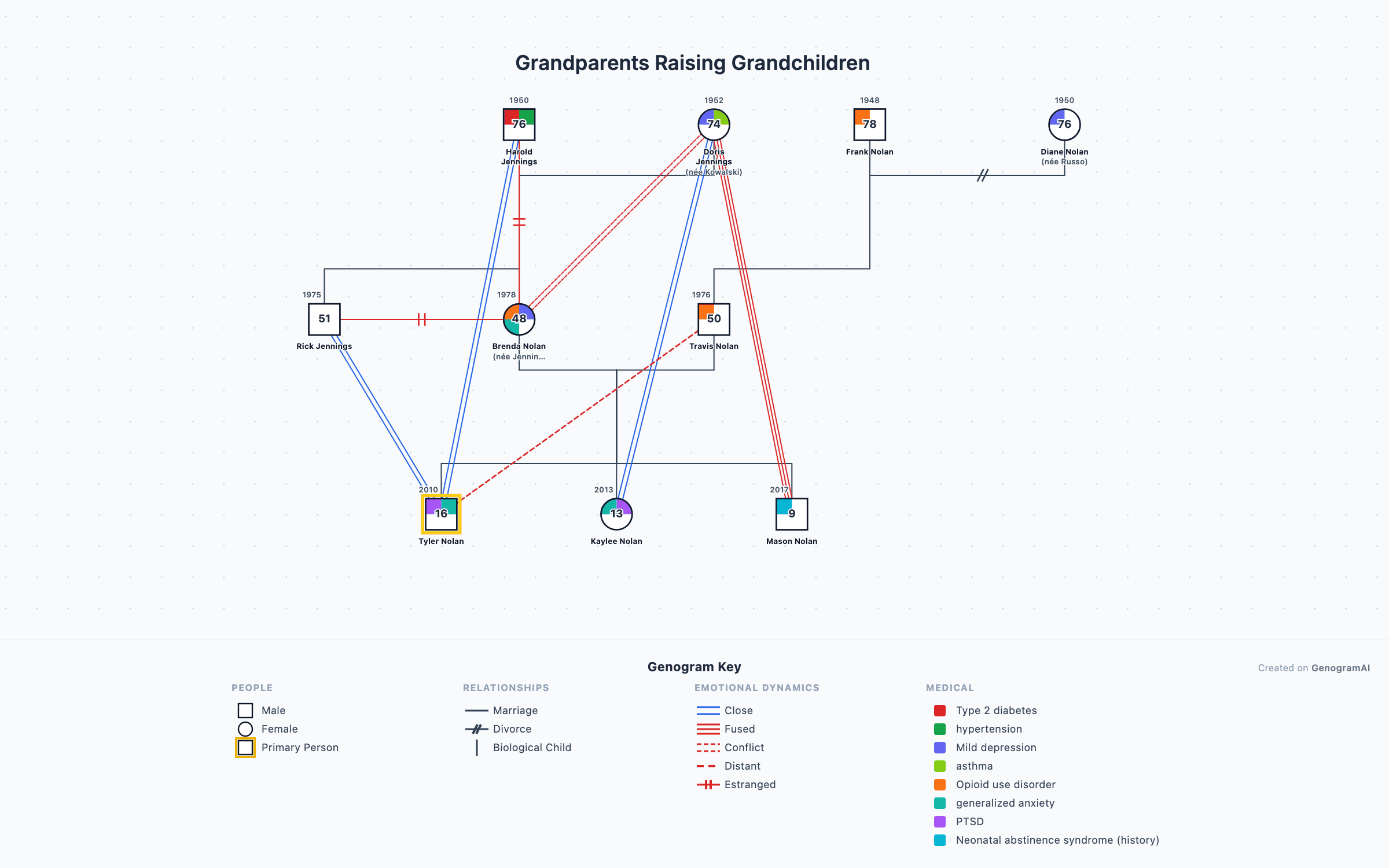
Worked examples for each stage
Child protection genogram (above): Section 47 enquiry and child protection plans for neglect, with the mother’s alcohol misuse, her partner’s domestic abuse history drawn as a violence line, half-siblings in their fathers’ households and previous involvement as a note.
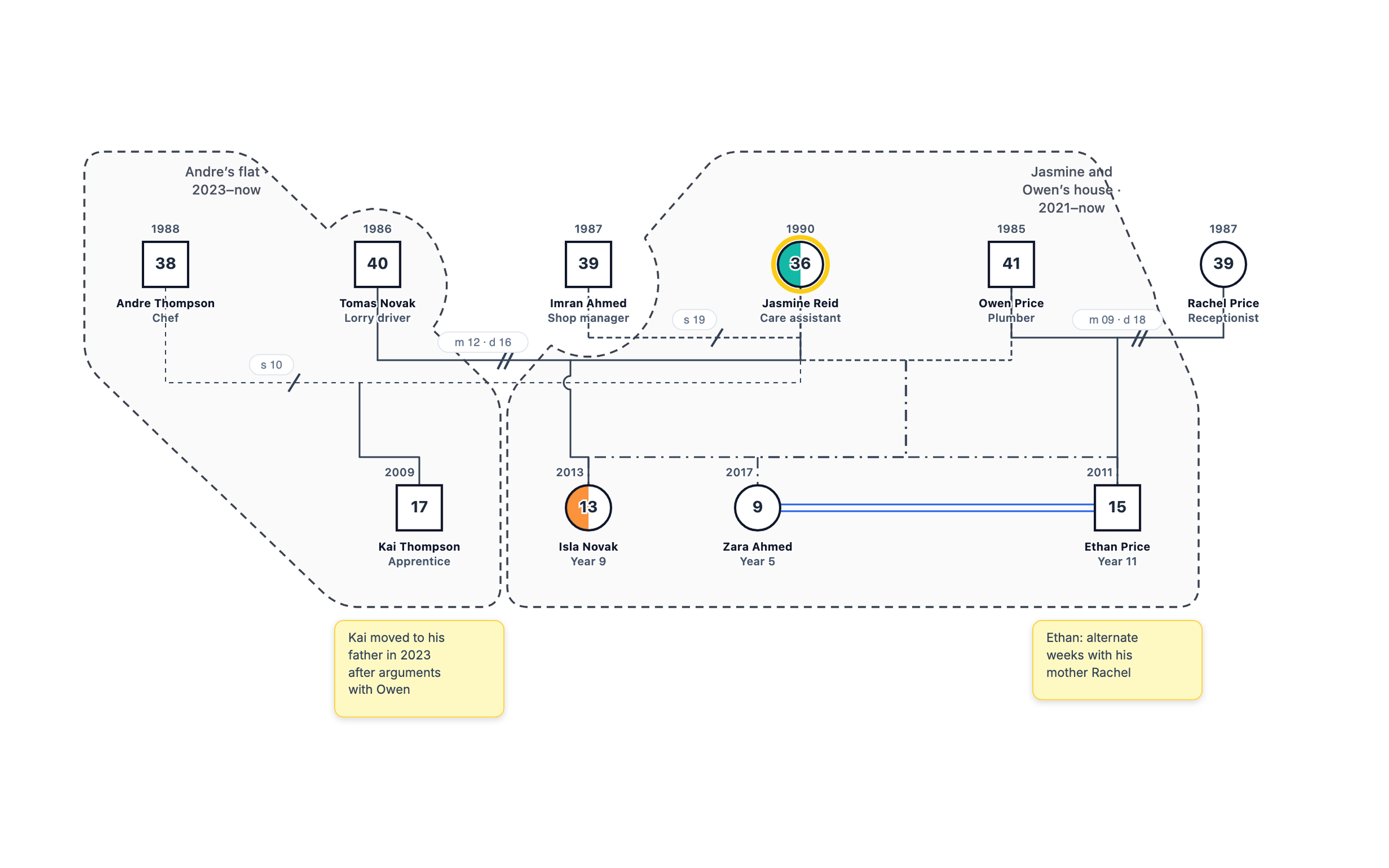
For practice outside the UK, the kinship care genogram for a child welfare assessment shows a grandmother caring for three grandchildren after a period in foster care.
Genograms in court evidence
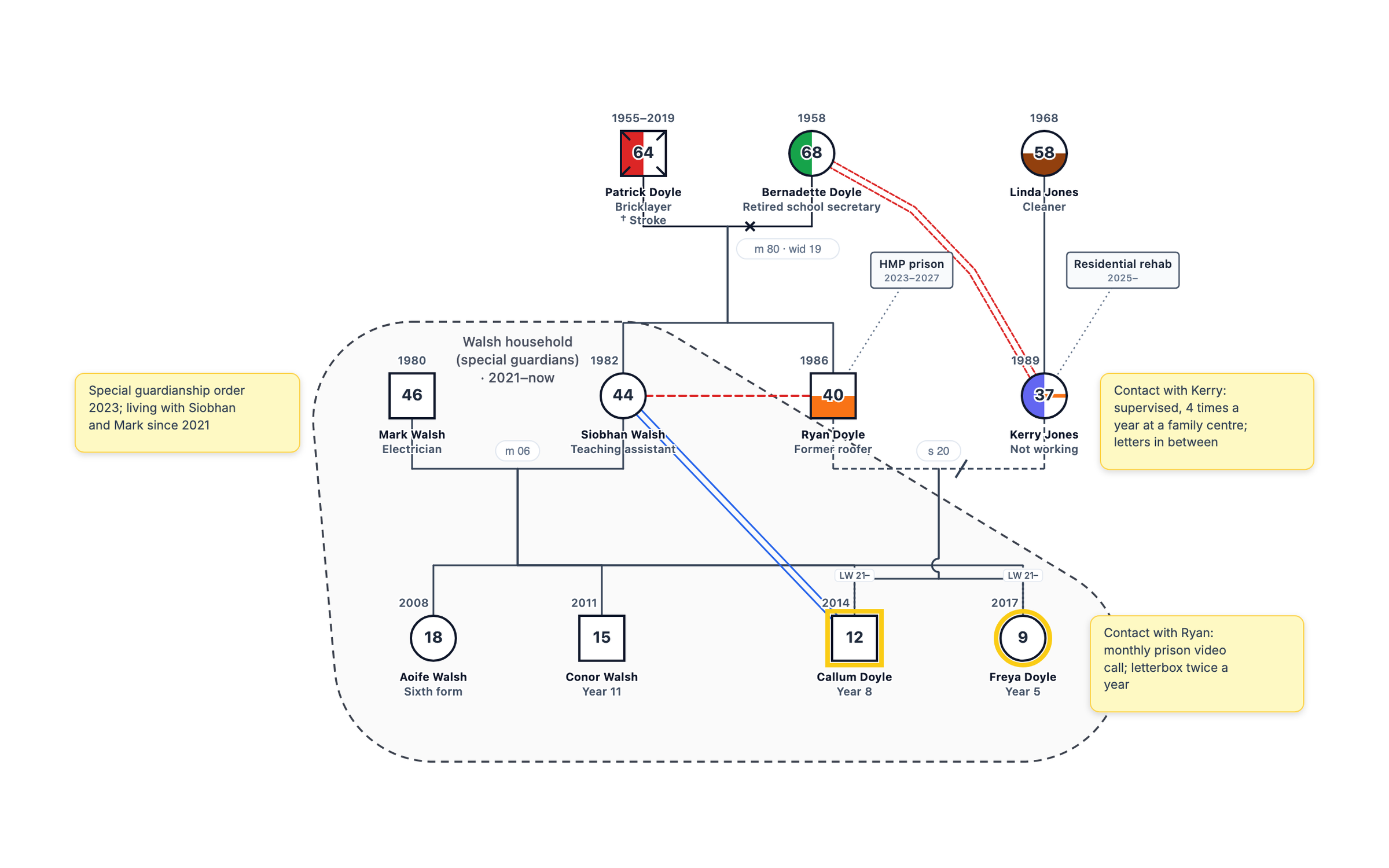
When a genogram goes into the social work evidence for care proceedings, or into a special guardianship or connected person report, it will be read by the judge, the children's guardian and every party's solicitor. Keep it readable and consistent with the written evidence:
- 1
Match the written evidence
Names, ages and dates of birth on the genogram must match the statement and chronology exactly. A mismatch invites challenge. - 2
Show only what is relevant
Include the people the court needs to understand the plan. Leave distant relatives off unless they were assessed or put themselves forward. - 3
Mark disputed facts
If paternity or a relationship is disputed, say so on the diagram rather than drawing it as settled. - 4
Add a legend and a date
A judge should not need to know genogram notation to read it. Add a key and a note with the date it was prepared.
Drawing a genogram quickly
Most social workers draw genograms in Word shapes, on paper, or in the case management system's basic diagram tool. All of them are slow to change when a new relative is named at the family network meeting. GenogramAI is built for that:
Type it the way you write notes
Exports for the case file
Clinical Mode for case data
Pair it with an eco-map
Case example: a family network meeting changes the plan
Fictional composite case for educational purposes
Situation: Two brothers, aged 4 and 7, were subject to child protection plans under the category of neglect. Their mother, Kelly, was misusing alcohol, and her partner Dean had previous convictions for domestic abuse. The children's father, Ryan, had not seen them for three years. The local authority entered pre-proceedings under the Public Law Outline.
The first genogram: Drawn at the Child and Family Assessment, it showed Kelly, Dean, the two boys and Kelly's mother, Sue, who was in poor health. Kelly said there was no one else.
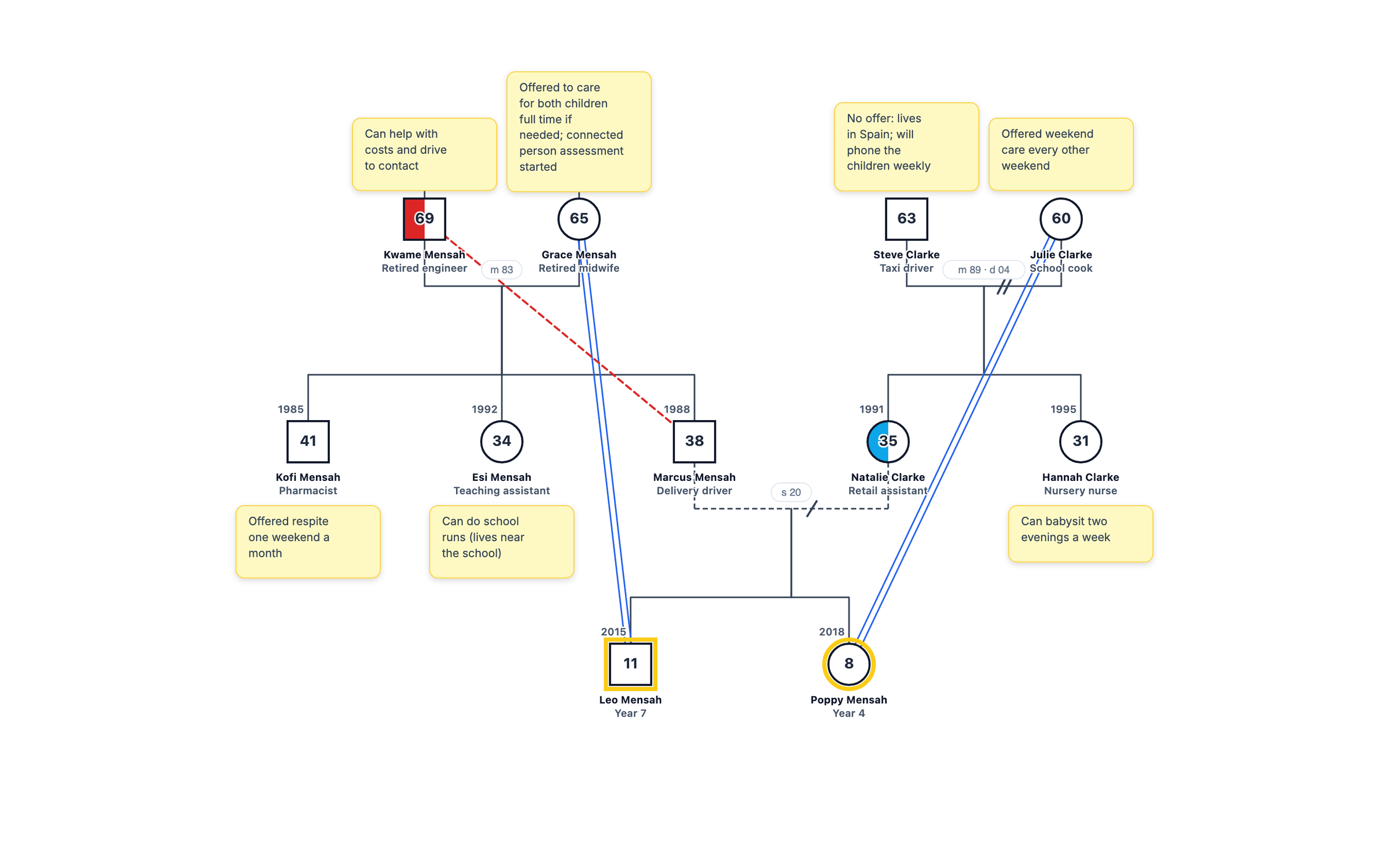
What changed: Before the family group conference, the social worker went through the genogram with Ryan on the phone. He named his sister, Leanne, who lived twenty minutes away, had two children at the same primary school, and had looked after the older boy as a baby. Ryan's side of the family had never been contacted.
Outcome: Leanne attended the conference and offered to care for the boys if needed. A connected person assessment was started straight away. The genogram, updated with each offer of support, went into the evidence and showed the court that the paternal family had been fully explored.
See a family network meeting genogram drawn this way, with each offer of support recorded as a note.
For teams, services and training academies
Children and Families services, social work academies and Assessed and Supported Year in Employment (ASYE) programmes use GenogramAI to give every practitioner the same tool and the same notation. Newly qualified social workers learn standard symbols faster when the tool draws them correctly, and practice supervisors can review genograms against the same conventions.
Volume licensing and invoicing
Onboarding and shared templates
See GenogramAI for organisations to request a proposal for your team.
Frequently asked questions
Do local authority social workers have to include a genogram in a Child and Family Assessment?
There is no single national rule that every assessment must contain a genogram, but most local authorities expect one, and many assessment templates have a family composition or genogram section. Working Together to Safeguard Children (2023) asks practitioners to understand the child within their wider family network, and a genogram is the quickest way to show that you have. Follow your own authority's practice standards.
How is a genogram used at a family group conference or family network meeting?
Before the meeting, the genogram identifies who belongs in the family network: both sides of the family, older siblings, godparents and close family friends. During the meeting it is a shared picture the family can correct and add to. Afterwards it records who offered what support, which feeds the family plan and any later connected person assessments.
Should a genogram go into the social work evidence for care proceedings?
Many local authorities include a genogram with the Social Work Evidence Template (SWET) or attach it to the parallel plan, because it lets the court, the guardian and the parties see the family at a glance. Date it, add a legend, mark which relationships are disputed, and make sure it matches the names and dates in the written evidence.
Can I use a genogram for a connected person or special guardianship assessment?
Yes. In a connected person (kinship foster carer) assessment, often written on CoramBAAF Form C, or a special guardianship report, the genogram shows the applicant's own family, their relationship to the child, and the other adults in their household and network. It also helps you check contact arrangements and whether the applicant can keep the child safe from anyone who poses a risk.
Is it safe to put case information into an online genogram tool?
Check your authority's information governance rules and, where needed, a data protection impact assessment before entering identifiable details. GenogramAI's Clinical plan adds Clinical Mode, which saves only on your device with zero-knowledge AES-256 encryption, so GenogramAI cannot read the chart. Many practitioners also draft with initials or first names only and add full details to the case record.
Is there a free genogram tool for social workers?
GenogramAI has a free plan with 2 genograms of up to 50 people each, every standard symbol and relationship line, and PNG export, with no credit card. For a team or a whole service, volume licensing with invoicing is arranged through the enterprise page rather than individual card payments.
Does this apply in Scotland, Wales and Northern Ireland?
The practice is the same; the legal framework and terminology differ. Wales works under the Social Services and Well-being (Wales) Act 2014, Scotland uses the Getting it right for every child (GIRFEC) approach and the Children's Hearings System, and Northern Ireland has its own Children (Northern Ireland) Order 1995. A genogram is useful in all of them.
Further Reading
- Department for Education — Working Together to Safeguard Children 2023. Statutory guidance, HM Government, 2023
- McGoldrick, M., Gerson, R., & Petry, S. — Genograms: Assessment and Treatment (4th ed.). W.W. Norton & Company, 2020
- Hartman, A. — Diagrammatic assessment of family relationships. Social Casework, 59(8), 465–476, 1978
- UK Parliament — Children Act 1989. legislation.gov.uk