Genogram example · Specialty
Special Guardianship Genogram: Aunt as Kinship Carer
Quick answer
At a glance
| This example | |
|---|---|
| Generations | 3 |
| Family members | 11 |
| Emotional relationships | Close, Conflict and Distant |
| Conditions marked | Medical shading and In remission or recovery |
| Category | Specialty |
| Tags | Family Structure, Substance Use, Clinical |
About this genogram
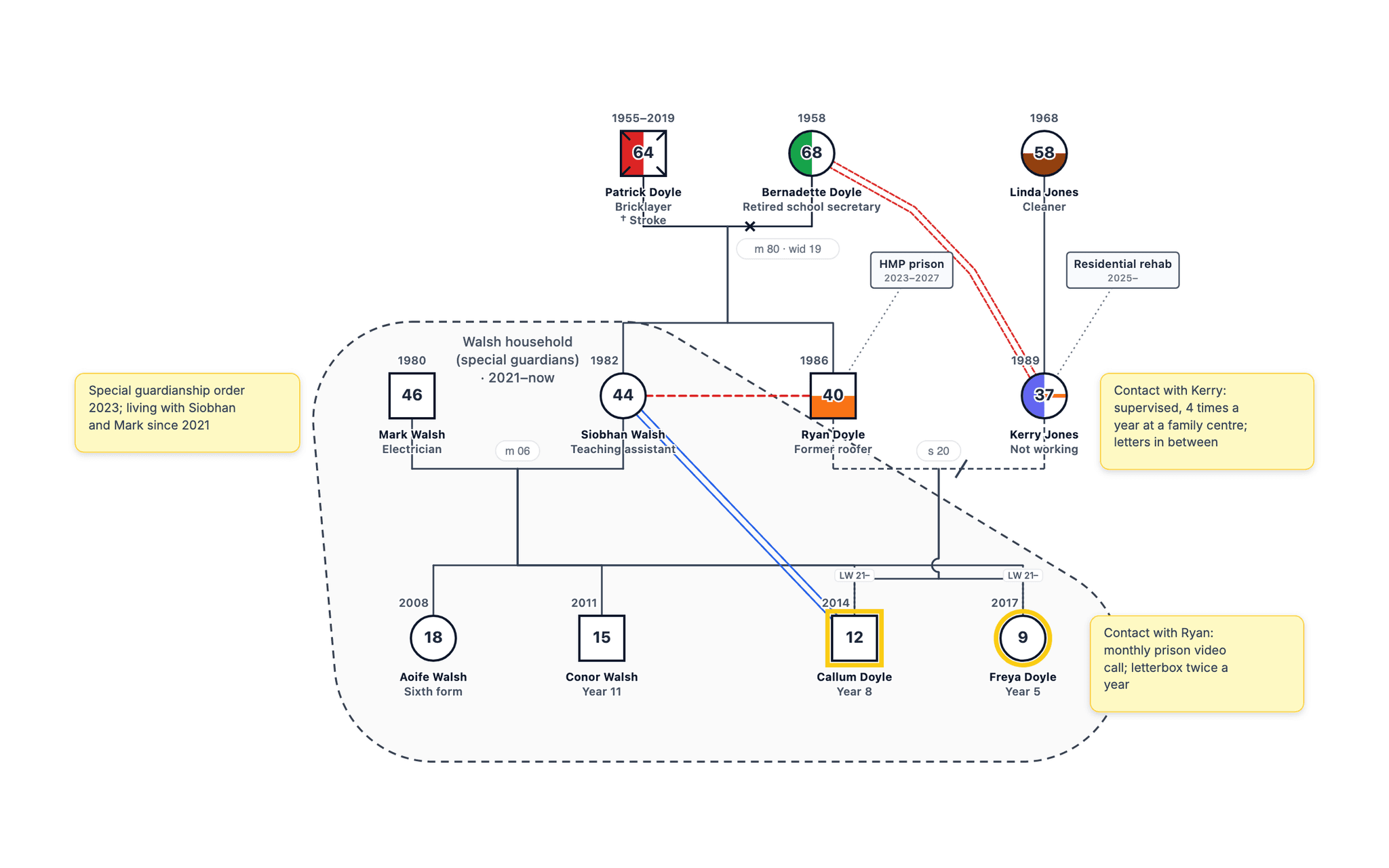
A special guardianship genogram for two children cared for by their paternal aunt and her husband. The birth father uses heroin and is in prison, drawn as an institution box; the birth mother is in residential rehab for crack cocaine use. The chart shows the special guardians’ own household and children, placement lines with lived-with years, and the contact arrangements for each birth parent. The family is fictional.
Family analysis
Overview
This three-generation genogram maps 11 family members for a fictional special guardianship case. The children at the centre of the assessment are Callum Doyle (12) and Freya Doyle (9). They were placed with their paternal aunt, Siobhan Walsh, and her husband Mark in 2021 as a connected person placement, and a special guardianship order was made in 2023.
The birth parents
Both birth parents use drugs. Ryan Doyle, Siobhan’s younger brother, has a history of heroin use and is serving a four-year sentence (2023–2027), drawn as a prison box. Kerry Jones has used crack cocaine, now shaded as in recovery, and entered residential rehab in 2025. Kerry’s mother Linda misuses alcohol and was not able to offer care. Ryan and Kerry separated in 2020, and Kerry is in conflict with Bernadette, the paternal grandmother.
The special guardians’ household
Siobhan and Mark have two children of their own, Aoife (18) and Conor (15). The household boundary takes in all six people, because the guardians’ children are part of any assessment of the placement. Bernadette, widowed in 2019, is close to Siobhan and is the main back-up carer; Siobhan’s relationship with her brother Ryan has become distant since the children came to live with her.
Contact
Notes beside each birth parent set out contact: supervised contact with Kerry four times a year at a family centre, with letters in between, and a monthly prison video call with Ryan plus letterbox contact twice a year. The close line between Siobhan and Callum reflects the bond that made the placement possible.
Using it in the assessment
The genogram supports the special guardianship report and the support plan. It shows the children’s identity and family history on both sides, who supports the guardians, and the contact plan in one place. Names and details are fictional.
How do you read the Special Guardianship Genogram: Aunt as Kinship Carer?
- 1
Find each person and generation
Squares are males and circles are females, and each row is one generation, oldest at the top. It spans 3 generations. - 2
Follow the family lines
Horizontal lines join partners and vertical lines drop to their children, born left to right in birth order. This genogram uses Marriage, Widowed, Ended unmarried relationship, Parent-child line, Kinship or foster placement line and Lived-with years lines. - 3
Read the emotional lines
Lines drawn between two people show how they relate: Close, Conflict and Distant. Notice who has several lines converging on them, and which patterns repeat from one generation to the next. - 4
Read the shading
Shaded symbols mark health conditions: Medical shading and In remission or recovery. Trace each line of descent to see where a condition recurs and where it stops.
Genogram symbols used in this example
| Symbol | Type | What it means |
|---|---|---|
| Male (Square) | Person Symbols | A square represents a male family member. |
| Female (Circle) | Person Symbols | A circle represents a female family member. |
| Index person (highlighted outline) | Person Symbols | The person at the centre of the assessment is drawn with a highlighted outline. |
| Deceased (X) | Person Symbols | An X through the symbol marks a person who has died; birth and death years are written above it. |
| Age inside the symbol | Person Symbols | The current age (or age at death) is written inside each symbol, with years above it. |
| Marriage | Couples and Children | A solid line between partners; the marriage year is written on the line (m 90 = married 1990). |
| Widowed | Couples and Children | A small x on the couple line marks the end of a marriage through death (wid 15). |
| Ended unmarried relationship | Couples and Children | A dashed or dotted couple line with one slash marks an unmarried relationship that has ended. |
| Parent-child line | Couples and Children | A vertical line from the couple line to each child; siblings run oldest to youngest from left to right. |
| Kinship or foster placement line | Couples and Children | A dotted child line from the carers marks a child placed with them; the child keeps solid lines to the birth parents. |
| Lived-with years | Couples and Children | A small "LW 21–" label on a child line gives the years a child has lived in that home. |
| Household boundary | Households, Institutions and Notes | A dashed outline around the people who live together, labelled with the household name and the year it began. |
| Institution box | Households, Institutions and Notes | A small labelled box (prison, residential rehab) with years, linked to the person by a dotted line. |
| Text note | Households, Institutions and Notes | A yellow note on the chart records information that has no symbol, such as previous involvement, contact arrangements or a relative’s offer of support. |
| Close | Emotional Relationships | Two parallel blue lines mark an emotionally close relationship. |
| Conflict | Emotional Relationships | Dashed red double lines mark open conflict. |
| Distant | Emotional Relationships | A red dashed line marks emotional distance between two people. |
| Medical shading | Medical | The left half of a symbol is shaded for a physical or mental illness and the bottom half for alcohol or drug use; each condition has its own colour, listed in the key. Hatching means suspected, a partial fill means in recovery. |
| In remission or recovery | Medical | A partly filled section marks a condition in remission or recovery. |
Build a genogram like this one
Example prompt
- 1
Start from the dashboard
Sign in to GenogramAI and choose Create with AI (paid plans), or open a blank genogram and use Ask AI (any plan). To start from this exact chart instead, use Open as template. - 2
Describe your family
Paste a description like the one above, with your own names, dates, relationships and health history. - 3
Check and adjust
Edit people and lines by hand, or ask the AI for one change at a time. - 4
Export
Download a PNG on the free plan. PDF and SVG export are on paid plans.
The free plan includes 2 genograms and 5 AI credits a month. See the AI genogram creator for what else it can do.
Related resources
- Special guardianship and connected person assessments are covered in our guide to genograms in children’s social care.
- For a grandmother caring for three grandchildren in the US system, see the kinship care genogram.
- See how adoption and foster lines are drawn.
- More on household boundaries.
Frequently asked questions
What does a special guardianship genogram need to show?
Who the children live with and since when, both birth parents and why they cannot care for the children, the special guardians’ own household (including their children, who are affected by the placement), the wider family on both sides and the contact plan. This example covers each of those on one page.
How do you show a child living with a kinship carer?
The children keep solid lines to their birth parents. A dotted placement line runs from Siobhan and Mark to each child, and a lived-with label ("LW 21–") gives the year the children moved in. The household boundary takes in the guardians, their own children and the placed children.
How is a parent in prison drawn?
With an institution box, labelled "HMP prison 2023–2027", joined to Ryan by a dotted line. The box keeps the sentence visible without changing Ryan’s place in the family. Kerry’s residential rehab is shown the same way.
Where do contact arrangements go?
In notes next to each birth parent. Kerry has supervised contact four times a year at a family centre with letters in between; Ryan has a monthly prison video call and letterbox contact twice a year.
Can I build a genogram like the Special Guardianship Genogram: Aunt as Kinship Carer example?
Yes. Open GenogramAI, choose Create with AI on the dashboard (paid plans) or open a blank genogram and use Ask AI in the editor (any plan), and describe the family in plain words: who is in it, how they are related, key dates and the relationships or health conditions you want to show. The AI draws the symbols and lines, and you can then edit by hand or ask for one change at a time. A family of 11 people like this one takes a short paragraph to describe. The free plan includes 2 genograms and 5 AI credits a month, with PNG export.
About this example