Comparison guide
Genogram vs family tree: what's the difference?
Quick answer
Family tree or genogram?
Family tree
- Shows who is related to whom. Focuses on ancestry, lineage, and biological connections across generations.
- Names and birth/death dates
- Parent-child relationships
- Marriages
- No emotional relationships
- No medical history
Genogram
- Shows how family members relate emotionally. Includes medical history, behavioral patterns, and relationship dynamics.
- All family tree data PLUS:
- 64 relationship types, including 39 emotional ones
- Medical conditions & mental health
- Divorces, cutoffs, conflicts
- Standardized clinical notation
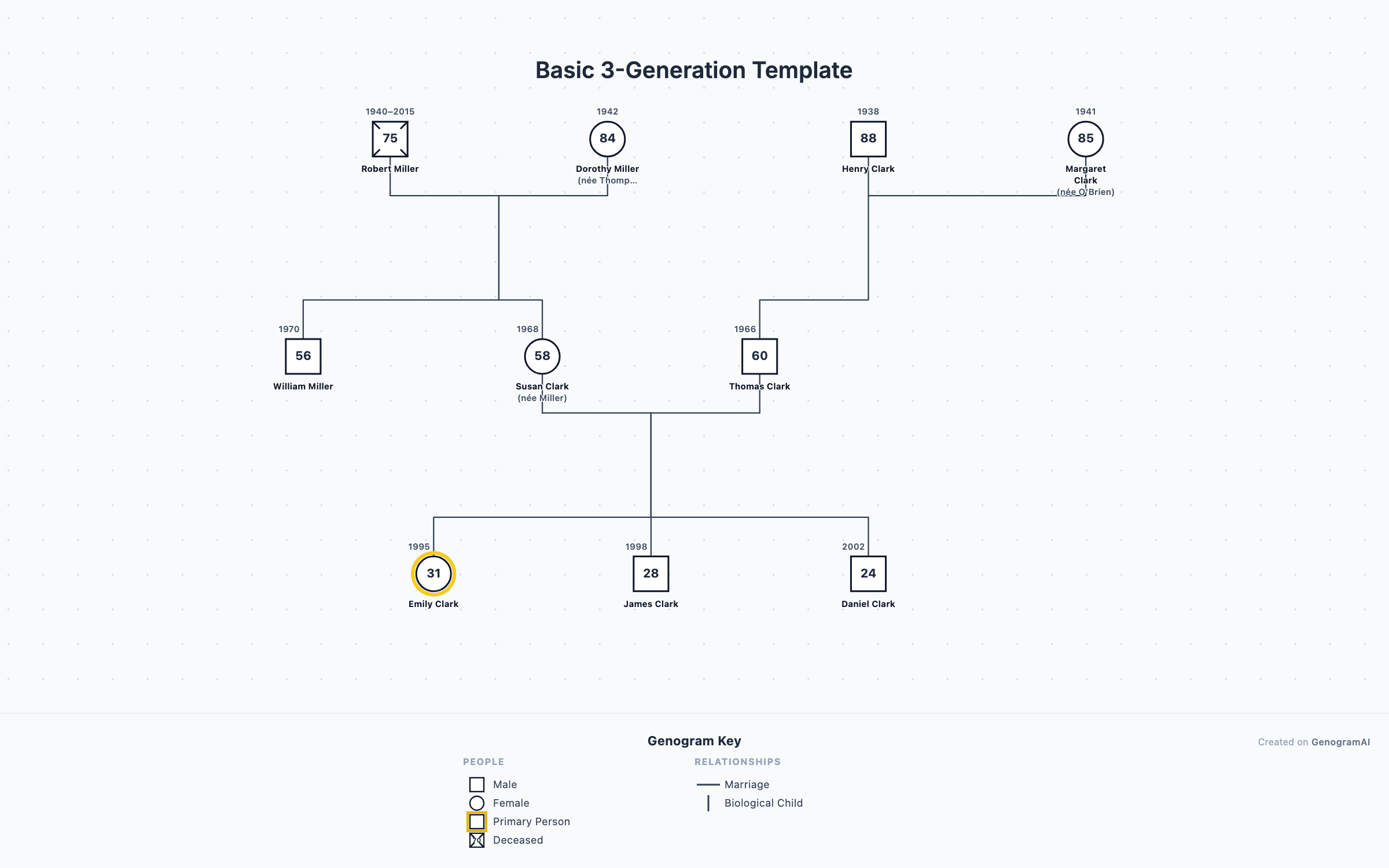
Feature-by-feature comparison
| Feature | Family tree | Genogram |
|---|---|---|
| Primary Purpose | Document ancestry and lineage | Analyze family dynamics and patterns✓ |
| Emotional Relationships | Not shown | 64 relationship types (close, hostile, cutoff, etc.)✓ |
| Medical History | Rarely included | Standard feature with condition symbols✓ |
| Mental Health Patterns | Not shown | Tracked across generations✓ |
| Behavioral Patterns | Not shown | Substance abuse, occupations, education✓ |
| Relationship Quality | Shows existence only | Shows closeness, conflict, enmeshment✓ |
| Divorce/Remarriage | Basic notation | Detailed with dates and relationship lines✓ |
| Clinical Use | Limited | Standard in therapy and social work✓ |
| Genealogy Research | Excellent | Good (includes all ancestry data) |
| Simplicity | Easy to create and read✓ | Requires symbol knowledge |
| Standardization | Varies widely | standard McGoldrick-style notation✓ |
| Software Support | Many options (Ancestry, MyHeritage) | Specialized tools (GenogramAI, GenoPro) |
When to use a genogram vs a family tree
Family Therapy
Genealogy Research
Medical Assessment
Social Work
School Projects
Psychology Research
The key insight
If you're researching ancestry, a family tree works. If you're trying to understand patterns—why certain issues repeat across generations, why some relationships are strained—you need a genogram. Our genogram maker can help you get started.
What can a genogram show that a family tree can't?
Emotional relationship quality
Medical history across generations
Behavioral patterns
Complex family structures
Pregnancy losses
Intergenerational trauma
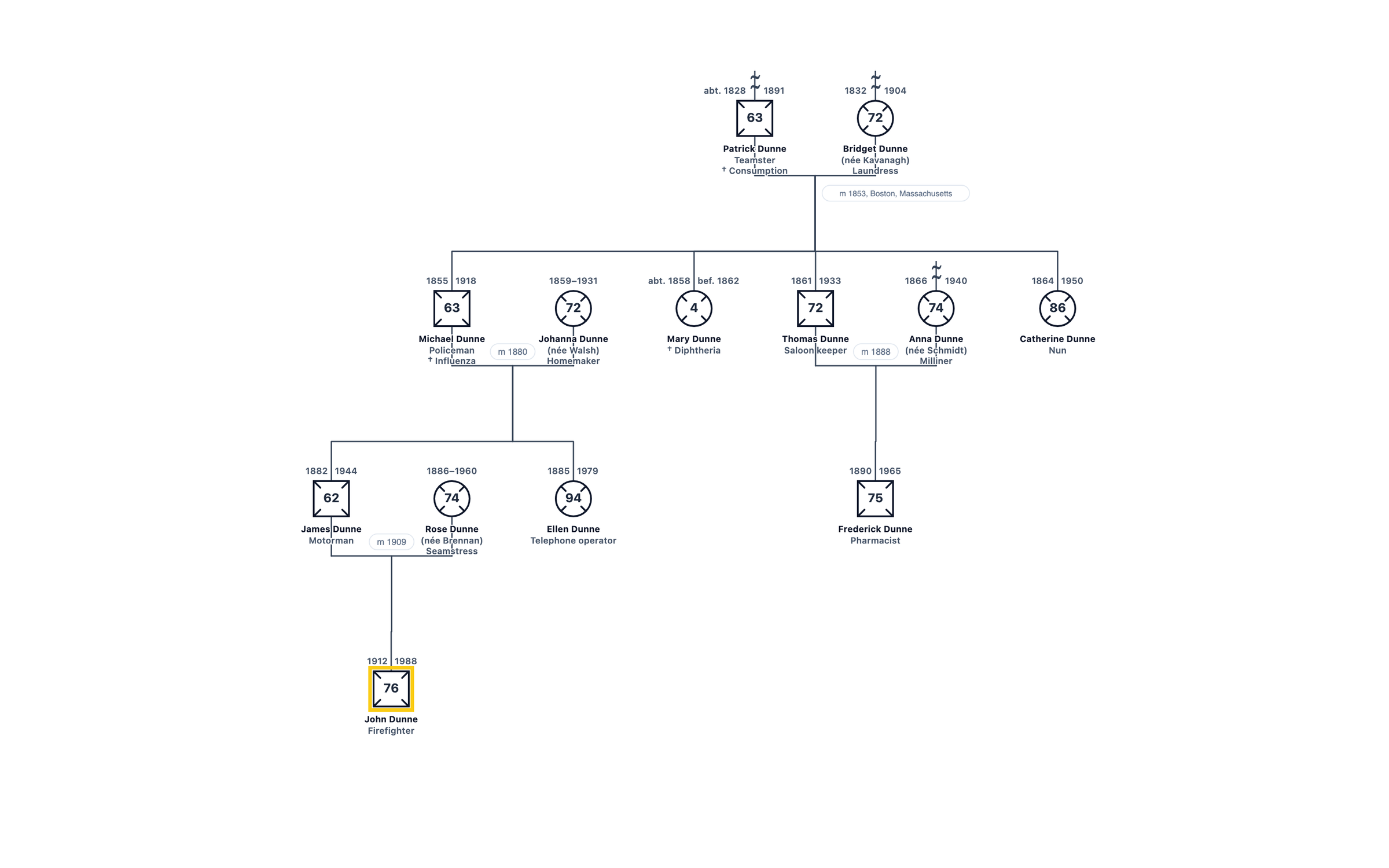
Researching your own family history? See our guide to genograms for genealogists — pattern analysis, GEDCOM import, and how a genogram extends your tree. Just need the simpler of the two? Use the free family tree maker.
Frequently asked questions
What is the main difference between a genogram and a family tree?
A family tree shows biological lineage and ancestry (who is related to whom). A genogram includes this plus emotional relationships (close, distant, conflicted), medical history, behavioral patterns, and life events using standardized clinical symbols. Genograms are diagnostic tools; family trees are genealogical records.
When should I use a genogram instead of a family tree?
Use a genogram when you need to understand relationship dynamics, identify health patterns, or work in clinical settings (therapy, social work, medicine). Use a family tree for genealogy research, ancestry documentation, or simple family records without emotional or medical detail.
Can a genogram replace a family tree?
Yes, a genogram contains all family tree information plus additional layers. However, if you only need ancestry records without clinical detail, a simpler family tree may be more appropriate. Genograms are more complex but more informative for understanding family systems.
Do therapists use family trees or genograms?
Therapists, counselors, and social workers primarily use genograms because they reveal relationship patterns, emotional dynamics, and intergenerational issues that family trees don't capture. Genograms are standard tools in family therapy, developed by Monica McGoldrick and Randy Gerson.
What can a genogram show that a family tree cannot?
Genograms show: emotional relationship quality (close, hostile, enmeshed, cutoff), medical conditions across generations, mental health patterns, substance abuse, divorces and remarriages, miscarriages and stillbirths, adoption and foster relationships, and occupational/educational information.
Is a pedigree chart the same as a genogram?
No. A pedigree chart (used in genetics) shows inheritance patterns for specific traits or conditions. A genogram is broader, including emotional relationships, behavioral patterns, and psychosocial factors beyond genetic inheritance. Pedigrees focus on biology; genograms include psychology.
How do I convert a family tree into a genogram?
Start with your family tree structure, then add: 1) Standardized symbols (squares for males, circles for females), 2) Relationship lines showing emotional quality, 3) Medical history for each person, 4) Life events and dates, 5) Behavioral patterns. GenogramAI can help automate this process.
What is an ecomap and how is it different from a genogram?
An ecomap shows a person's connections to external systems (work, school, community, healthcare) rather than family relationships. Genograms focus on family; ecomaps focus on social environment. They're often used together in social work assessments for a complete picture.
Ready to create a genogram?
Further Reading
- McGoldrick, M., Gerson, R., & Petry, S. — Genograms: Assessment and Treatment (4th ed.). W.W. Norton & Company, 2020
- Bowen, M. — Family Therapy in Clinical Practice. Jason Aronson, 1978
- DeMaria, R., Weeks, G., & Twist, M. — Focused Genograms: Intergenerational Assessment of Individuals, Couples, and Families (2nd ed.). Routledge, 2017
- Broderick, C.B., & Schrader, S.S. — The Origins of Family Therapy. Journal of Marital and Family Therapy, 17(3), 225–232, 1991