Family tree maker
Blended family tree maker
Quick answer
What does a blended family tree need to show?
A standard family tree assumes one couple per generation and children who belong to both of them. Blended families break that assumption in three places at once: a parent may have more than one partner, a child may have more than two parental figures, and siblings may share one parent or none.
The fix is not more boxes. It is more kinds of lines. A genogram keeps the family tree layout but distinguishes a current marriage from a past one, a biological child from a stepchild, and a step-parent who is close to a child from one who is distant. That is why a genogram is often described as an advanced family tree: same people, more of the truth.
A worked example: the Holt and Mitchell families
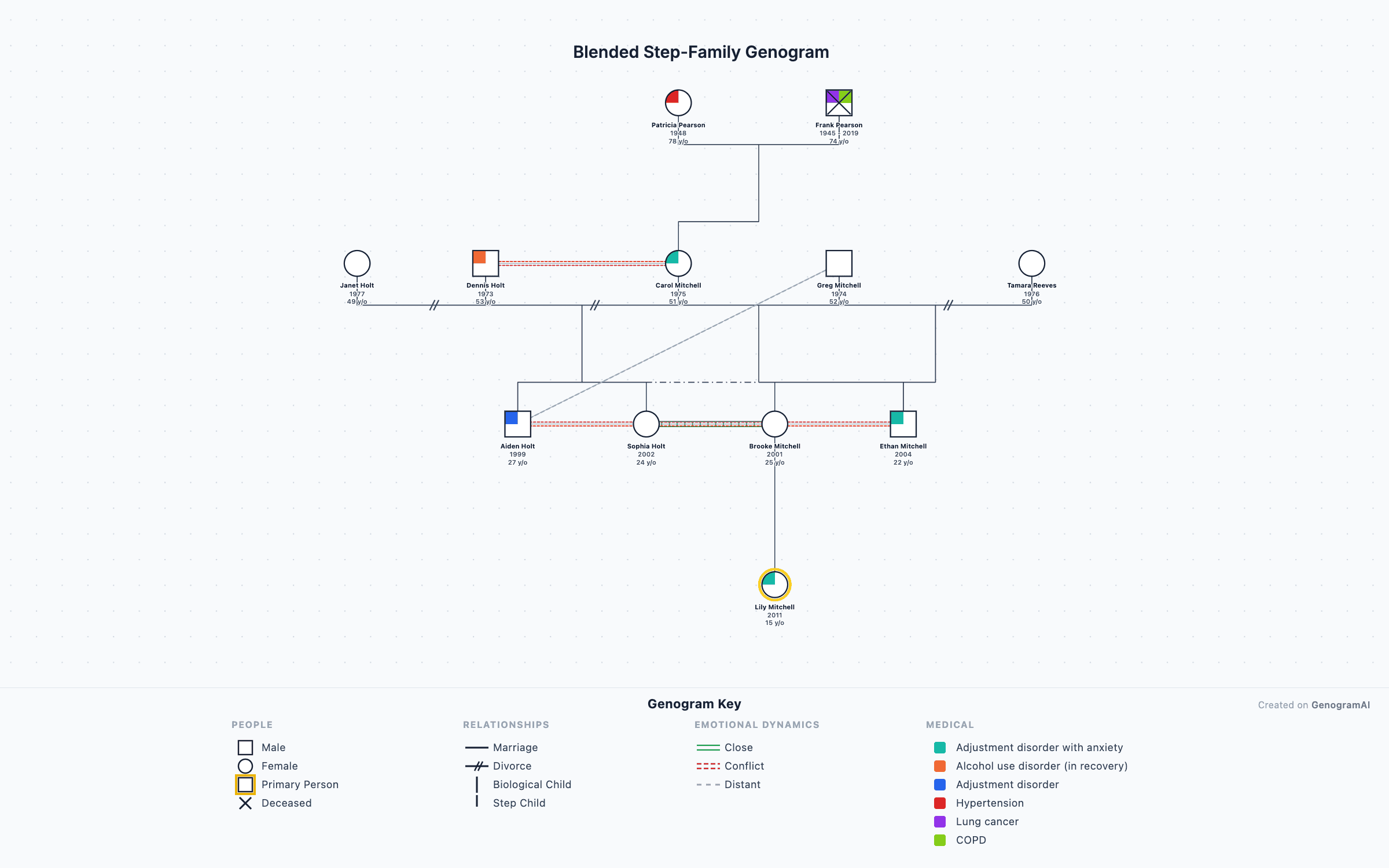
Read it from the middle row. Each adult has a former spouse on the outside, with the double slash of a divorce on that marriage line, and the current partner on the inside. The older children hang from their parents' first marriages; Lily, born to the new couple, is a half-sister to them. Then look at the colored lines: Sophia and her stepsister Brooke are close, Aiden is distant from his stepfather Greg, and Aiden and his stepbrother Ethan are in conflict. A plain tree can't say any of that: the remarriage did not land evenly for every child.
Which line to use for each relationship
| Relationship | How it is drawn | When to use it |
|---|---|---|
| Marriage | Solid horizontal line between partners | Current and past marriages, each with its own year |
| Divorce | Marriage line with two slashes | A marriage that ended; one slash means separated |
| Remarriage | A second marriage line from the same person | Placed beside the first marriage, not replacing it |
| Living together | Dashed line between partners | Partners who share a home without marrying |
| Biological child | Solid vertical line | Hangs from the couple the child was born to |
| Stepchild | Dash-dot vertical line | Connects a child to the parent’s new partner |
| Adopted child | Dashed vertical line | Common when a step-parent formally adopts |
How to make a blended family tree
- 1
Start with the couple at the center
Add the two partners who formed the blended family and draw their marriage line with the year. - 2
Add each former partner
Place each ex-spouse beside the person they were married to, and mark that marriage as divorced or separated with its year. - 3
Hang the children from the right couple
Each child descends from the couple they were born to. Children the new couple had together hang from the new marriage line. - 4
Add step and adoptive links
Connect stepchildren to their step-parent with a stepchild line, or an adopted line if the step-parent formally adopted. - 5
Show how people actually get along
Add close, distant or conflict lines where they explain the family. Optionally draw households to show who lives where.
Children moving between two homes?
Or describe the family and let the AI draw it
Sample description
Carol married Dennis in 1997 and divorced in 2008; they have Aiden (1999) and Sophia (2002). Greg married Tamara in 2000 and divorced in 2009; they have Brooke (2001) and Ethan (2004). Carol and Greg married in 2010 and had Lily in 2011. Aiden and his stepfather Greg are distant. Sophia and Brooke are very close.
Paste a paragraph like this into Ask AI in the editor. The AI places the marriages, divorces and children, and you fix anything by hand or with a follow-up message.
Common mistakes on blended family trees
Drawing the new couple as the only parents
Connecting step-siblings to each other
Forgetting dates
Leaving out the relationships
More blended family examples
Father married three times
Remarriage later in life
Single-parent family
Blended family genogram example
Frequently asked questions
How do you show step-siblings on a family tree?
Step-siblings share no parent, so they are not connected to each other directly. Each child descends from their own parents’ marriage line, and the step relationship comes from the marriage between one child’s parent and the other child’s parent. A stepchild line (dash-dot) from the step-parent makes the bond explicit when it matters, for example when a step-parent helped raise the child.
How do you show half-siblings on a family tree?
Half-siblings share exactly one parent. Draw that parent’s two partnerships as two separate marriage lines, and hang each child from the line of the couple they were born to. Because both lines touch the shared parent, the half-sibling relationship is visible without a label.
Where does an ex-spouse go on a blended family tree?
Next to the person they were married to, on the same row, with the marriage line crossed by two slashes to show divorce (one slash for separation). Convention puts earlier partners further from the current one, so the order of marriages reads left to right or outward from the person.
Should I include a step-parent’s children from another marriage?
Yes, if they are part of family life. A blended family tree is most useful when it shows both households: the children each partner brought, the children they had together, and the other biological parents. Leave out people only if the chart is getting too wide for its purpose.
Is it free to make a blended family tree?
Yes. The free plan includes 2 trees with up to 50 people each, every relationship type (including divorce, remarriage and stepchild lines), 5 AI credits a month and PNG export. Paid plans add more trees, unlimited people and AI, and PDF or SVG export.