Family tree maker
Adoption family tree
Quick answer
What should an adoption family tree show?
Most family tree templates have one slot for a mother and one for a father, and every line means “born to.” For an adopted child that forces a bad choice: list the adoptive parents as if the child were born to them, or list birth parents the child may never have met. Neither is accurate.
A genogram solves this with different kinds of child lines. The adoptive parents are the child's parents, drawn with a dashed adoption line. Birth parents, if you include them, are a separate couple with their own link to the child. An emotional line can show how much contact there is, from close and regular to none. The result is one honest chart instead of two incomplete ones.
A worked example: the Feldman family
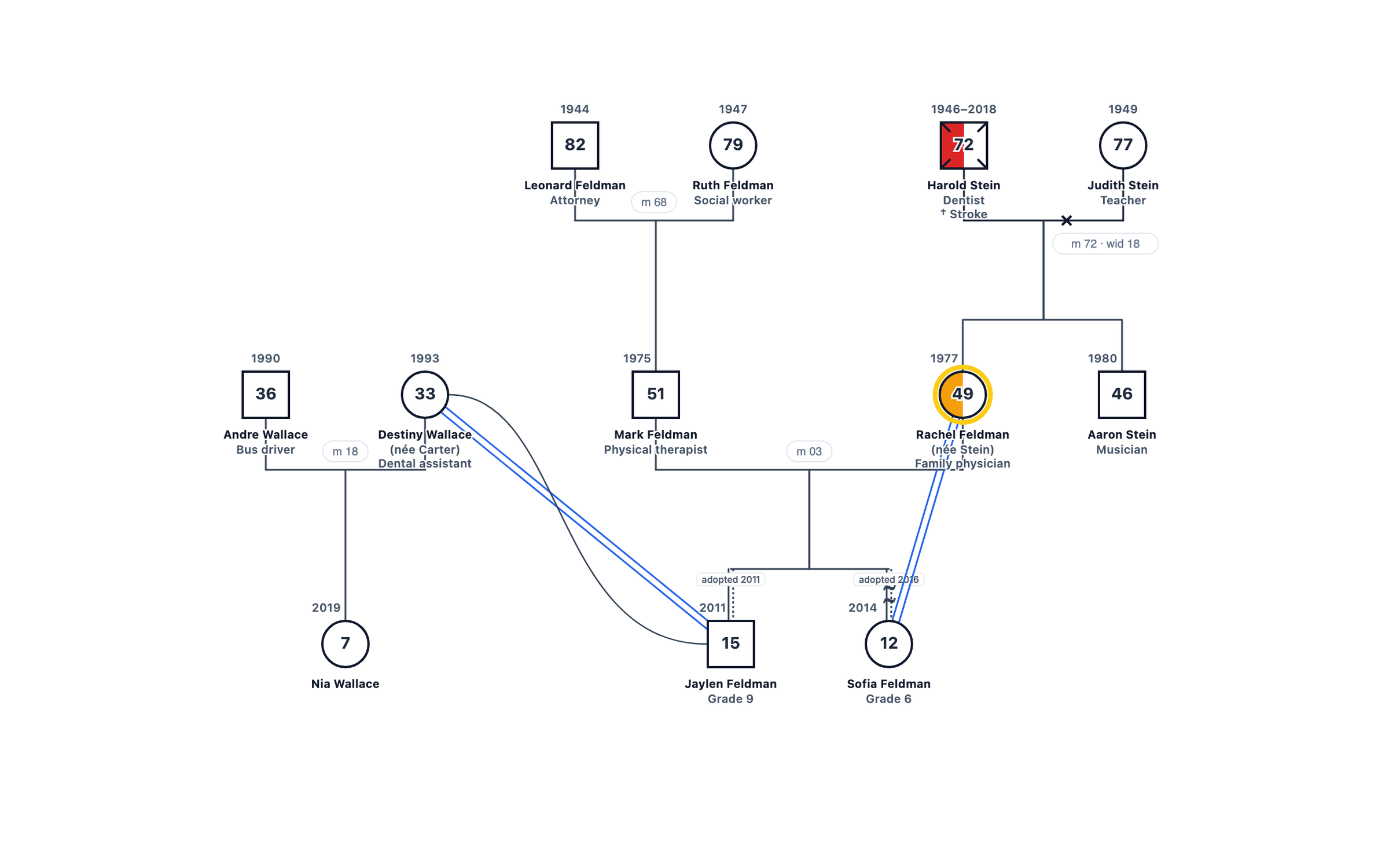
Both children hang from Mark and Rachel's marriage line, so the chart says plainly who their parents are. The labels on the dashed lines give the adoption years. To the left, Jaylen's birth mother Destiny, her husband Andre and their daughter Nia are drawn as their own family, with Destiny linked to Jaylen and a close line between them: this is an open adoption, and Nia is Jaylen's half-sister. Sofia has no birth-family branch because none is known, which the chart reflects without leaving an awkward empty box.
Lines for adoption, foster care and step relationships
| Relationship | How it is drawn | When to use it |
|---|---|---|
| Biological child | Solid vertical line | Children born to the parents they hang from |
| Adopted child | Dashed vertical line | Legal, permanent adoption; add the year beside it |
| Foster child | Dotted vertical line | Temporary placement with foster parents |
| Stepchild | Dash-dot vertical line | A partner’s child, before or without a step-parent adoption |
| Birth parents | A couple of their own, linked to the child | Known birth mother, father or both, in an open or closed adoption |
| Close / distant | Emotional line between any two people | How much contact the child has with birth relatives |
How to make an adoption family tree
- 1
Build the adoptive family first
Add the adoptive parents, their marriage line, and grandparents and siblings on both sides, the same way you would for any family tree. - 2
Add the child with an adoption line
Add the adopted child under the parents and set the connection to Adopted. Add the adoption year. - 3
Decide on the birth family
If known and wanted, add the birth mother, birth father or both as their own couple, and link them to the child as birth parents. Add their other children if the child knows them. - 4
Show contact and closeness
Use close, distant or other emotional lines between the child and birth relatives to show what the relationship is actually like. - 5
Export or share
Download a PNG free, print it, or share a view-only link with relatives.
Faster: describe it
Making the tree with an adopted child
Let the child lead on the birth family
Keep the language neutral
Use placeholders for the unknown
Record health history where known
More adoption, foster and kinship examples
Adoptive family with biological and adopted children
Foster care family
Kinship care with a grandmother
Chosen family
Frequently asked questions
How do you show an adopted child on a family tree?
Connect the child to their adoptive parents with a dashed vertical line instead of the solid line used for biological children. Add the adoption year next to the line if you know it. If the birth parents are known and you want to include them, add them as a couple of their own and connect the child to them with a birth-parent link.
Should an adopted child’s tree include the birth family?
That is the family’s decision, and it can change over time. Many adoptive families keep one chart with both families on it, because an open adoption already includes birth relatives in the child’s life. Others start with the adoptive family only and add birth relatives later. A diagram tool makes either choice easy to revise.
What if the birth parents are unknown?
Add a placeholder couple labeled "Birth parents (unknown)" or leave them off entirely. A placeholder keeps the place open for information the child may learn later, and it tells anyone reading the chart that the adoption is part of the story rather than a gap.
How is foster care shown differently from adoption?
Foster children are connected with a dotted line, adoption with a dashed line and biological children with a solid line. The difference matters because foster care is usually temporary and the child’s legal parents are still part of the picture. Kinship care, where a relative raises the child, is drawn with the child living in the relative’s household.
Is this a good tool for a school family tree assignment for an adopted child?
Yes. A standard school template assumes one set of biological parents, which can be hard for adopted children. A genogram-style tree lets the child show the family who raised them as the main tree, with birth family included only if the child and parents want it. The school project guide has more on framing.